
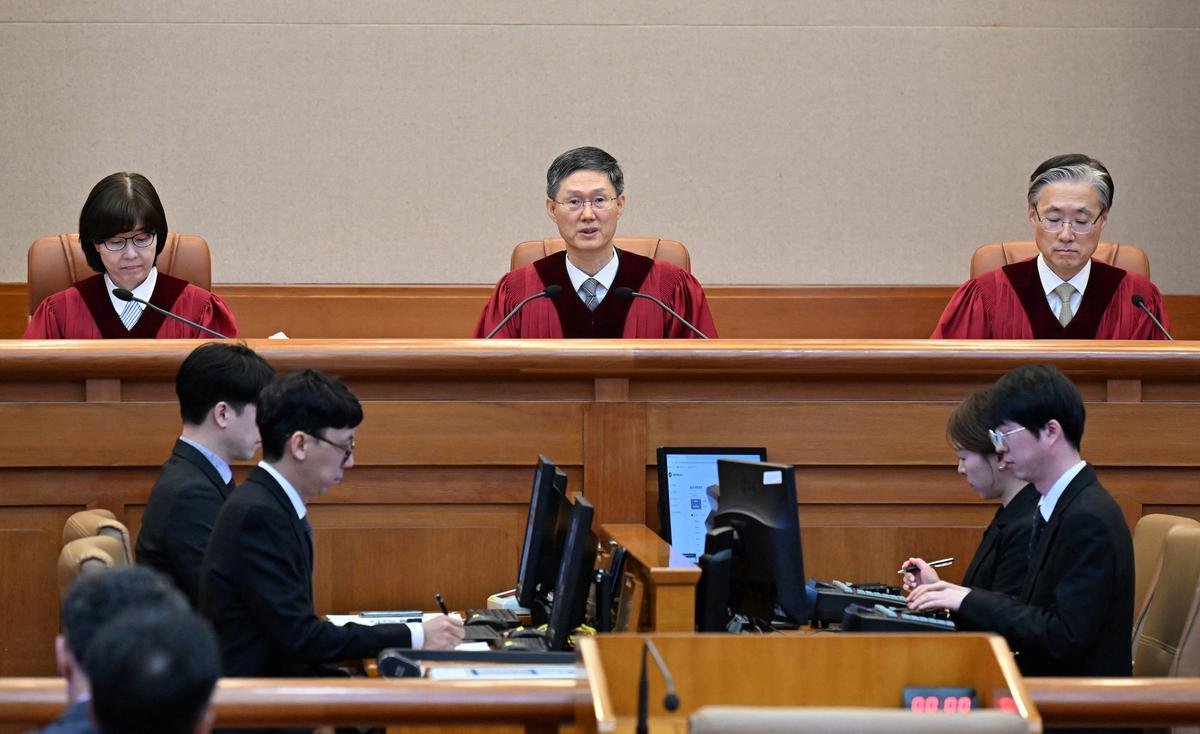
Former President Yoon Suk Yeol’s legal team and prosecutors are set to appear before the Seoul High Court on Monday for the first preliminary hearing in his appeal against a conviction for leading an insurrection. The hearing, scheduled for 2 p.m. Local time, follows a February ruling by the Seoul Central District Court that sentenced Yoon to life imprisonment over his declaration of martial law on December 3, 2024. Yoon, who remains in custody, is not required to attend the session, which will focus on procedural matters ahead of the substantive trial.
The appeal stems from Yoon’s short-lived attempt to impose martial law, which was swiftly rejected by the National Assembly and led to his impeachment and removal from office. Prosecutors, led by special counsel Cho Eun-suk, had sought the death penalty during the initial trial, arguing that Yoon’s actions were intended to subvert the constitutional order. The defense has maintained that the martial law declaration was a legitimate exercise of presidential authority in response to perceived national security threats.
Yoon is not the only former official facing legal consequences. Former Defense Minister Kim Yong-hyun received a 30-year prison sentence for his role in the alleged insurrection, while six other senior military and police officials were also convicted in the same case. The Seoul High Court has established a dedicated panel to handle the appeal, citing the need for efficient processing under the Special Act on the Trial of Criminal Cases, Including Insurrection and Foreign Aggression Cases, which was promulgated in January 2016.
Court officials have acknowledged public concern over delays in scheduling the appeal hearing, noting that the first session was not set even after the February verdict. In response, the Seoul High Court’s spokesperson, Yu Jemin, explained that procedural requirements — including the shortened seven-day deadline for submitting appellate briefs under special counsel law and mandatory service of documents to multiple defense teams — necessitate careful scheduling to uphold defendants’ rights. The court emphasized that it is working to move as quickly as possible while ensuring legal compliance.
Preparatory hearings are expected to run from April 27 through May 7, with the main trial proceedings scheduled to begin on May 14. A separate case involving former Justice Minister Park Sung-jae, accused of involvement in the martial law declaration, is nearing conclusion at the Seoul Central District Court.
Understanding the Legal Framework Behind the Appeal
The appeal is being processed under South Korea’s Special Act on the Trial of Criminal Cases, Including Insurrection and Foreign Aggression Cases, which governs proceedings for offenses deemed to threaten national sovereignty or constitutional order. Enacted in 2016, the law allows for the creation of specialized court panels and modifies certain procedural timelines, such as reducing the window for filing appeals from 20 to seven days in cases investigated by special prosecutors.
Under this framework, the Seoul High Court’s Criminal Division 12-1 is responsible for reviewing both the factual findings and legal interpretations from the lower court. The appellate panel will assess whether the trial court correctly applied the law regarding insurrection charges, particularly whether Yoon’s actions met the legal threshold of “intending to subvert the constitutional order” — a key element prosecutors must prove beyond a reasonable doubt.
Legal experts note that appellate review in such cases typically focuses on procedural correctness and legal interpretation rather than re-examining evidence, unless there are claims of newly discovered facts or constitutional violations. The court may affirm the lower court’s ruling, modify the sentence, or order a new trial if significant legal errors are identified.
Who Is Affected and What’s at Stake
The outcome of Yoon’s appeal carries significant political and legal implications. If the life sentence is upheld, Yoon would remain incarcerated unless pardoned or granted clemency — a power reserved for the sitting president. A reduction in sentence could lead to early release, while an acquittal, though considered unlikely by legal analysts, would trigger debates over accountability and the limits of presidential authority.
Beyond Yoon, the case affects other former officials convicted in the same proceedings. Kim Yong-hyun’s 30-year term and the sentences of military and police commanders are also subject to appeal, though their cases may be considered separately or in conjunction depending on shared legal questions. The rulings could influence how future allegations of executive overreach are evaluated, particularly regarding the use of emergency powers during political crises.
Public opinion remains divided, with supporters of Yoon framing the prosecution as politically motivated, while critics view the trial as a necessary check on executive power. The proceedings are being closely watched by international observers concerned about democratic backsliding and the rule of law in South Korea, a key U.S. Ally in Northeast Asia.
What Happens Next in the Legal Process
The immediate next step is the preliminary hearing on April 28, where the court will address procedural issues such as evidence disclosure, witness lists and the schedule for substantive arguments. No testimony or new evidence is expected at this stage. Following the preparatory period ending May 7, the court is set to begin the main trial hearings on May 14, during which both sides will present legal arguments regarding the interpretation of insurrection law and the validity of the original conviction.
Observers can access official updates through the Seoul High Court’s website, which posts hearing schedules, press releases, and procedural guidelines. The court has also made available detailed information about its “insurrection-dedicated panel,” including its mandate and operational procedures, to increase transparency in high-profile cases.

As South Korea navigates this unprecedented legal challenge involving a former head of state, the proceedings serve as a test of judicial independence and the resilience of democratic institutions. The court’s handling of the case may set precedents for how similar situations are addressed in the future, both domestically and in comparative constitutional law.
Stay informed about developments in this case by following official court communications and verified news sources. Share your thoughts on the implications of this trial for democratic governance in the comments below.
Worth a look