Unveiling Cosmic Detail: A New Era of Astronomical Imaging with Photonic Lantern Technology
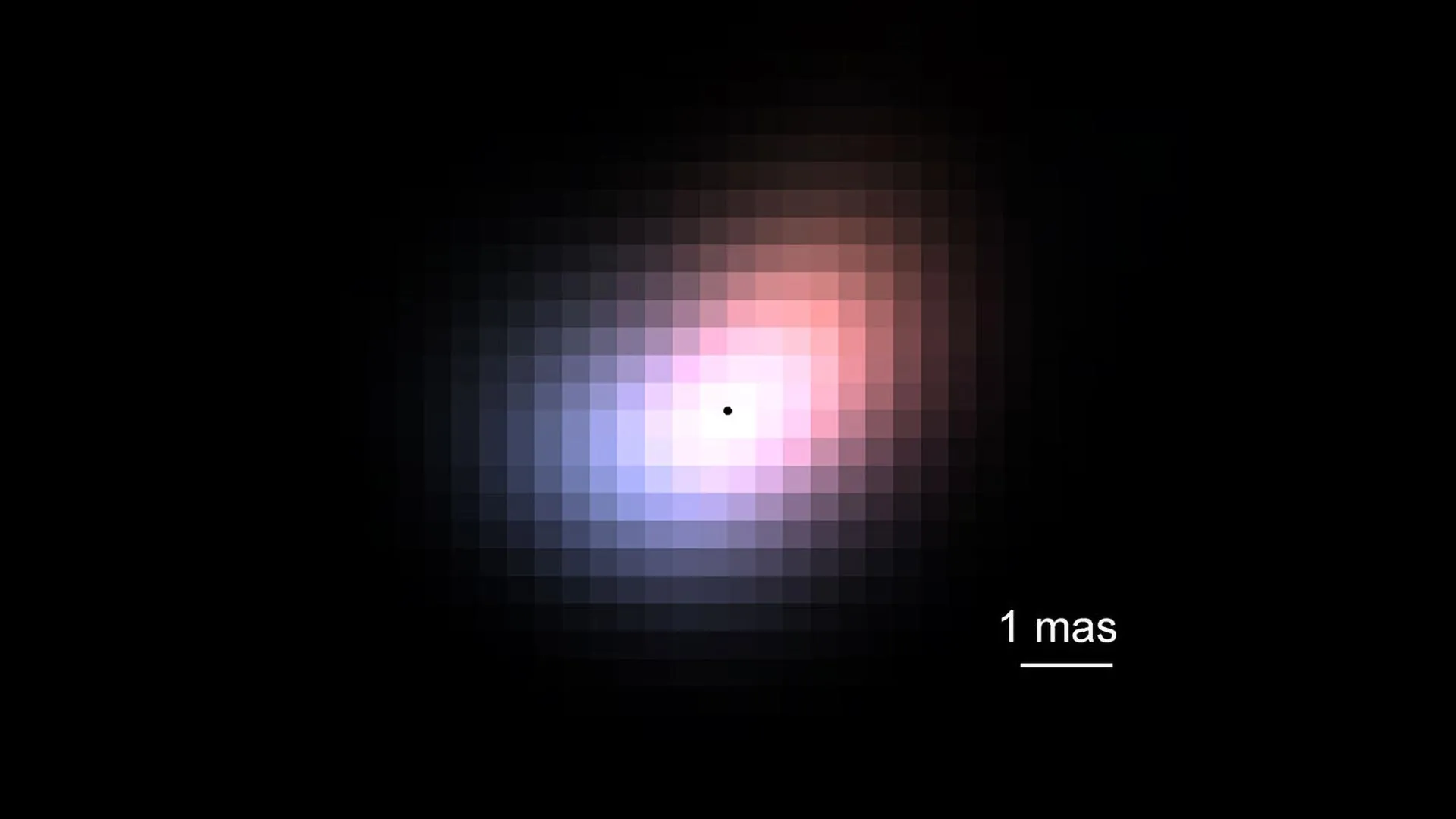
For decades, astronomers have been pushing teh boundaries of what’s visible in the universe, striving to overcome the inherent limitations of light and atmosphere. now, a groundbreaking new technique utilizing a “photonic lantern” is poised to revolutionize our understanding of star systems and the environments surrounding them. A recent study, led by Yoo Jung Kim of UCLA, has demonstrated the power of this technology, delivering a remarkably high-resolution image of a disk around a nearby star and opening a new window onto the cosmos.
The Challenge of Seeing Clearly
Conventional telescopes, despite their immense size and power, are fundamentally limited by the wave nature of light.This limitation, known as the diffraction limit, dictates the finest level of detail that can be observed. Overcoming this barrier requires innovative approaches, and the team behind this research has delivered just that.
Introducing the Photonic Lantern: A Breakthrough in Light manipulation
The core of this advancement lies in the photonic lantern – a refined device that acts as a spectral and spatial light divider. Imagine separating the individual notes from a complex musical chord; the photonic lantern performs a similar function with light, dissecting incoming starlight into its constituent wavelengths (colors) and spatial components. Developed collaboratively by researchers at the University of Sydney and the University of Central Florida, this device is a key component of FIRST-PL, an instrument spearheaded by the Paris Observatory and the University of Hawai’i. FIRST-PL is installed on the Subaru Coronagraphic Extreme Adaptive Optics instrument at the Subaru Telescope in Hawai’i, operated by the National Astronomical observatory of Japan.
“What excites me most is that this instrument blends cutting-edge photonics with the precision engineering done here in Hawai’i,” explains sebastien Vievard, a faculty member at the University of Hawai’i’s Space Science and Engineering Initiative. “It shows how collaboration across the world, and across disciplines, can literally change the way we see the cosmos.”
Beyond the Diffraction Limit: Achieving Unprecedented Resolution
This innovative approach allows astronomers to achieve sharper resolution than previously possible with conventional telescope cameras. As UCLA professor of physics and astronomy Michael Fitzgerald explains, “Our team has been working to use a photonic lantern to advance what is achievable at this frontier.” The potential impact is important, as highlighted by Nemanja Jovanovic of Caltech: “This work demonstrates the potential of photonic technologies to enable new kinds of measurement in astronomy. We are just getting started. The possibilities are truly exciting.”
Conquering Atmospheric turbulence: A Critical Hurdle
A major obstacle to achieving this clarity is the Earth’s atmosphere. The same atmospheric turbulence that causes shimmering on the horizon distorts starlight, blurring images. The Subaru Telescope team expertly addressed this challenge using adaptive optics – a technology that actively compensates for atmospheric distortions in real-time. Though, even with adaptive optics, the photonic lantern’s sensitivity demanded further refinement.
“We need a very stable environment to measure and recover spatial information using this fiber,” notes Kim. “Even with adaptive optics, the photonic lantern was so sensitive to the wavefront fluctuations that I had to develop a new data processing technique to filter out the remaining atmospheric turbulence.” This demonstrates the team’s dedication to overcoming technical hurdles and pushing the boundaries of observational astronomy.
A Lopsided Disk Reveals Unexpected Complexity
To validate their technique, the researchers focused on beta Canis Minoris (β CMi), a star approximately 162 light-years away surrounded by a rapidly rotating hydrogen disk. By meticulously analyzing the subtle color shifts in the starlight – a outcome of the Doppler effect – they were able to measure the disk’s rotation and structure with unprecedented precision.
The results were surprising. The team discovered that the disk around β CMi is not symmetrical, but rather lopsided.”We were not expecting to detect an asymmetry like this, and it will be a task for the astrophysicists modeling these systems to explain its presence,” Kim states. This unexpected finding underscores the power of this new technology to reveal previously hidden complexities in stellar systems.
The Future of Astronomical Observation
This breakthrough represents a paradigm shift in astronomical imaging. The ability to observe smaller, more distant objects with greater clarity will unlock new avenues for research, potentially resolving long-standing cosmic mysteries and uncovering entirely new phenomena.
This project is a testament to the power of international collaboration, bringing together expertise from institutions including the University of Hawai’i, the national Astronomical Observatory of Japan, the California Institute of Technology, the University of Arizona, the Astrobiology Center in Japan, the Paris Observatory, the University of Central Florida, the University of Sydney, and the University of California Santa Cruz.
The era of high-resolution astronomical imaging powered by photonic technology has arrived, promising a future filled with groundbreaking discoveries and a deeper understanding of