
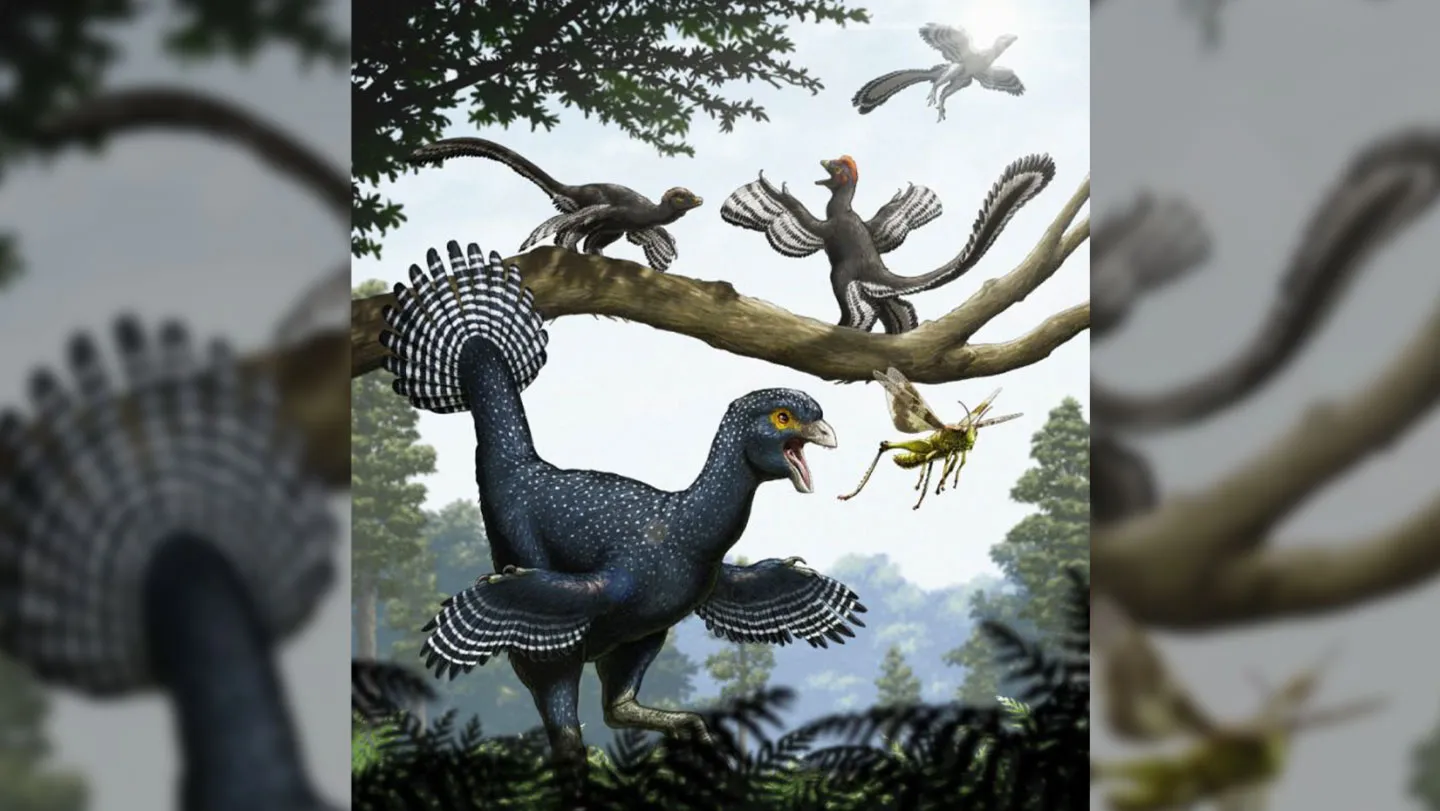
For decades, paleontologists have grappled with a fundamental biological puzzle: the “half-wing” paradox. In the evolutionary timeline, there exists a period where feathered dinosaurs possessed appendages that looked like wings but were far too small, too stiff, and too symmetrical to provide the lift necessary for flight. This raises a critical question in evolutionary biology: if these structures could not fly, why did nature spend millions of years refining them?
The traditional view often suggested that wings evolved for gliding or thermal regulation, but recent research is pivoting toward a more active, behavioral explanation. A team of international scientists has proposed that the evolution of wings before flight was not an accident of anatomy, but a sophisticated hunting strategy. By utilizing robotic simulations to trigger the instincts of modern insects, researchers are uncovering how “proto-wings” may have served as a tool to flush out prey long before the first dinosaur ever took to the skies.
This intersection of robotics, neurology, and paleontology offers a rare glimpse into the behavioral ecology of extinct species. By reconstructing the physical movements of ancestors like Caudipteryx, scientists are moving beyond the static evidence of the fossil record to experimentally test how prehistoric animals actually interacted with their environment.
The Biomechanical Barrier to Flight
To understand why early wings weren’t for flying, one must look at the physics of avian flight. For a creature to achieve lift, it requires a specific combination of surface area, joint flexibility, and feather morphology. Many early feathered dinosaurs, known as pennaraptorans, simply did not possess these traits.

According to vertebrate paleontologists, the surface area of these early proto-wings was insufficient to create the aerodynamic force needed to lift the animal’s body mass off the ground. The range of motion in their wing joints was limited, preventing the powerful, rhythmic downstroke required for powered flight. Perhaps most tellingly, the fossil record indicates that these dinosaurs lacked asymmetrical feathers. In modern birds, the asymmetrical shape of the feather vane is crucial for creating the pressure differential that allows for lift; without this asymmetry, a wing is essentially a decorative fan rather than an airfoil.
This anatomical dead-end for flight suggests that the wings must have provided a different survival advantage. If a trait persists through evolution, it generally provides a fitness benefit. If the benefit wasn’t movement, it was likely related to foraging, communication, or courtship.
Robopteryx: Testing the “Flushing” Hypothesis
To test the theory that early wings were used for hunting, researchers developed a specialized robotic model named “Robopteryx.” This robot was designed based on the fossils of Caudipteryx, a three-foot-long omnivorous dinosaur that lived more than 124 million years ago in what is now China.
The research team, including scientists from Seoul National University and the Museum and Institute of Zoology of the Polish Academy of Sciences, equipped the robot with motors to simulate the flapping of proto-wings. The goal was to see if this specific movement would trigger a reaction in modern insects, which share similar ancestral instincts with the bugs of the Cretaceous period.
The experiments focused on grasshoppers, a known food source for Caudipteryx. The researchers discovered that when the robotic dinosaur flapped its wings, it triggered a “flight response” in the insects. Rather than staying hidden in the undergrowth, the grasshoppers leaped into the open to escape the perceived threat. This behavior effectively “flushed” the prey, making them easy targets for a predator that could quickly snap them up with its beak.
This finding suggests that the flapping of proto-wings acted as a visual stimulus—a way to startle prey into moving. By evolving the ability to manipulate their environment through visual cues, early dinosaurs gained a significant caloric advantage without needing to leave the ground.
From Hunting Tool to Aerial Innovation
The transition from a hunting tool to a flight organ represents a classic example of exaptation—a process where a trait evolved for one purpose is later co-opted for another. The “flushing” behavior provided a bridge that allowed the wing structure to be maintained and refined over generations.
Once the musculature and skeletal structure for flapping were established for hunting, the evolutionary pressure shifted. Any mutation that increased the surface area or introduced asymmetry in the feathers would have provided a slight advantage in balance, leaping, or eventually, gliding. Over millions of years, these incremental improvements transformed a tool for startling insects into a sophisticated mechanism for atmospheric travel.
This research, published in the journal Scientific Reports, underscores the importance of interdisciplinary science. By combining the precision of robotics with the observations of behavioral zoology, researchers can simulate “extinct behaviors” that fossils alone cannot reveal.
Key Evolutionary Milestones of the Wing
| Stage | Primary Function | Key Anatomical Feature |
|---|---|---|
| Early Proto-wing | Display / Thermoregulation | Symmetrical, simple feathers |
| Behavioral Wing | Prey Flushing / Hunting | Flapping musculature, limited joint range |
| Gliding Wing | Controlled Descent | Increased surface area, rudimentary lift |
| Powered Flight | True Aerial Locomotion | Asymmetrical feathers, high joint flexibility |
Why This Matters for Modern Science
Understanding the evolution of flight is not merely an exercise in prehistoric curiosity; it informs our understanding of how complex biological systems emerge. The study of Caudipteryx and the use of Robopteryx demonstrate that evolution rarely takes a linear path toward a “goal.” Instead, it optimizes for the immediate needs of the organism.

For the medical and biological community, this highlights the concept of plasticity—the ability of a biological structure to serve multiple roles. In the same way that a dinosaur’s wing shifted from a hunting tool to a flight organ, many human physiological systems have been repurposed over millennia to adapt to new environments and diets.
the use of robotic proxies to study animal cognition and instinct is a growing field. This methodology allows scientists to test hypotheses about extinct species without relying solely on conjecture, providing a data-driven approach to the history of life on Earth.
As researchers continue to refine these simulations, the next step will likely involve testing a wider array of dinosaur species to determine if “flushing” was a universal trait among pennaraptorans or a specialized tactic unique to certain lineages. This will help map the exact branching point where the drive to hunt on the ground became the drive to conquer the air.
The next phase of this research is expected to involve more complex environmental simulations to see how these proto-wings functioned in dense forests versus open plains, providing a more holistic view of Cretaceous ecosystems.
Do you think the “flushing” hypothesis explains the mystery of early wings, or are there other behavioral uses we’ve overlooked? Share your thoughts in the comments below.