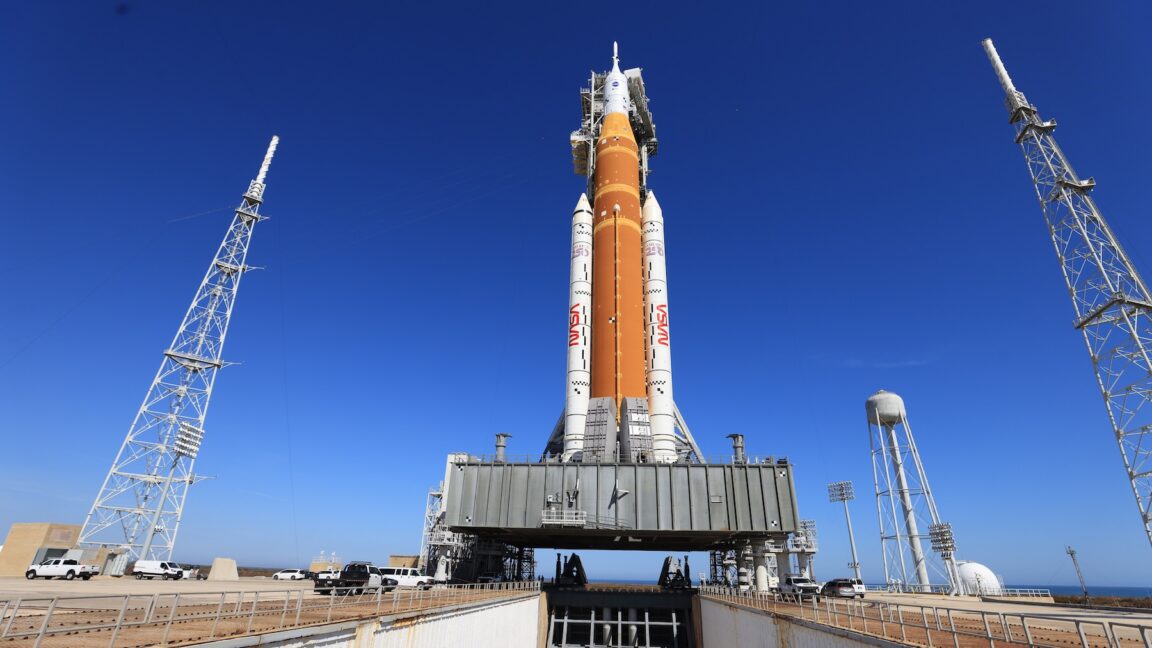
After a successful second fueling test, NASA is cautiously optimistic about launching the Artemis II mission to the Moon as early as March 6, 2026. The test, completed Thursday night at Kennedy Space Center in Florida, demonstrated significant improvement over a previous attempt earlier this month, resolving a hydrogen leak that had threatened to delay the highly anticipated flight. This mission represents a pivotal moment in the Artemis program, aiming to return humans to the lunar vicinity for the first time in over half a century.
The Artemis II mission is more than just a repeat of past lunar voyages; it’s a crucial stepping stone toward establishing a sustained human presence on the Moon and, preparing for crewed missions to Mars. The mission will carry a crew of four astronauts – commander Reid Wiseman, pilot Victor Glover, and mission specialists Christina Koch and Jeremy Hansen – on a roughly ten-day journey around the far side of the Moon. This flight will not land on the lunar surface, but will rigorously test the Orion spacecraft’s life support systems and capabilities in the harsh environment of deep space, paving the way for future lunar landings.
Hydrogen Leak Resolved, Launch Window Narrows
The primary hurdle to the March launch window was a hydrogen leak detected during a “wet dress rehearsal” – a full-scale simulation of the launch process – on February 2nd. Engineers traced the leak to seals within the rocket’s fueling system. Following the initial issue, technicians at Kennedy Space Center replaced those seals, and Thursday’s test confirmed the repairs were effective. “For the most part, those fixes all performed pretty well yesterday,” stated Lori Glaze, acting associate administrator for NASA’s exploration programs, as reported by NASA.gov. “We were able to fully fuel the SLS rocket within the planned timeline.”
Despite the successful test, Glaze cautioned that work remains before a final launch decision can be made. “I am going to caveat that. I want to be open, transparent with all of you that there is still pending work. There’s work, a lot of forward work, that remains,” she said. The current target launch date is March 6th, with a two-hour window opening at 8:29 pm EST (01:29 UTC on March 7th). However, NASA has identified backup launch dates on March 7th, 8th, 9th, and 11th. The availability of these dates is constrained by the Moon’s orbit, the required flight trajectory, and thermal and lighting conditions, with only approximately five days per month offering suitable launch opportunities.
Artemis II: A Crewed Test Flight to the Moon
The Artemis II mission represents a significant leap forward in space exploration. The crew – Wiseman, Glover, Koch, and Hansen – will push the boundaries of human spaceflight, traveling farther from Earth than any human has gone before. The mission will serve as a critical test of the Orion spacecraft’s systems, including life support, navigation, and communication, in the challenging environment of deep space. The data collected during the flight will be invaluable in preparing for future Artemis missions, including the planned Artemis III mission, which aims to land astronauts on the lunar south pole as early as 2026.
Commander Reid Wiseman is a veteran astronaut with extensive experience in spaceflight, including a previous mission to the International Space Station. Pilot Victor Glover will turn into the first African American astronaut to travel to the Moon. Mission specialists Christina Koch and Jeremy Hansen bring a wealth of scientific and engineering expertise to the mission. Koch holds the record for the longest single spaceflight by a woman, while Hansen is a Canadian astronaut and the first Canadian to be assigned to a lunar mission. The diverse crew reflects NASA’s commitment to inclusivity and international collaboration in space exploration.
The Space Launch System (SLS) Rocket
The Artemis II mission will be powered by NASA’s Space Launch System (SLS) rocket, the most powerful rocket ever built. The SLS is designed to send the Orion spacecraft beyond low Earth orbit and on to destinations like the Moon and Mars. The rocket’s development has been years in the making and has faced numerous challenges, including cost overruns and delays. However, the successful fueling test represents a major milestone in the SLS program, demonstrating the rocket’s readiness for its first crewed flight. According to the Houston Chronicle, the successful test is a critical step towards achieving NASA’s long-term goals for lunar exploration.
The SLS rocket consists of two solid rocket boosters and four RS-25 engines, providing the immense thrust needed to lift the Orion spacecraft off the launch pad. The rocket’s core stage contains the liquid hydrogen and liquid oxygen propellants that fuel the engines. The successful fueling test confirmed that the rocket’s systems can handle the extreme temperatures and pressures associated with launch. The hydrogen leak that plagued the initial wet dress rehearsal was a significant concern, as hydrogen is highly flammable and can pose a safety risk.
What’s Next for Artemis II?
With the fueling test complete, NASA teams will now focus on completing the remaining tasks necessary for launch. This includes final inspections of the rocket and spacecraft, software checks, and crew training. The crew will continue to practice procedures for various scenarios that could arise during the mission, including emergency situations. The launch team will too monitor weather conditions closely in the days leading up to the launch, as unfavorable weather could cause further delays.
The Artemis II mission is a complex undertaking, and Notice still risks involved. However, the successful fueling test has significantly increased confidence in the mission’s prospects. If all goes according to plan, the launch on March 6th will mark a new era of human space exploration, paving the way for a sustained presence on the Moon and, eventually, journeys to Mars. As noted by NBC News, this mission is “long-awaited” and represents a significant investment in the future of space exploration.
The next major milestone will be the Flight Readiness Review, a comprehensive assessment of the mission’s readiness for launch. This review will involve experts from across NASA and its partners, who will evaluate all aspects of the mission, from the rocket and spacecraft to the ground support systems and crew training. Following the Flight Readiness Review, NASA will announce a firm launch date.
Stay tuned to World Today Journal for further updates on the Artemis II mission as we approach the planned launch date. We will continue to provide in-depth coverage of this historic event, bringing you the latest news and analysis from Kennedy Space Center and beyond. Share your thoughts on the upcoming mission in the comments below!
Keep reading