
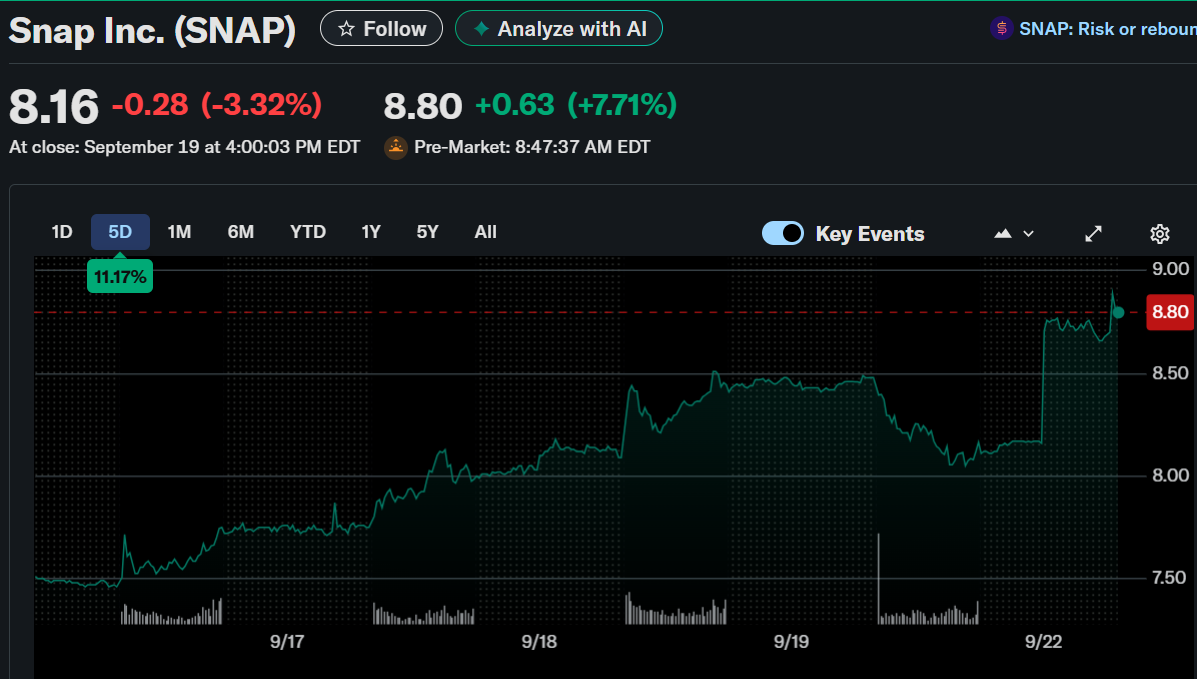
Snap Inc., the parent company behind the popular social media platform Snapchat, has faced renewed investor scrutiny as its stock price dipped sharply in recent trading, reflecting broader concerns about the company’s ability to sustain growth in a challenging ad-driven market. While the tech sector continues to navigate economic headwinds, Snap’s performance has drawn particular attention—highlighting the pressures on social media companies to balance user engagement with revenue stability. As of May 13, 2026, the stock’s decline underscores the volatility of consumer tech valuations, particularly for firms reliant on advertising as their primary revenue stream.
The downturn in Snap’s stock comes amid a broader market reassessment of social media companies, where ad revenue growth has slowed due to macroeconomic factors, shifting consumer behavior, and increased competition from AI-driven platforms. Analysts and investors are closely watching Snap’s ability to adapt, especially as it competes with rivals like Meta (Facebook/Instagram) and TikTok for ad dollars. The company’s recent financial disclosures and strategic pivots—such as expanding its AI tools and exploring new monetization avenues—will be critical in determining whether the stock can recover or if further declines are ahead.
For now, the stock’s performance reflects deeper industry trends: the erosion of ad revenue margins, the rise of ad-blocking tools, and the growing influence of generative AI in reshaping digital marketing. Snap’s challenge is not unique, but its smaller market cap and narrower revenue streams make it more vulnerable to downturns. Below, we break down the key factors driving the stock’s decline, the company’s response, and what investors should watch next.
Why Is Snap’s Stock Falling?
Snap’s stock has been under pressure for several quarters, but recent declines have intensified due to three primary factors:
- Ad Revenue Decline: Snap’s core business—displaying ads to its 750 million+ monthly active users—has shown signs of stagnation. While the company has reported year-over-year growth in some regions, the rate of increase has slowed, particularly in the U.S. And Europe, where ad spend is more sensitive to economic conditions. According to Snap’s most recent earnings report (Q1 2026), ad revenue grew by just 3% year-over-year, below analyst expectations and a notable slowdown from prior quarters.
- Market Sentiment and Analyst Downgrades: Investment firms have grown cautious about Snap’s outlook. In early May 2026, Freedom Broker downgraded Snap’s stock rating from Buy to Hold, citing concerns over ad revenue growth and citing a lowered price target to $5.00 from $7.00. This downgrade followed similar moves by other analysts, signaling a shift in confidence. The stock’s performance has also been influenced by broader tech sector trends, where growth stocks are facing reevaluation as interest rates remain elevated.
- Competition and Platform Fatigue: Snapchat’s user base has stabilized, but engagement metrics—such as daily active users (DAUs) and session length—have flattened in key markets. This stagnation comes as competitors like TikTok and Instagram invest heavily in features that appeal to younger audiences, including AI-generated content and interactive tools. Snap’s response has been to double down on AI, launching tools like My AI in late 2025, but adoption has been slower than expected, raising questions about whether the platform can innovate quickly enough to retain users and advertisers.
How Snap’s Stock Compares to Peers
Snap’s struggles are part of a larger trend affecting social media stocks. Unlike Meta, which benefits from a diversified ecosystem (Facebook, Instagram, WhatsApp), Snap’s revenue is almost entirely tied to Snapchat. This concentration makes it more exposed to shifts in user behavior and ad market dynamics. For context:

| Company | Stock Price (May 13, 2026) | YoY Revenue Growth | Primary Revenue Driver |
|---|---|---|---|
| Snap Inc. (SNAP) | $4.80 (down ~4.8%) | 3% (Q1 2026) | Advertising |
| Meta Platforms (META) | $420.50 (up ~1.2%) | 18% (Q1 2026) | Advertising + Reels |
| TikTok (via ByteDance, private) | N/A | Estimated 40%+ (2025) | Advertising + Creator Fund |
Note: TikTok’s financials are not publicly disclosed, but industry reports suggest rapid ad revenue growth driven by its dominance among Gen Z users.
Snap’s Response: AI and New Monetization Strategies
In an effort to reverse its fortunes, Snap has accelerated its investment in artificial intelligence, positioning AI as the next frontier for user engagement and ad targeting. The company’s My AI feature, launched in late 2025, allows users to interact with a chatbot for creative tasks, news summaries, and personalized recommendations. While still in its early stages, My AI represents Snap’s bet on AI-driven stickiness—a strategy that mirrors Meta’s push into generative AI tools.

Beyond AI, Snap is exploring alternative revenue streams, including:
- E-Commerce Integration: Snap has quietly expanded its Shop feature, allowing businesses to tag products in Stories and ads. Early data suggests this has driven incremental sales for some brands, though it remains a small fraction of Snap’s total revenue.
- Subscription Tiers: Rumors persist about Snap testing premium subscription models, though no official announcement has been made. A subscription service could create a more stable revenue stream, but it risks alienating Snapchat’s core user base, which has historically resisted paywalls.
- Hardware and AR: Snap’s foray into augmented reality (AR) glasses and wearables remains a long-term play. The company’s Spectacles line has struggled to gain traction, but Snap continues to invest in AR as a potential growth driver for ads and immersive experiences.
What’s Next for Snap’s Stock?
The next critical checkpoint for Snap’s stock will be its earnings report for Q2 2026, expected on July 29, 2026. Investors will be watching for:
- Ad revenue growth (or decline) and guidance for the year.
- User engagement metrics, particularly in high-growth markets like India and Southeast Asia.
- Updates on My AI adoption and whether it’s driving meaningful increases in session length or ad impressions.
- Any new monetization experiments, such as subscriptions or expanded e-commerce tools.
In the shorter term, Snap’s stock will continue to react to broader market conditions, including:
- Federal Reserve policy decisions, which impact ad spend and consumer confidence.
- Competitive moves from Meta and TikTok, particularly in AI and ad targeting.
- Macroeconomic trends, such as inflation and unemployment, which affect discretionary spending on digital ads.
Key Takeaways for Investors
- Snap’s stock is volatile but not doomed: While the recent decline is concerning, Snap remains a profitable company with a loyal user base. The key question is whether its AI and monetization strategies can deliver sustainable growth.
- Ad revenue is the wild card: If Snap can demonstrate even modest acceleration in ad revenue—particularly in high-margin areas like branded content—it could stabilize the stock.
- AI is a double-edged sword: My AI and other AI tools could boost engagement, but they also require significant investment. Early signs of success will be critical for investor confidence.
- Diversification is urgent: Snap’s reliance on Snapchat ads is a risk. Any progress on subscriptions, e-commerce, or hardware could materially improve its long-term outlook.
- Watch the earnings call: Snap CEO Evan Spiegel will need to address concerns about growth and provide a clear path forward.
What This Means for Users and Creators
While Snap’s stock performance is primarily an investor concern, the company’s financial struggles could have ripple effects for its user community. For example:

- Potential feature cuts: If ad revenue continues to lag, Snap may deprioritize non-core features or reduce spending on developer tools, which could impact third-party creators.
- More ads or paywalls: As Snap explores subscriptions, users may see increased monetization efforts, such as more frequent ads or limited free-tier access.
- AI as a user tool: Features like My AI could become more prominent, offering new ways for users to interact with the platform—but also raising privacy and data concerns.
For now, Snapchat remains a dominant force in social media, particularly among younger audiences. However, the company’s ability to innovate and adapt will determine whether it can maintain its position—or risk being left behind by faster-growing competitors.
Final Thoughts: A Stock to Watch
Snap’s stock may have entered a period of uncertainty, but the company’s challenges are not insurmountable. With AI at the forefront of its strategy and a clear focus on monetization diversification, Snap has the potential to turn the tide—if it can execute effectively. For investors, the coming months will be pivotal. For users, the focus should remain on whether Snapchat continues to deliver the creative, engaging experience that has defined it for over a decade.
We’ll continue to monitor Snap’s progress and update this analysis as new developments emerge. In the meantime, what do you think Snap’s next move should be? Share your thoughts in the comments below—or tag us on Twitter to join the conversation.