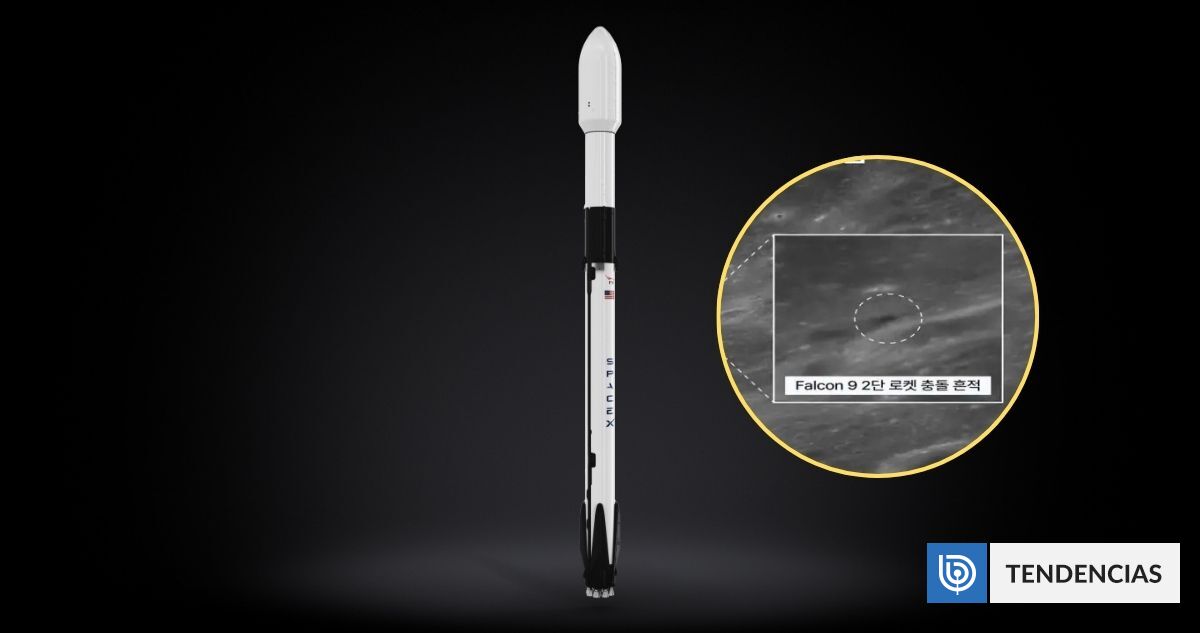
SpaceX rocket debris crashing into the moon has left an 18-meter crater after a rogue Falcon 9 upper stage struck the lunar surface at nearly 8,700 kilometers per hour. The unguided collision, which occurred during the early hours of Wednesday, August 5, 2026, has drawn scrutiny from aerospace scientists and space agencies tracking the volume of orbital debris. According to the United States National Aeronautics and Space Administration (NASA), the hardware originated from a launch supporting Firefly Aerospace’s Blue Ghost 1 lunar lander under NASA’s Commercial Lunar Payload Services initiative.
The spent rocket component had been drifting through space since January 15, 2025, after propelling its payload beyond Earth’s gravitational pull. Because missions targeting the moon require immense energy, the second stage exhausted nearly all its propellant during ascent, leaving insufficient fuel for a controlled retro-burn or atmospheric reentry. Over the subsequent months, a combination of solar activity and gravitational forces nudged the four-ton piece of technology into an unstable high-energy orbit, culminating in an unintended lunar impact.
Data compiled by researchers following the crash indicates that the violent collision carved a scar approximately 18 meters wide and nearly 4 meters deep into the lunar soil. Despite the scale of the impact, NASA officials emphasized that the event posed no threat to operations on Earth or active missions near the moon. The space agency noted that such occurrences provide an opportunity to study hypervelocity impacts in a natural setting, helping scientists understand how lunar regolith responds to heavy mechanical stress.
Scientific Opportunities and the Physics of Lunar Craters
While the collision was unplanned, researchers view the impact site as a natural laboratory. Because the moon lacks a substantial atmosphere and its surface remains stable over long periods, impact craters preserve physical evidence. By analyzing the exact mass, trajectory, and velocity of the Falcon 9 upper stage, planetary scientists can refine computer models that simulate how man-made materials interact with lunar dust and rock.
According to La Vanguardia, space agencies occasionally use intentional impacts as a controlled and predictable method to dispose of hardware at the end of a mission’s operational lifespan. Historical precedents include discarded stages from the Apollo program and spent components from Chinese lunar missions, which were guided into the moon to help sismometers understand the interior of the satellite. However, unlike those deliberate descents, the uncontrolled drift of the SpaceX booster highlighted the nature of high-energy orbital debris.
Orbital tracking networks continue to monitor the region as high-resolution imaging systems aboard international orbiters swing into position. Spacecraft operated by space agencies in the United States and South Korea are scheduled to capture detailed photographs of the crater in the coming days. These visual records will allow researchers to compare actual crater dimensions with theoretical models, improving tracking algorithms for future deep-space missions.
The Growing Challenge of Orbital Debris
The incident has reignited conversations among astronomers regarding space traffic management and the accumulation of discarded hardware beyond Earth’s immediate orbit. Although the moon receives impacts of meteorites almost daily, objects of human manufacture are less frequent. As commercial and national space programs accelerate their cadence of lunar exploration, managing spent upper stages remains an engineering challenge.

Space agencies maintain that tracking these structures is vital for safeguarding future crewed outposts and robotic assets operating within the lunar sphere. Observers awaiting further data can monitor official updates through NASA’s public portal or follow announcements from international space research groups as new orbital imagery becomes available. Readers are encouraged to share their thoughts or join the discussion in the comments section below.
Keep reading
- Swiss Model Tamy Glauser Accuses SBB Employee of Assault in Zurich
- Luca Dante Spadafora on Föhr: Snapchat Spotlight Viral Video
- James Webb Space Telescope Captures Detailed Infrared Image of Lion Nebula (time.news)
- Emmerdale Spoilers: Dr Todd Murder Investigation Takes Major Twist As Killer Is Confirmed (news-usa.today)