
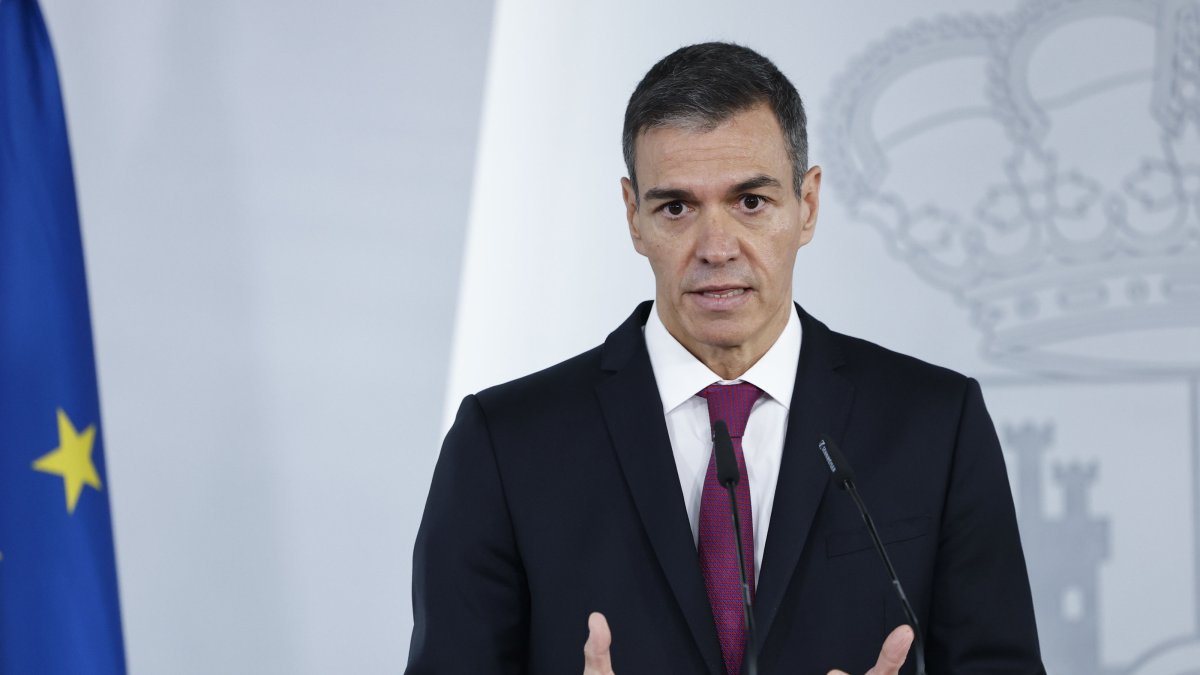
Spanish Prime Minister Pedro Sánchez has called for the European Broadcasting Union (EBU) to ban Israel from the Eurovision Song Contest, arguing that the international community must avoid “double standards” regarding the exclusion of nations from cultural competitions during times of conflict.
Speaking at a news conference in Madrid, Sánchez linked his demand to the precedent set in 2022, when Russia was banned from the contest following its invasion of Ukraine. The Prime Minister asserted that a similar standard should be applied to Israel due to its ongoing military action in Gaza, stating that “what we cannot allow is double standards in culture.”
The call for a Pedro Sanchez Eurovision Israel ban comes amid heightened diplomatic tensions between Madrid, and Jerusalem. Sánchez, whose government officially acknowledged a Palestinian state last year, has emerged as one of the most vocal critics of the Israeli government’s conduct in the region.
Russia Precedent and the Call for Consistency
Central to the Spanish Prime Minister’s argument is the principle of coherence in international law and human rights. Sánchez noted that the global community acted decisively three years ago when Russia was removed from international competitions. He argued that Spain’s commitment to these values must be “constant and must be coherent,” and suggested that Europe’s approach should be equally consistent.
The Prime Minister’s rhetoric has intensified in recent months. During a session in Congress, Sánchez referred to Israel as a “genocidal state,” further signaling a significant shift in Spain’s diplomatic posture toward the Israeli administration.
Contest Results and Public Reaction
The demand for a ban follows the recent Eurovision Grand Final held in Switzerland. Despite the political controversy surrounding its participation, Israel’s representative, Yuval Raphael, secured second place with the song “New Day Will Rise.”

While the professional juries and the public vote often diverge, Israel topped the public vote in this instance. Notably, Spanish viewers awarded Israel the maximum 12 points, highlighting a disconnect between the Spanish government’s official position and the voting behavior of some of its citizens.
Israeli Government Response
The reaction from Jerusalem was swift and dismissive. Amichai Chikli, Israel’s minister for diaspora affairs, used social media to ridicule the Spanish Prime Minister’s stance. Chikli characterized the result of the public vote—particularly the high points awarded by Spain—as a “slap in the face” for Sánchez, claiming the sentiment was felt “here in Jerusalem.”

The clash underscores the deepening divide between the two nations, as Sánchez continues to express solidarity with the people of Palestine, who he stated are experiencing the “injustice of war and bombardment.”
Key Diplomatic Context
- Palestinian Statehood: Spain officially recognized a Palestinian state last year, a move that significantly strained ties with Israel.
- International Law: PM Sánchez has repeatedly cited the need for adherence to international law as a prerequisite for global stability.
- Cultural Boycotts: The debate centers on whether cultural events like Eurovision should remain neutral or serve as tools for political accountability.
The European Broadcasting Union (EBU), the organizing body of the contest, has been asked for comment regarding the Spanish Prime Minister’s demands, though a formal response has not yet been detailed in available reports.
The next critical development will be the EBU’s official response to the call for a ban and any subsequent diplomatic actions taken by the Spanish government to pressure the organization.
World Today Journal encourages readers to share their thoughts on the intersection of culture and politics in the comments below.