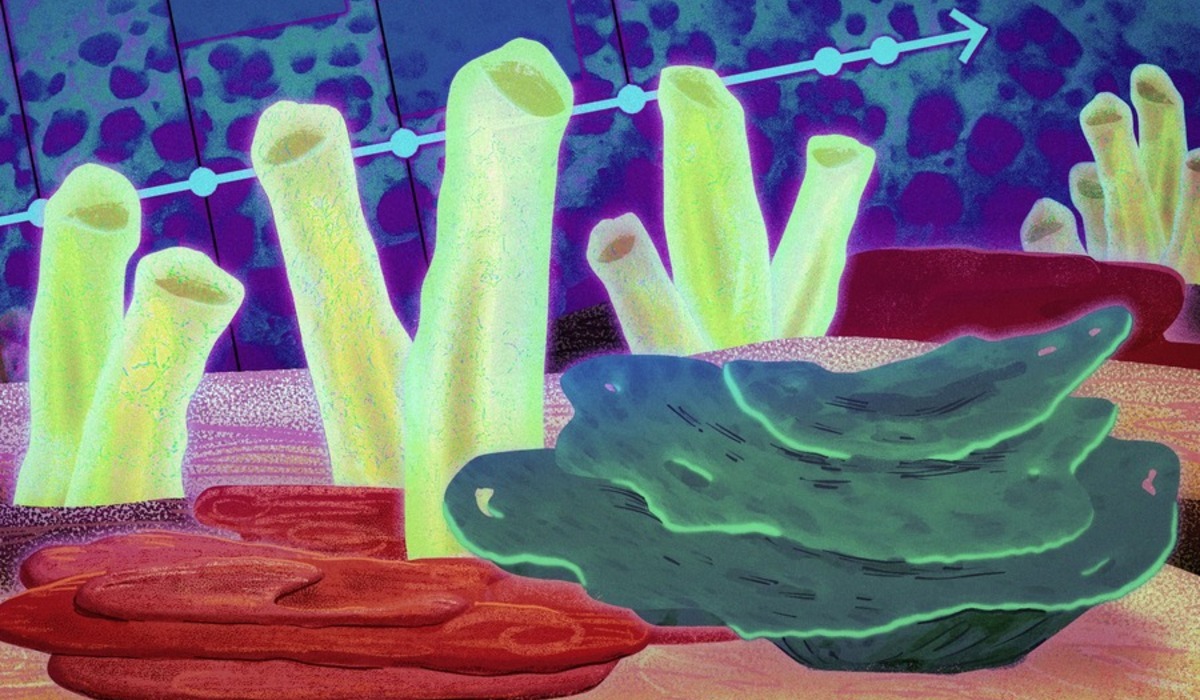
The question of Earth’s earliest animal life has long captivated scientists. Now, a groundbreaking study from the Massachusetts Institute of Technology (MIT) suggests the answer lies not with complex, mobile creatures, but with a seemingly simple organism: the sponge. Researchers have uncovered compelling evidence that ancestors of modern sponges were the first animals to emerge on our planet, pushing back the timeline for the evolution of animal life by at least 60 million years. This discovery, based on the analysis of “fossil chemicals” preserved in ancient rocks, fundamentally alters our understanding of life’s early history and the conditions that allowed for its diversification.
For decades, paleontologists have struggled to pinpoint the first animal due to the lack of readily fossilized remains. Early animals lacked the hard skeletons of dinosaurs or other later life forms, leaving behind only faint traces of their existence. This new research bypasses the limitations of traditional fossil hunting by focusing on “chemical fossils”—stable molecular compounds preserved within ancient sedimentary rocks. These molecules act as biomarkers, providing clues about the organisms that once inhabited these environments. The team, led by Professor of Geobiology Emeritus Roger Summons and researcher Lubna Shawar, focused on a specific type of molecule called sterane, a derivative of sterols found in the cell membranes of complex organisms.
Unlocking the Past Through ‘Fossil Chemistry’
The research, published in the Proceedings of the National Academy of Sciences (PNAS), centers around the identification of steranes within rocks dating back to the Ediacaran Period, approximately 541 to 635 million years ago. Samples were collected from Oman, India, and Siberia, representing a geographically diverse range of ancient marine environments. The key finding wasn’t simply the presence of steranes, but their unique molecular structure. Specifically, the researchers discovered an abundance of steranes containing 31 carbon atoms (C31), a configuration rarely found in other organisms. This C31 sterane signature proved to be the crucial link connecting the ancient molecules to a specific group of sponges – those belonging to the class Demospongiae.
“Unlike dinosaur fossils, which are bones, the first animals on Earth had very soft bodies and didn’t leave clear physical traces,” explained Professor Summons in a statement. “Instead, they left ‘molecular footprints’ called chemical fossils.” The team’s meticulous analysis revealed that modern Demospongiae sponges possess the unique genetic capability to produce sterols with 31 carbon atoms. Humans, for comparison, produce sterols with 27 carbon atoms, while most plants typically have 29. The rarity of the C31 molecule serves as a definitive “biological fingerprint,” confirming that the compounds found in the ancient rocks originated from living organisms, and not from geological processes.
The Significance of 31 Carbon Atoms
The presence of C31 steranes is not merely a chemical curiosity; it’s a powerful indicator of biological origin. Researchers rigorously validated their findings through a three-pronged approach. First, they extracted steranes from the Neoproterozoikum rock samples. Second, they analyzed the genes and sterol content of modern Demospongiae sponges. Finally, they conducted laboratory simulations, synthesizing the compounds to observe how they would change over millions of years under intense pressure. Only two compounds consistently matched the C31 sterane found in the ancient rocks, both originating from the Demospongiae sponge lineage. MIT News details the comprehensive methodology used in the study.
This discovery challenges previous assumptions about the timing of animal evolution. Prior to this research, the earliest widely accepted evidence of animal life dated back to around 541 million years ago, coinciding with the Cambrian explosion – a period of rapid diversification of life forms. The MIT team’s findings suggest that animal life began to evolve at least 60 million years earlier, during the Ediacaran Period. This extended timeline has significant implications for understanding the environmental conditions that fostered the emergence of animal life. The presence of these early sponges likely played a role in altering the chemistry of the ancient oceans, increasing oxygen levels and creating a more habitable environment for more complex organisms to evolve.
What Were These Early Sponges Like?
While the exact physical appearance of these ancient sponges remains a mystery, scientists believe they were likely simple, soft-bodied organisms lacking the rigid silica skeletons (spicules) found in many modern sponges. “They were undoubtedly soft-bodied, and we suspect they didn’t have the silica frameworks that characterize modern sponges,” Summons stated. This explains why paleontologists have rarely discovered intact sponge fossils from the pre-Cambrian era. Without hard parts, the fatty molecules in their cell membranes are the only remnants that have survived the passage of hundreds of millions of years.
Sponges are relatively simple animals, lacking true tissues and organs. They filter feed by drawing water through their bodies, extracting bacteria, plankton, and detritus. Their role as filter feeders likely contributed to the oxygenation of the ancient oceans, paving the way for the evolution of more complex life forms. The Demospongiae class, to which these ancient ancestors belong, is the largest class of sponges, encompassing around 70% of all known sponge species. These sponges are characterized by their skeletal structure, which is composed of spicules made of silica or spongin fibers.
Implications for Understanding Early Life
The identification of sponges as the earliest animals has broader implications for our understanding of the evolution of multicellularity. Sponges represent a relatively simple form of multicellular life, and their emergence suggests that the transition from single-celled organisms to complex multicellular animals may have been a more gradual process than previously thought. Further research will focus on expanding the search for chemical fossils in other regions to refine the timeline of early animal evolution and to understand how these early organisms adapted to the changing environmental conditions of the ancient Earth.
The team plans to continue their investigation by analyzing rock samples from different locations around the globe, hoping to pinpoint the exact timeframe when these first animals emerged and how they managed to survive through periods of extreme climate change. This ongoing research promises to further illuminate the origins of animal life and the remarkable journey of evolution on our planet. The study highlights the power of “fossil chemistry” as a tool for unraveling the mysteries of the deep past, offering a new window into the earliest chapters of life on Earth.
Key Takeaways
- Sponges are the earliest known animals: Evidence suggests that ancestors of modern sponges were the first animals to evolve on Earth, predating the Cambrian explosion by at least 60 million years.
- ‘Fossil chemistry’ provides crucial evidence: The discovery relies on the analysis of sterane molecules, specifically those with 31 carbon atoms, found in ancient rocks.
- Demospongiae sponges are the key: The unique molecular signature points to sponges from the Demospongiae class as the earliest animal lineage.
- Early sponges likely altered ocean chemistry: Their filter-feeding activity may have contributed to increasing oxygen levels in the ancient oceans.
The research team’s findings represent a significant step forward in our understanding of the origins of animal life. As scientists continue to explore the chemical signatures of the past, People can expect further revelations about the remarkable story of life on Earth. For more information on the research and the methods used, you can visit the Proceedings of the National Academy of Sciences website.
What are your thoughts on this groundbreaking discovery? Share your comments below and let us know how this new understanding of early animal life impacts your perspective on the history of our planet.