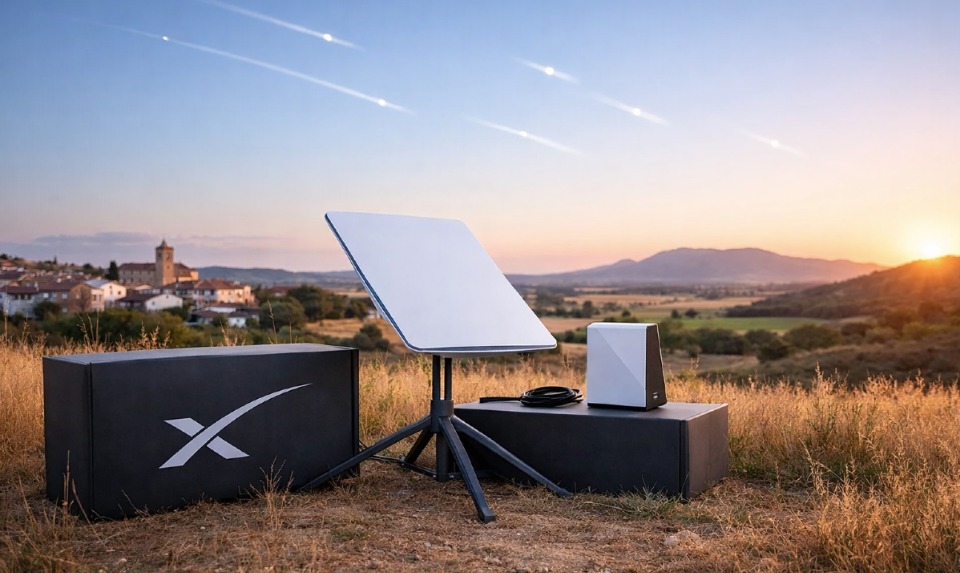
SpaceX’s satellite internet arm, Starlink, has launched what is being described as one of its most aggressive commercial campaigns to date in the Spanish market. In a strategic move to disrupt the established broadband landscape, the company has introduced a Starlink promotion with free kits and up to 65% discounts on plans, significantly lowering the barrier to entry for fresh users in a region historically dominated by fiber optic infrastructure.
The offensive focuses on two primary levers: a drastic reduction in monthly subscription costs and the elimination of the initial hardware investment. By shifting from a purchase model to a loan-based system for its equipment, Starlink is attempting to mirror the accessibility of conventional fixed broadband, challenging the market share of traditional telecommunications operators in Spain.
This pricing shift is particularly notable given the competitive nature of the Spanish connectivity market. According to reports from Forbes España, the entry-level monthly fee has dropped to as low as 10 euros, a price point previously unseen in the satellite connectivity segment.
The promotion is not permanent; it is limited to a three-month period and is available until the end of April 2026. This window suggests a tactical “blitz” designed to accelerate customer acquisition and establish a firmer foothold in both urban and rural areas where high-speed internet is essential but potentially underserved by ground-based cables.
Breaking Down the New Pricing Structure
The core of Starlink’s current strategy lies in the tiered discounts applied to its three primary service plans. The reductions vary depending on the speed and capacity of the plan, with the most significant savings offered to those choosing the basic tier. Specifically, the basic plan (100 Mbps) has seen a discount of up to 65%, while the intermediate plan (200 Mbps) is reduced by 49%, and the most advanced option (400 Mbps or more) features a 32% price cut, as detailed by Forbes España.
Beyond the monthly fees, the most disruptive change is the handling of the hardware. Previously, users were required to purchase the satellite dish and router, with costs typically ranging between 300 and 400 euros. Under the new promotional model, this hardware is provided without an initial entry or installation cost. This represents structured as a “cession” or loan model, meaning the equipment must be returned if the user cancels the service.
For those requiring professional-grade connectivity, Starlink continues to offer high-performance equipment and priority tariffs. While the promotional residential plans target the mass market, the high-performance hardware remains available for a cost of 2,389 euros, providing public IPs and network preference for data-heavy users, according to Wired.
Comparison of Residential and Priority Options
| Plan Type | Hardware Cost (Standard) | Monthly Starting Price (Promo) | Key Feature |
|---|---|---|---|
| Residential (Promo) | 0€ (Cession Model) | 10€ | High-speed home access |
| Residential (Standard) | 450€ + 23€ shipping | 49€ | Standard domestic coverage |
| Priority/High Performance | 2,389€ | From 93€ (40GB) | Public IP & Network Preference |
The Technology Behind the Disruptive Pricing
To understand why Starlink can compete with fiber optics on latency, one must glance at the orbital architecture. Traditional satellite internet relies on geostationary satellites positioned approximately 36,000 kilometers above the Earth. In contrast, Starlink operates a constellation of satellites in Low Earth Orbit (LEO), at an altitude of approximately 500 kilometers. This proximity drastically reduces the time it takes for a signal to travel from the user to the satellite and back, which is the primary cause of “lag” or latency in satellite connections.
The current network consists of approximately 6,000 satellites, with plans to expand this number to 12,000 to ensure more stable and widespread coverage (Wired). This infrastructure allows the service to offer response times (latency) between 20 and 40 milliseconds, making it viable for activities that were previously impossible on satellite internet, such as online gaming or real-time video conferencing.
the hardware is engineered for resilience. The kits are designed to withstand extreme weather conditions, including heavy rain, strong winds, and sleet. The antennas are even capable of melting snow to maintain a clear line of sight to the satellite constellation, ensuring a reported uptime of over 99.9% (Starlink Official).
Market Impact and Strategic Implications
Spain is one of the best-connected countries in Europe regarding fiber optic penetration. For Starlink to enter this market with a 10-euro entry point is a clear signal that the company is no longer targeting only the “unreachable” rural areas, but is now competing directly for urban and suburban customers. By removing the upfront hardware cost, Starlink eliminates the primary psychological and financial barrier that previously kept potential customers tied to traditional ISPs.
This move is part of a broader global strategy. In Latin America, Starlink has already formed strategic alliances, such as the partnership with Telefónica in Mexico to offer a service known as Connection+, with plans to expand this model into Peru, Colombia, Chile, and Brazil (Wired).
The implications for the Spanish market are twofold. First, it puts pressure on traditional operators to lower prices or improve service in rural zones. Second, it accelerates the transition toward satellite-based redundancies for businesses and homes that cannot risk downtime. The “cession” model for hardware effectively turns the satellite dish into a utility rather than a luxury purchase.
Key Takeaways for Potential Users
- Limited Window: The promotional discounts and free kit offer are available only until the end of April 2026.
- Hardware Terms: The “free” kit is a loan; equipment must be returned if the subscription is cancelled.
- Pricing: Monthly fees can start as low as 10 euros for the basic 100 Mbps plan.
- Performance: Low Earth Orbit (LEO) technology provides latency between 20ms and 40ms.
- Resilience: Equipment is designed to operate in extreme weather, including snow-melting capabilities.
As the promotion concludes at the end of April, the next key checkpoint for observers will be the adjustment of pricing tiers and the announcement of whether the hardware cession model becomes a permanent fixture of the Spanish market or remains a temporary acquisition tool. Users interested in the service can identify official updates and registration portals at the official Starlink website.
We invite our readers to share their experiences with satellite connectivity in the comments below. Do you believe LEO satellites can truly replace fiber optics in urban environments?
Keep reading
- Crédit Agricole Centre France Renews Support for Creuse Summer Festival
- Australian Library Book Found in Fireplace Returns 150 Years Late
- Penn Defies Industry Layoffs With Plans to Hire 1,000 New Employees (newsdirectory3.com)
- AI Stock Slump Forces Hedge Fund Prodigy to Sell; Musk Denies Tesla Split Plans (archyde.com)