
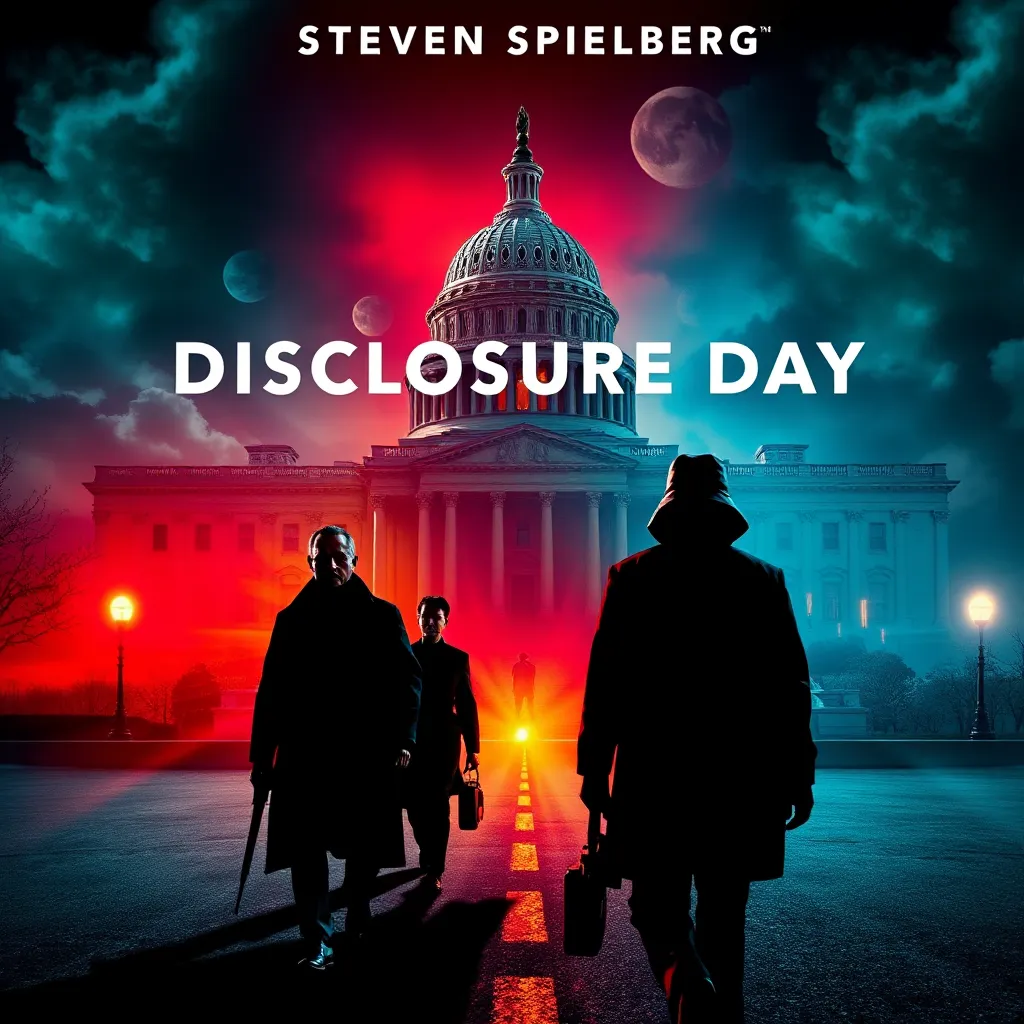
Steven Spielberg’s latest film, Disclosure Day, has ignited fierce debate among critics and audiences, with conservative commentators Rod Dreher and Steve Deace labeling it a “profoundly evil” and “direct assault on Christianity.” The film, which explores themes of extraterrestrial contact and spiritual awakening, earned a middling B CinemaScore—unexpected for the Oscar-winning director—and has drawn sharp criticism from religious observers who argue it promotes a new form of faith centered on alien beings.
While mainstream critics have praised Disclosure Day as a return to form for Spielberg, conservative pundits like Dreher and Deace have framed the film as a deliberate attempt to displace traditional Christianity with a belief system rooted in extraterrestrial revelation. Dreher, an Orthodox Christian and film critic, went so far as to call the movie “close to evil” in his review, suggesting it represents a “new religion” that replaces biblical faith with an alien-centric gospel.
Deace, host of The Steve Deace Show and a prominent conservative commentator, echoed these sentiments, describing the film as a “direct assault on Christianity.” He argued that the movie’s portrayal of nuns and religious figures reacting to extraterrestrial contact—without depicting other global faiths—was a deliberate exclusion meant to marginalize Christianity. “No other religion is even depicted,” Deace noted, questioning why the film’s narrative centered solely on Christian institutions.
Despite the controversy, Disclosure Day opened to a respectable $43 million in its debut weekend, according to Box Office Mojo. While the figure is solid for an original sci-fi narrative, it falls short of the blockbuster expectations set by Spielberg’s earlier works. The film’s box office performance raises questions about whether its spiritual and philosophical themes will resonate with mainstream audiences or alienate them.
MY REVIEW OF DISCLOSURE DAY — A DIRECT ASSAULT ON CHRISTIANITY (AND SPIELBERG’S WORST MOVIE)
Because of how intentional I believe this film is in attempting to deconstruct Christianity, and because I want to warn people about not seeing it, this will be a very spoiler-filled…— Steve Deace (@SteveDeaceShow) June 13, 2026
Why Are Critics Calling Disclosure Day a ‘New Religion’?
At the heart of the controversy lies the film’s portrayal of extraterrestrial beings as a source of moral and spiritual guidance. Dreher, in his critique, argues that Spielberg—once a filmmaker deeply rooted in Judeo-Christian themes—has shifted his focus to a belief system where aliens replace God as the ultimate authority. “To be charitable, we could assume that Spielberg, no longer able to believe in the God of the Bible, has transferred his hopes to aliens,” Dreher wrote. “That is the gospel he preaches in this film.”
Deace expanded on this idea, comparing Disclosure Day to Spielberg’s 1977 classic Close Encounters of the Third Kind. While the earlier film left the nature of extraterrestrial life ambiguous, Deace argues that Disclosure Day explicitly frames aliens as saviors, offering humanity a path to salvation. “It’s a blatant attempt to evangelize into a new religion,” he said, drawing parallels to UFO enthusiasts like Dr. Steven Greer, who have long promoted the idea of extraterrestrial benevolence.
One of the most contentious scenes in the film involves a convent, where nuns cling to their rosaries while the Mother Superior appears to approve of the extraterrestrial revelation. Deace questioned why Christianity was the only faith depicted in the film, suggesting that the exclusion of other religions—such as Islam, Hinduism, or Judaism—was a deliberate choice. “Why is that?” he asked. “All the potential answers to this question are bad.”
How Does Disclosure Day Compare to Spielberg’s Earlier Work?
Disclosure Day marks a significant departure from Spielberg’s earlier films, particularly those that engaged with religious or spiritual themes. In Schindler’s List (1993) and The Color Purple (1985), Spielberg explored faith as a source of resilience and hope. However, Disclosure Day presents a radical shift: instead of human spirituality, the film centers on an extraterrestrial revelation that some critics argue undermines traditional religious beliefs.
According to Rotten Tomatoes, Close Encounters of the Third Kind was praised for its wonder and ambiguity, leaving audiences to interpret the nature of the extraterrestrial encounter. In contrast, Disclosure Day appears to offer a clear narrative: aliens are not just visitors but potential saviors, a concept that Dreher and Deace argue is a form of religious propaganda.
Spielberg has not publicly addressed the criticism, but the film’s premise—government officials and religious leaders grappling with the disclosure of extraterrestrial life—has sparked broader discussions about the intersection of science, faith, and pop culture. Some film scholars suggest that Disclosure Day reflects a growing trend in Hollywood to explore spiritual questions through sci-fi lenses, while others see it as a deliberate challenge to traditional religious narratives.
Will the Controversy Affect the Film’s Long-Term Success?
The box office performance of Disclosure Day suggests that audiences are divided. While the film’s opening weekend gross of $43 million is respectable for an original sci-fi release, it is significantly lower than the $100 million+ openings of Spielberg’s recent hits like Ready Player One (2018) and The Fabelmans (2022). The question now is whether the film’s spiritual and philosophical themes will resonate with enough viewers to sustain its run—or if the controversy will limit its appeal.
Industry analysts note that films with heavy thematic content often struggle with mainstream appeal. For example, Her (2013), which explored artificial intelligence and human connection, earned critical acclaim but underperformed at the box office. Similarly, Arrival (2016), which blended sci-fi with deep philosophical questions, was a critical darling but not a commercial blockbuster.
However, Disclosure Day benefits from Spielberg’s star power and Universal Pictures’ marketing machine. The studio has positioned the film as a must-see event, and early word-of-mouth—while mixed—has kept interest alive. Whether the controversy will ultimately hurt or help the film remains to be seen.
What’s Next for Disclosure Day?
As of now, Disclosure Day continues its theatrical run, with no major reshoots or re-edits announced. The film’s reception—both critical and commercial—will likely shape its legacy. If it underperforms at the box office, it could be seen as a misstep for Spielberg, particularly given his history of delivering both critical and commercial successes.
Meanwhile, the debate over the film’s religious implications shows no signs of slowing. Dreher and Deace have continued to engage with the topic on their respective platforms, while mainstream critics have largely focused on the film’s technical merits rather than its spiritual undertones. The contrast between these perspectives highlights a broader cultural divide over how faith and science should intersect in storytelling.
For now, audiences are encouraged to decide for themselves whether Disclosure Day is a visionary work of art or a provocative challenge to traditional beliefs. As Spielberg himself has said, “The role of the artist is to make the revolution irresistible.” Whether this film will be remembered as revolutionary—or controversial—remains to be seen.
What do you think of Disclosure Day? Does it offer a compelling new perspective on faith and extraterrestrial life, or does it cross a line? Share your thoughts in the comments below.
Worth a look
- Annie Yi Teases Possible Reunion with Ex-Husband Harlem Yu During Live Stream with Son En-li
- Bai Lu Laughs Hilariously as a Big Dog Almost Spins Her Around
- Why Rotten Tomatoes Scores Split Critics From Audiences (daybreakwire.com)
- Kratom’s Rising Popularity Sparks Addiction Concerns and Sales Bans (news-usa.today)