
The intersection of storytelling and state power has long been a subject of academic study, but few recent works attempt to map the entire trajectory from early 20th-century psychology to the digital battlefields of today. In the book Stories Are Weapons: Psychological Warfare and the American Mind, author and journalist Annalee Newitz explores how psychology, propaganda, and storytelling evolved into tools of modern information warfare, shaping both military strategy and public opinion.
Published in 2024 by W.W. Norton and Company, the perform serves as a synthesis of archival research and contemporary interviews. Newitz draws heavily from the Propaganda and Psychological Warfare archive at the Hoover Institution at Stanford University to probe the deep-seated relationship between advertising and the emergence of psychological warfare. By tracing these roots, the book argues that the mechanisms used to sell products are often indistinguishable from those used to manipulate populations during wartime.
For a global audience, the book’s analysis of the “American mind” provides a critical lens into how democratic public life can be eroded by the very tools designed to manage it. From the influence of early public relations pioneers to the role of science fiction in military doctrine, Newitz examines how the narrative is often more powerful than the fact in the theater of psychological operations.
The Architecture of Persuasion: From Freud to Bernays
Newitz begins the historical exploration with World War I, a period when the U.S. Military’s propaganda and psychological operations—or “psy-ops”—were essentially synonymous. During this era, these efforts were helmed by the influential Walter Lippman. This early stage of state-sponsored persuasion set the groundwork for a more scientific approach to manipulating public perception.
The book segues into the emergence of modern psychology under Sigmund Freud, noting how Freud’s theories on the human subconscious were later appropriated by his nephew, Edward Bernays. Often cited as the father of public relations, Bernays applied Freud’s psychological insights to the advertising industry, effectively bridging the gap between clinical psychology and commercial persuasion. This transition shifted the focus of communication from informing the public to subconsciously steering them.
This ideological divide created a lasting tension in how society views the act of persuasion. In his work Public Opinion, Lippman argued that propaganda erodes democratic public life. Freud shared the view that propaganda is corrosive to civil society. Conversely, Bernays viewed persuasion as a civil right, arguing in Crystalizing Public Opinion that it was a fundamental part of everyday communication. This unresolved debate continues to define the “grey area” between information warfare and modern advertising.
Military Doctrine and the Role of Speculative Fiction
A distinctive element of Newitz’s research is the examination of how the U.S. Military solidified its psychological warfare doctrine after World War II. The book illuminates an unexpected influence: 20th-century science fiction authors. By analyzing how these writers imagined future conflicts and societal control, Newitz shows how speculative storytelling informed actual military strategy and the conceptualization of psychological operations.
Over time, the terminology evolved. While “propaganda” became a term associated with civilian or foreign influence, “psy-ops” became more closely linked to formal military operations. Yet, the underlying goal remained the same: the employ of information as a weapon to achieve strategic objectives without necessarily engaging in physical combat.
The book also addresses the real-world consequences of these operations on marginalized communities. Newitz includes a specific chapter detailing the work of the Coquille Indian Tribe, which has sought to undo the damage caused by psychological operations directed at certain Oregon tribes in the past. This highlight emphasizes that psychological warfare is not just a tool for international diplomacy or foreign conflict, but has been used domestically against indigenous populations.
Modern Information Warfare and the Culture War
Moving into the contemporary era, Stories Are Weapons addresses the proliferation of misinformation, fake news, and the digital landscape of the 21st century. Newitz describes the book as an urgent call for individuals to learn how to push back against stories specifically intended to cause harm. The author’s own impetus for the project stemmed from observing the social media dynamics during the Black Lives Matter protests in Washington D.C., noting how Twitter (now X) became a primary site for the deployment of narrative-driven warfare.
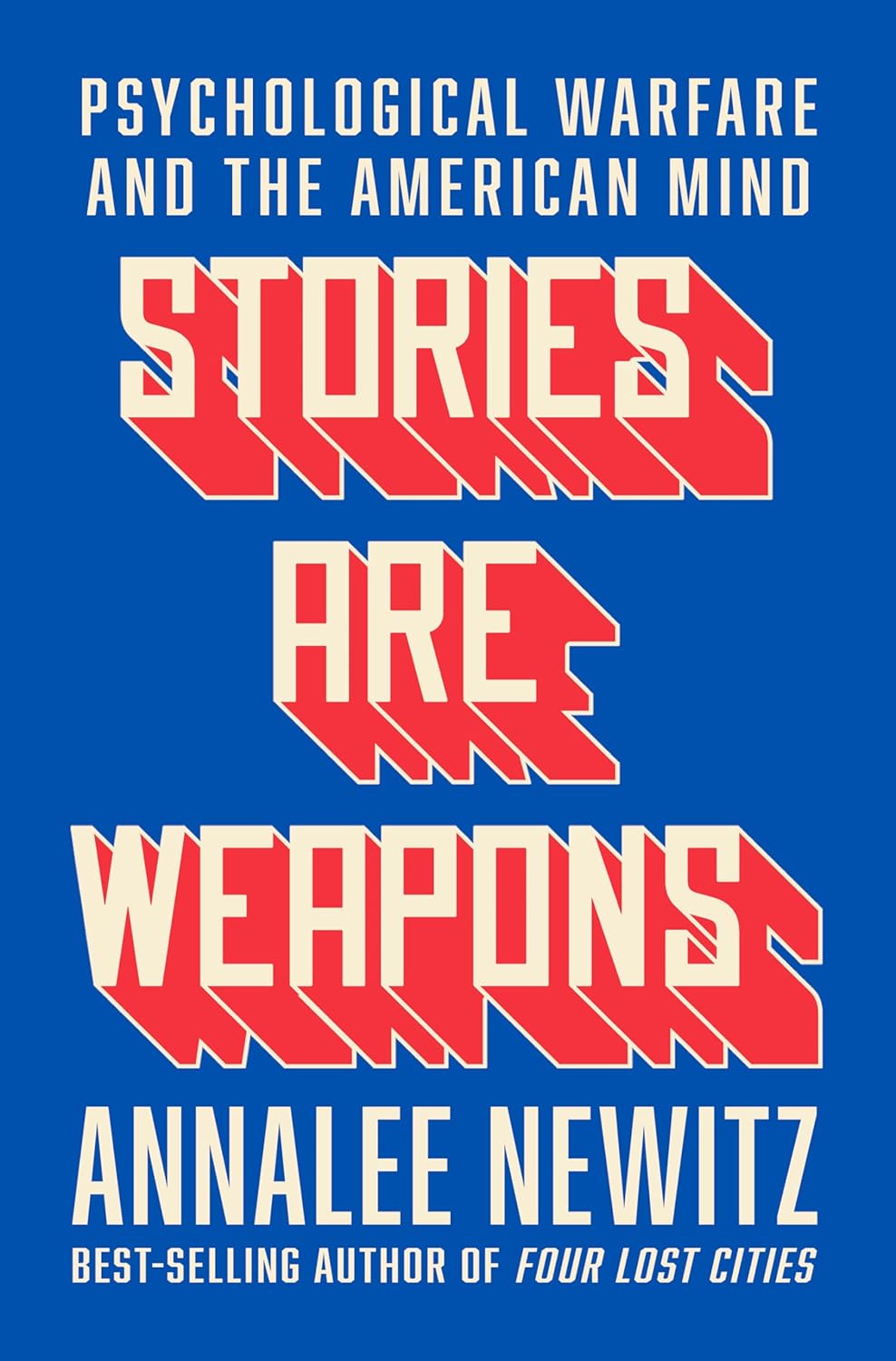
Perhaps the most debated aspect of the book is its treatment of the American culture war. Some critics and readers have found Newitz’s analysis of these internal societal conflicts to be biased or polemical. Despite this, the work is presented as a necessary contribution to the literature on information warfare, as it connects the historical dots between the “father of PR” and the algorithmic amplification of discord in the modern age.
By framing stories as weapons, Newitz suggests that the current crisis of truth is not a glitch in the system, but the intended result of a century of psychological engineering. When persuasion is treated as a science and storytelling is used as a tactical tool, the boundary between a citizen and a target disappears.
Key Historical Influences in Psychological Warfare
| Figure/Entity | Key Contribution | Perspective on Propaganda |
|---|---|---|
| Walter Lippman | Helmed early U.S. Military propaganda in WWI | Argued it erodes democratic public life |
| Sigmund Freud | Founded modern psychology | Viewed propaganda as corrosive to civil society |
| Edward Bernays | Father of Public Relations | Identified persuasion as a civil right |
| U.S. Military | Post-WWII doctrine development | Integrated sci-fi concepts into psy-ops strategy |
For those seeking to understand the mechanics of modern misinformation, the book provides a roadmap of how we arrived at this point. It suggests that the first step in resisting psychological warfare is recognizing the history of the tools being used against the public. By understanding the lineage of Bernays and Lippman, readers can better identify the patterns of manipulation in today’s digital feeds.
The exploration of these themes is further detailed in interviews and discussions, such as those hosted by OPB’s “Think Out Loud”, where Newitz discusses the urgency of pushing back against harmful narratives.
As the landscape of information warfare continues to shift with the integration of AI and more sophisticated targeting, the historical precedents outlined in Stories Are Weapons remain relevant. The transition from the printed pamphlet to the viral tweet is a change in medium, but the psychological triggers remain largely the same.
Readers interested in the intersection of geopolitics and psychology are encouraged to explore the archival records of the Hoover Institution to observe the primary documents that inform this analysis. Understanding the history of psychological operations is no longer just an academic exercise; it is a prerequisite for navigating the modern information environment.
Stay tuned for further analysis of international information trends and the impact of psychological operations on global stability. We invite our readers to share their perspectives on the role of storytelling in modern politics in the comments below.