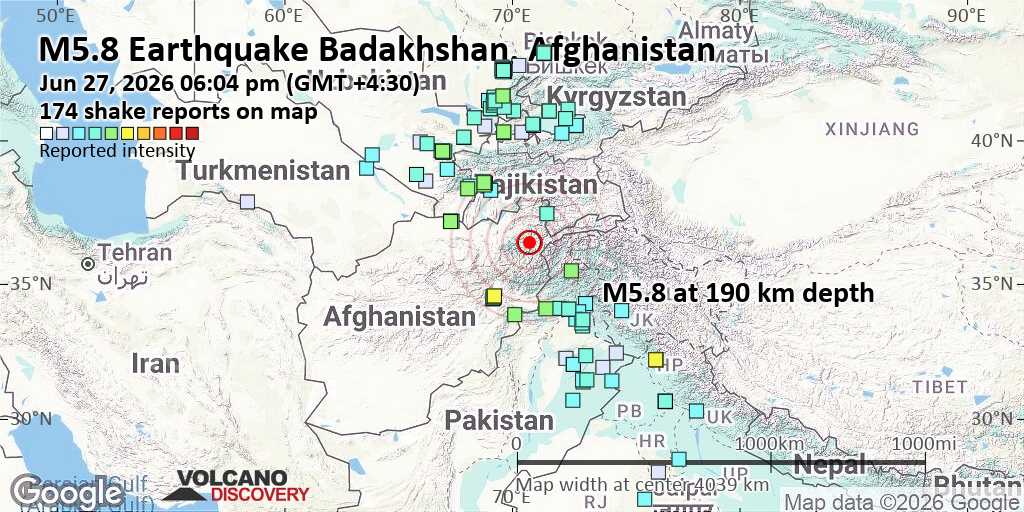
A powerful earthquake with a magnitude of 6.1 struck the Badakhshan province of Afghanistan on Saturday, June 27, 2026, according to seismic monitoring data. The tremor, which occurred at 18:04 local time (13:34 GMT), was centered approximately 44 kilometers south of Jurm, a region known for its complex tectonic activity within the Hindu Kush mountain range. The seismic event was felt across a wide area, with reports of tremors reaching as far as the capital city of Kabul.
The Hindu Kush region is historically prone to significant seismic activity due to its location at the convergence of the Indian and Eurasian tectonic plates. According to data provided by Volcano Discovery, the depth and location of this specific earthquake are consistent with the deep-seated tremors frequently recorded in the high-altitude terrain of northeastern Afghanistan. While seismic monitoring agencies often provide varying initial magnitude estimates—with some reports citing a 6.2 magnitude for this event—the consensus among international observers confirms a high-intensity tremor that caused widespread concern among residents in both Afghanistan and neighboring Pakistan.
Geographic Impact and Seismic Context
The epicenter of the June 27 earthquake was located in a rugged, mountainous area where infrastructure is often vulnerable to natural disasters. Because the Hindu Kush range features a high concentration of deep-focus earthquakes, the energy released can be felt over a larger geographic radius compared to shallower quakes of similar magnitude. This explains why inhabitants in urban centers like Kabul reported feeling the ground shake, despite the epicenter being located hundreds of kilometers away in the remote Badakhshan province.

According to reports from regional media outlets, including BioBioChile and CNN Chile, the tremors were significant enough to prompt residents in affected provinces to evacuate buildings as a precautionary measure. In regions where building standards vary, even moderate-to-high magnitude earthquakes can present substantial risks to local infrastructure. The 24horas news service noted that the seismic activity also extended into parts of Pakistan, highlighting the cross-border nature of the geological instability in the region.
Understanding Regional Tectonic Risks
The Hindu Kush, extending across Afghanistan and into Pakistan, acts as a primary seismic hub for Central Asia. The collision of the Indian Plate moving northward into the Eurasian Plate results in constant crustal compression. This geological environment frequently generates deep-focus earthquakes, which are characterized by their depth—often ranging between 100 and 200 kilometers below the surface. These deep events are less likely to cause the same level of surface destruction as shallow quakes of equal magnitude, yet their reach remains vast.
For those living in the affected provinces, preparedness remains a critical challenge. The United States Geological Survey (USGS) provides ongoing resources and real-time monitoring for global seismic events, which can be used by residents and aid organizations to track developments following such tremors. While international monitoring agencies continue to analyze the telemetry from the June 27 event, local authorities in Afghanistan have historically relied on regional coordination to assess damage in the wake of such high-magnitude occurrences.
What Happens Next
In the aftermath of a magnitude 6.1 earthquake, geological agencies typically monitor the site for aftershocks, which can occur hours or even days after the initial rupture. Residents in the Badakhshan province and surrounding areas are advised to follow official guidance from local disaster management authorities regarding building safety and emergency response procedures. As of this report, international humanitarian organizations remain on standby to assist with any localized assessments of infrastructure integrity that may be required by regional officials.

For the latest verified updates, residents and observers are encouraged to consult official bulletins from the European-Mediterranean Seismological Centre (EMSC), which tracks seismic events globally. The situation remains fluid as regional agencies continue to consolidate reports from the affected districts. Please share this report with those who may be seeking verified information, and feel free to leave comments regarding local conditions if you are in the affected area.
Keep reading