Atom-Sized Gates Mimic Biological Processes, Paving the Way for Advances in DNA Sequencing and Computing
Osaka, Japan – Scientists at The University of Osaka have achieved a significant breakthrough in nanotechnology, creating atom-scale “gates” that closely resemble the function of biological ion channels. This innovation, detailed in a recent publication in Nature Communications, promises to revolutionize fields like DNA sequencing and neuromorphic computing by offering a new way to control the flow of ions and study matter at the atomic level. The ability to fabricate structures with such precision has long been a challenge, but this new technique utilizes a chemically driven process to create and control pores smaller than a nanometer – roughly the width of a single atom.
Ion channels are fundamental to life, acting as tiny passageways that regulate the movement of charged particles across cell membranes. These movements are crucial for a vast array of biological functions, from nerve impulse transmission to muscle contraction. Reproducing these structures artificially has been a major goal for nanotechnologists, as it opens doors to understanding and mimicking the complex processes that occur within living organisms. The University of Osaka team’s work represents a substantial step toward realizing that goal, offering a novel approach to creating functional nanoscale devices.
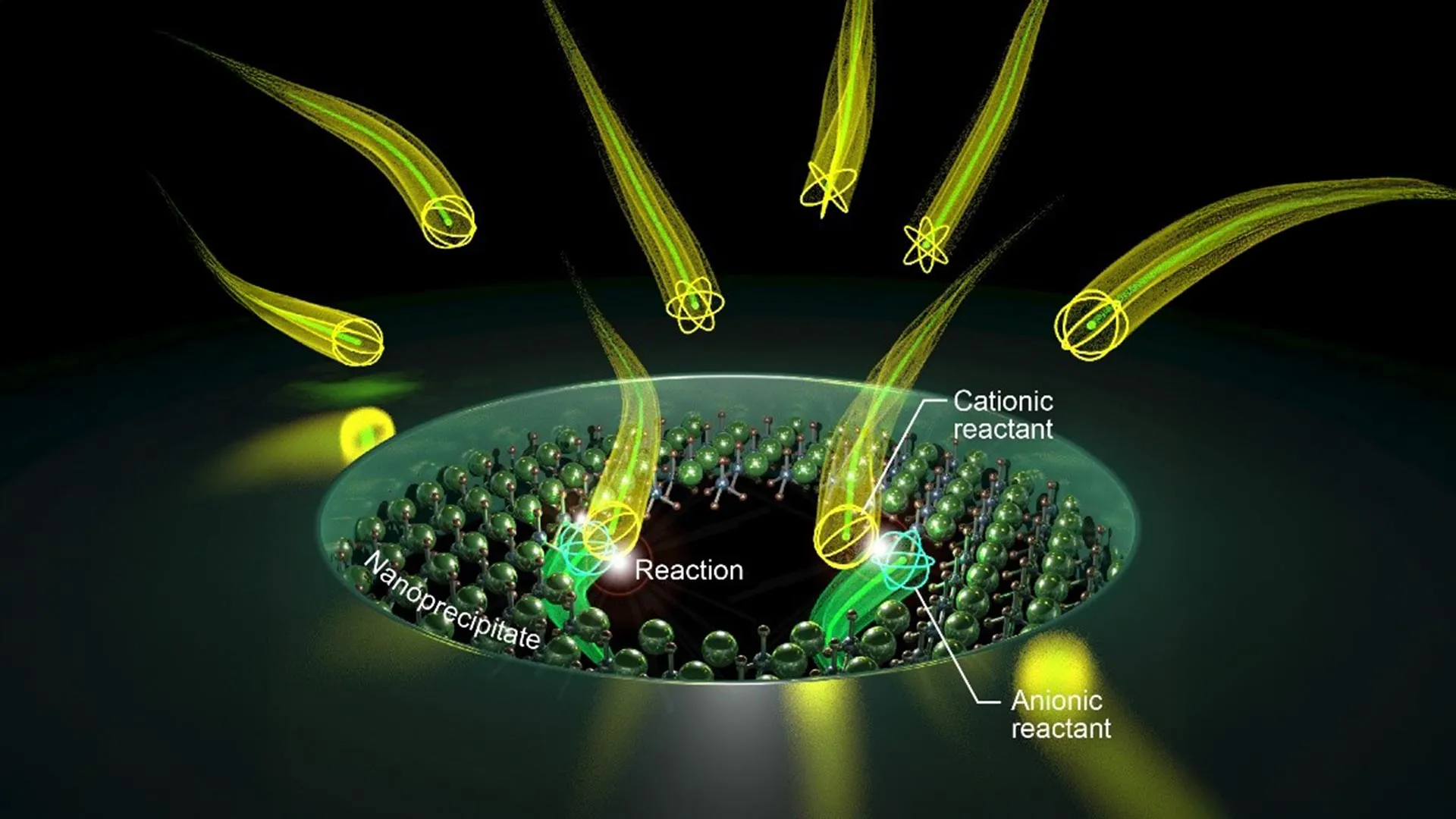
The research builds on the understanding that ion channels aren’t static structures; they dynamically open and close in response to external stimuli. This “breathing” action is key to their function. The team’s innovation lies in creating a solid-state analogue that mimics this behavior, using a miniature electrochemical reactor to form subnanometer pores within a silicon nitride membrane. This approach allows for the repeatable creation and manipulation of these incredibly minor openings, a feat previously difficult to achieve with consistent precision.
Mimicking Nature’s Electrical Gateways with a Chemical Reactor
The core of the breakthrough lies in the team’s use of a nanoscale pore as a reaction chamber. By applying a negative voltage across a silicon nitride membrane, they induced a chemical reaction that produced a precipitate – a solid that gradually blocked the pore. Reversing the voltage dissolved the precipitate, reopening conductive pathways. This process, repeated hundreds of times over several hours, demonstrated the robustness and controllability of the system, as explained by lead author Makusu Tsutsui. “We were able to repeat this opening and closing process hundreds of times over several hours,” Tsutsui stated, highlighting the stability of the reaction scheme. The University of Osaka detailed the process in a press release on February 18, 2026.
To understand what was happening within the membrane, the researchers carefully monitored the ion current flowing through it. They observed sharp spikes in the current, mirroring patterns seen in natural ion channels. Further analysis confirmed that these spikes were consistent with the formation of numerous subnanometer pores within the original nanopore. This observation is crucial, as it demonstrates the creation of multiple functional “gates” within a single structure, significantly increasing the potential for complex interactions and sensing capabilities.
The team too discovered they could fine-tune the behavior of these pores by adjusting the chemical composition and pH of the reactant solutions. According to senior author Tomoji Kawai, “We were able to vary the behavior and effective size of the ultrasmall pores by changing the composition and pH of the reactant solutions,” enabling selective transport of ions based on their size. EurekAlert! reported on this capability on February 19, 2026.
Potential Applications: From DNA Sequencing to Brain-Inspired Computing
The implications of this research are far-reaching. The ability to create and control pores at the atomic scale opens up exciting possibilities in several key areas. One promising application is in single-molecule sensing, particularly in DNA sequencing. Nanopores can be used to thread DNA strands through them, and by measuring changes in ion current as each base passes through, the genetic code can be read. The smaller and more precise these pores are, the more accurate and efficient the sequencing process becomes.
Another significant area of potential impact is neuromorphic computing. This emerging field aims to build computers that mimic the structure and function of the human brain. Biological neurons communicate through electrical signals generated by the flow of ions across cell membranes. By creating artificial “neurons” with nanoscale ion channels, researchers hope to develop computers that are more energy-efficient and capable of complex pattern recognition than traditional computers. The electrical spikes observed in the University of Osaka’s experiments are directly analogous to the signals used by biological neurons, making this technology a promising building block for brain-inspired computing systems.
Beyond these two primary applications, the technology could also be used to create nanoreactors – tiny chambers where chemical reactions can be precisely controlled. The confined space within the nanopores can alter reaction rates and pathways, potentially leading to the development of new materials and chemical processes. The ability to generate multiple ultrasmall pores within a single nanopore provides a unique platform for studying how ions and fluids behave in extremely confined spaces, offering insights into fundamental scientific questions.
The Future of Nanopore Technology
The University of Osaka’s research represents a significant advancement in nanopore technology. While challenges remain in scaling up production and integrating these nanoscale devices into larger systems, the potential benefits are substantial. The team’s chemically driven approach offers a promising pathway toward creating functional nanoscale devices that can mimic the complexity and efficiency of biological systems. ScienceDaily highlighted the breakthrough on February 19, 2026, noting its potential to transform sensing and brain-inspired tech.
Researchers are now focused on refining the process and exploring different materials and chemical compositions to optimize the performance of the nanopores. Further research will also be needed to develop methods for integrating these devices into practical applications, such as portable DNA sequencers and energy-efficient computer chips. The ongoing development of this technology promises to unlock new possibilities in a wide range of fields, from medicine and biotechnology to materials science and artificial intelligence.
The next step for the research team involves exploring the long-term stability and scalability of the nanopore fabrication process. They plan to present their findings at the International Nanotechnology Conference in Tokyo in November 2026. Readers interested in following the progress of this research are encouraged to check the University of Osaka’s website for updates.
What are your thoughts on the potential of this technology? Share your comments below, and don’t forget to share this article with your network!
Related reading