The Race to Succeed António Guterres
The campaign to select the next United Nations Secretary-General is underway. Diplomatic maneuvers are taking shape in New York ahead of the December 2026 transition.
This succession process arrives at a critical juncture for multilateral diplomacy. It is marked by ongoing conflicts in Ukraine, Gaza, and the Middle East, alongside persistent global economic pressures.
The second mandate of current Secretary-General António Guterres draws to a close on December 31, 2026. Member states are engaging in formal auditions and informal corridor negotiations. For the first time in the organization’s history, international discussions feature significant momentum toward potentially electing a female leader, with regional rotation expectations pointing toward Latin America and the Caribbean.
Veto Power and the Security Council Vise
The formal mechanism for appointing the UN chief is outlined in Article 97 of the 1945 UN Charter. It stipulates that the Secretary-General is appointed by the General Assembly upon the recommendation of the Security Council.
The General Assembly holds the ultimate nominal authority to vote on the selection. Yet the process is heavily influenced by the five permanent members of the Security Council—China, France, Russia, the United Kingdom, and the United States—each holding veto power.
Reforms initiated in 2015 have opened the nomination process. Public hearings are broadcast on UN Web TV, allowing candidates to present their visions and engage directly with member states and civil society.
Geographic Rotation and the Latin American Push
Diplomatic convention and informal geographic rotation strongly favor Latin America for the upcoming term. Past secretaries-general from the region include Javier Pérez de Cuéllar of Peru, who served from 1982 to 1991.
Global deliberations have also highlighted a broader geographic consideration. No national from Russia, China, or India has ever held the top post.
Traditional practice dictates that the Secretary-General should not originate from any of the five permanent member states to preserve institutional independence.
Frontrunners in Diplomatic Discussions
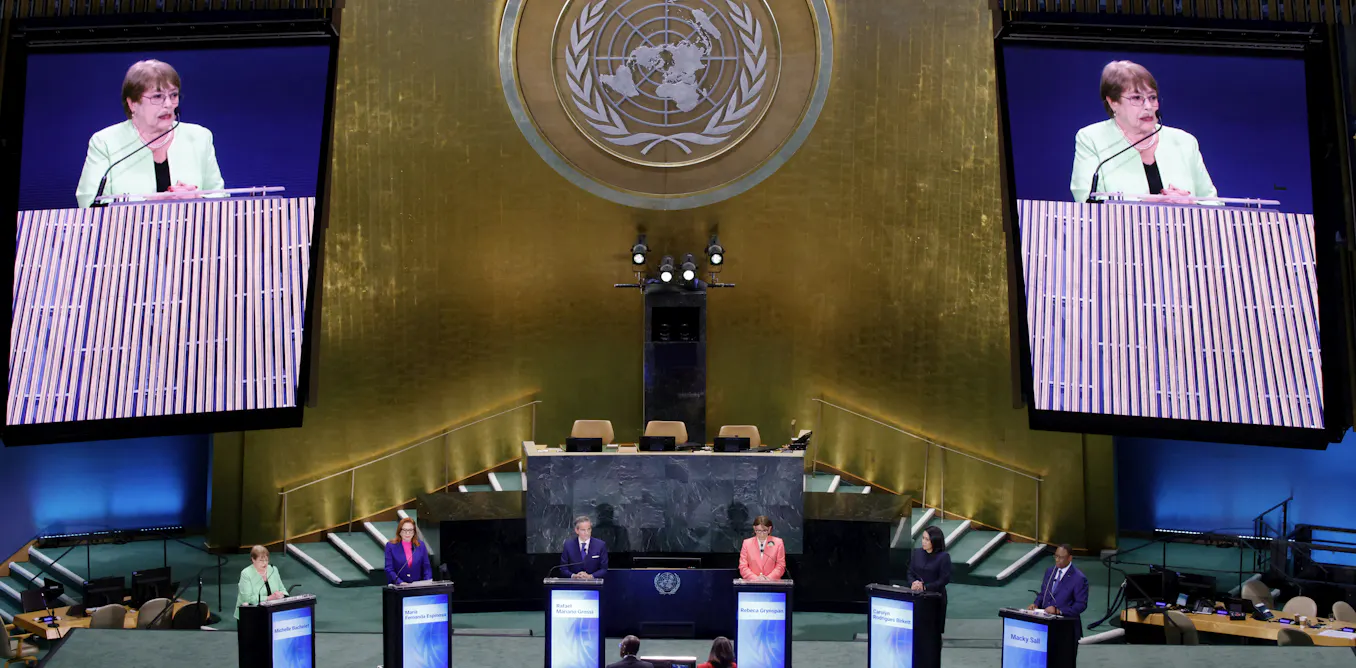
Several prominent figures have emerged in diplomatic discussions. Michelle Bachelet is the former president of Chile and former UN High Commissioner for Human Rights. She has drawn attention for her extensive executive background within the UN system, including her leadership of UN Women.
Other widely discussed candidates include:
Rebeca Grynspan, current Secretary-General of the United Nations Conference on Trade and Development (UNCTAD) and former vice president of Costa Rica.
Rafael Grossi, Argentine diplomat and Director General of the International Atomic Energy Agency (IAEA).
Macky Sall, former Senegalese President, who has emphasized representation for the Global South and African priorities within international governance.
Navigating Modern Geopolitical Friction
The evolving contest reflects broader fractures within the international order. Emerging economies and multilateral frameworks are navigating shifting global power dynamics.
Candidates have articulated distinct priorities during preliminary sessions. These range from administrative and budgetary reform to human rights preservation and economic development.
As informal consultations continue ahead of the formal selection votes, the ultimate choice will hinge on consensus among the Security Council’s permanent members regarding a leader equipped to navigate modern geopolitical friction.