
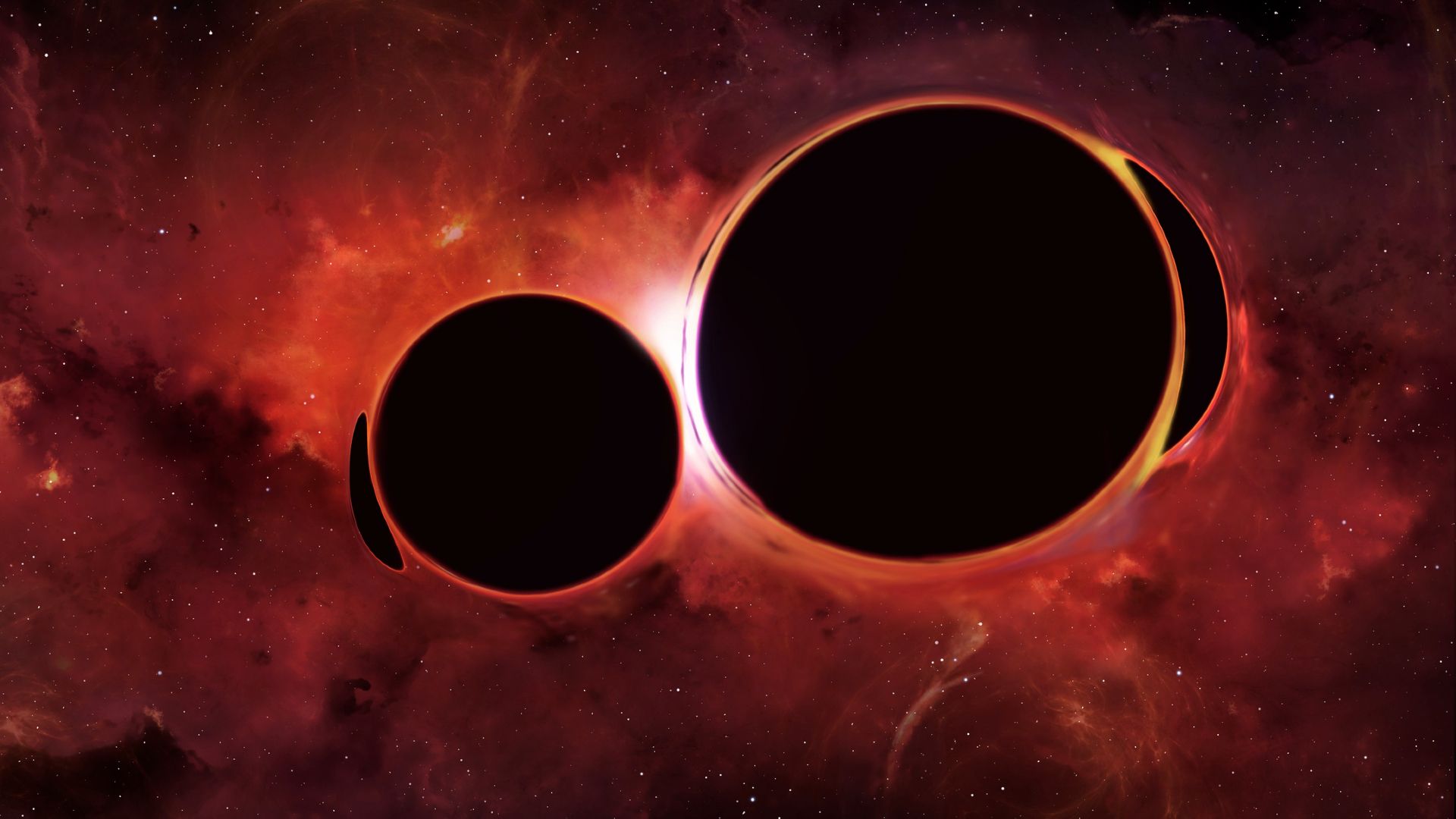
In a galaxy 500 million light-years from Earth, astronomers have identified two supermassive black holes spiraling toward a potential collision that could occur within the next century. The discovery, based on decades of radio telescope observations, suggests the merger would release powerful gravitational waves rippling across spacetime—effects that, while incredibly faint by the time they reach us, could theoretically be detected by sensitive instruments on Earth.
This finding, published in March 2024 in the journal Monthly Notices of the Royal Astronomical Society, centers on an object previously classified as a blazar—a highly luminous galactic core typically powered by a single supermassive black hole. However, anomalous energy jets observed in the system indicate the presence of two black holes in a tight orbital dance, challenging earlier assumptions about the nature of this extreme cosmic phenomenon.
The research team, led by Silke Britzen of the Max-Planck Institute for Radio Astronomy in Germany, analyzed long-term radio data revealing a hidden, precessing jet of energy. This jet’s behavior is inconsistent with a single black hole model but aligns with simulations of two supermassive black holes orbiting each other before merger. “We expect one (merged) black hole to remain,” Britzen told BBC Science Focus, adding that observing the final stages of this “dance” offers a rare opportunity to study black hole binary evolution in real time.
While the merger itself would unfold in a distant galaxy, its aftermath could contribute to the growing background of nanohertz gravitational waves permeating the universe. These low-frequency ripples, generated by countless supermassive black hole pairs across cosmic time, continuously stretch and squeeze spacetime—including our own Milky Way galaxy—though at scales far too slight to detect without specialized observatories.
How Gravitational Wave Observatories Detect Distant Mergers
Ground-based detectors like LIGO and Virgo are designed to catch high-frequency gravitational waves from stellar-mass black hole collisions, which produce sharp, short-lived signals. In contrast, the merger of supermassive black holes—each millions or billions of times more massive than our sun—emits waves at much lower frequencies, nanohertz range, requiring vastly larger detectors to observe.
To capture these gradual undulations, scientists are turning to pulsar timing arrays, which use the Milky Way itself as a gravitational wave detector. By monitoring the ultra-precise radio pulses from dozens of millisecond pulsars scattered across our galaxy, researchers can identify tiny deviations in arrival times caused by passing gravitational waves warping the fabric of spacetime.
In 2023, international collaborations including the North American Nanohertz Observatory for Gravitational Waves (NANOGrav), the European Pulsar Timing Array (EPTA), and the Parkes Pulsar Timing Array in Australia reported the first compelling evidence of a gravitational wave background consistent with populations of supermassive black hole binaries. This discovery, announced through multiple peer-reviewed papers in The Astrophysical Journal Letters, marked a milestone in low-frequency gravitational wave astronomy.
The potential merger in the blazar-like system, located in a galaxy approximately 500 million light-years away, could add to this background signal. Though the event is too distant and too slow-moving to produce a detectable burst with current technology, its contribution to the stochastic hum of spacetime may become identifiable as observation techniques improve.
What In other words for Our Understanding of Galaxy Evolution
Supermassive black holes reside at the hearts of most large galaxies, and their growth is closely tied to the evolution of their host systems. When galaxies collide, their central black holes can sink toward the merged core and begin orbiting each other, eventually merging in a process that releases immense energy—though gravitational waves carry away only a fraction as detectable ripples.
Studying candidate binary systems like this one helps astronomers refine models of how galaxies grow over billions of years. If confirmed, a merger within 100 years would provide an unprecedented observational window into the final stages of black hole coalescence, a phase rarely seen due to the immense timescales typically involved in such dynamical processes.
“I am really curious to observe how this ‘dance’ will continue,” Britzen said, emphasizing the value of long-term monitoring. Continued radio and multi-wavelength observations over the coming decades could track changes in the system’s jet structure, orbital period, and emission patterns—offering direct insights into the physics of extreme gravity and relativistic dynamics.
Challenges in Confirming a Supermassive Black Hole Binary
Despite the compelling evidence, definitive proof of a supermassive black hole binary remains challenging. Alternative explanations, such as jet precession caused by a single spinning black hole or complex accretion disk dynamics, must be ruled out through sustained observation and modeling.

Future observations using very long baseline interferometry (VLBI), which links radio telescopes across continents to achieve extraordinary resolution, may assist resolve the two black holes spatially if they are close enough. Monitoring for periodic variations in brightness or jet orientation could provide further circumstantial support for a binary model.
As of now, no confirmed electromagnetic counterpart to a supermassive black hole merger has been observed, largely because such events unfold over timescales far exceeding human observational history. Gravitational wave detection remains the most direct method, though current space-based concepts like LISA (the Laser Interferometer Space Antenna), scheduled for launch in the mid-2030s, will target millihertz waves—still too high-frequency to capture the nanohertz signals from the most massive binaries.
For now, the system stands as a intriguing candidate, inviting continued scrutiny from the global astronomical community. Whether or not a merger occurs within the next 100 years, its study advances our grasp of how the universe’s most powerful engines shape cosmic structure over time.
As researchers refine their techniques and expand pulsar timing arrays with next-generation radio telescopes, the ability to detect and interpret the faint gravitational hum of distant black hole mergers will only improve. For readers interested in following developments, updates from the NANOGrav collaboration and the Max-Planck Institute for Radio Astronomy offer reliable sources of peer-reviewed findings and technical progress in this rapidly evolving field.
If you found this exploration of cosmic phenomena informative, consider sharing it with others curious about the universe’s hidden rhythms. Join the conversation below—what aspect of black hole physics or gravitational wave astronomy fascinates you most?