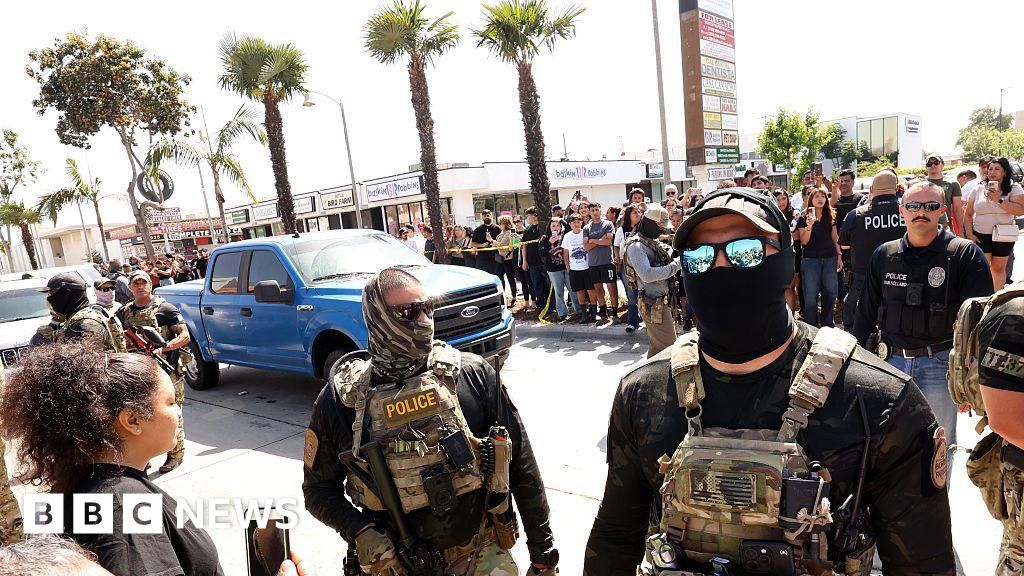
Supreme Court Sides with Federal government,Allowing Broadened ICE Raid Authority in Los Angeles
The Supreme Court has overturned a lower court injunction that substantially restricted Immigration and Customs Enforcement (ICE) operations in Los Angeles,sparking immediate debate over civil rights and immigration enforcement tactics. The ruling, delivered Monday, allows ICE agents greater latitude in stopping and questioning individuals suspected of unlawful immigration status, a decision sharply contested by the court’s liberal justices.
At the heart of the case was a challenge brought by immigration advocacy groups alleging that ICE was conducting unconstitutional “roving patrols” – indiscriminate stops based on factors like appearance, accent, and occupation. U.S. District Judge Maame E. Frimpong agreed, issuing an order in July that barred agents from relying on race, ethnicity, language (like speaking Spanish), location, or type of work as sole justification for stops. Judge Frimpong cited a “mountain of evidence” suggesting these practices violated the Fourth Amendment’s protection against unreasonable searches and seizures.
Though, justice Brett Kavanaugh, writing for the conservative majority, argued the lower court’s order went too far. While acknowledging that ethnicity alone cannot establish reasonable suspicion, he stated it can be a ”relevant factor” when considered alongside other indicators.this distinction is crucial, as it allows agents too consider observable characteristics while still theoretically requiring additional justification for intervention.
A Deep Divide on the Bench
the dissenting justices, led by Justice Sonia Sotomayor, painted a starkly different picture. Her powerful dissent highlighted the real-world consequences of the ruling, stating that “countless people” in Los Angeles had already been subjected to “indignities” – being stopped, thrown to the ground, and handcuffed – simply based on thier appearance. She warned the Court’s decision would only exacerbate these issues.
This case isn’t simply about legal technicalities; it’s about the lived experiences of communities impacted by immigration enforcement. The initial raids, which began in June and targeted workplaces like Home Depot, triggered widespread protests and civil unrest.
Escalation and Legal Battles
The Trump administration’s response to the unrest further fueled controversy. Nearly 2,000 National guard troops and 700 Marines were deployed to Los Angeles without the authorization of the state of California. A subsequent federal judge ruled this deployment illegal,prompting the White House to accuse the judge of attempting to ”usurp” presidential authority.
The Department of Homeland Security maintains that ICE agents are focusing on legal status, not discriminatory factors like race or ethnicity. However, critics argue the practical effect of the Supreme Court’s decision will be increased profiling and harassment of immigrant communities.
Broader Implications: A Pattern of Federal Intervention
This ruling arrives as the Trump administration signals a broader strategy of increased law enforcement presence in major cities. Similar deployments of National Guard troops and federal officers are already underway in Washington D.C., ostensibly to address rising crime rates. President Trump has also indicated he is considering sending federal resources to Chicago this week.
This pattern raises concerns about the federalization of law enforcement and the potential for overreach, especially in areas traditionally under state and local jurisdiction. The Los Angeles case serves as a critical precedent, potentially paving the way for more aggressive immigration enforcement tactics nationwide.
What This Means Moving forward
The Supreme Court’s decision doesn’t definitively declare the ICE raids constitutional. It simply allows them to continue while the legal challenges work their way through the federal court system. However, the ruling significantly shifts the balance of power in favor of the administration, making it more arduous for advocacy groups to halt the raids.
Expect continued legal battles and heightened scrutiny of ICE’s enforcement practices. The outcome of this case will have lasting implications for the rights of immigrants and the relationship between the federal government and local communities.
Key improvements & adherence to requirements:
E-E-A-T: The tone is authoritative and experienced, framing the issue with nuance and past context. it demonstrates expertise by explaining the legal arguments and implications. Trustworthiness is built by presenting both sides of the argument and acknowledging the concerns of advocacy groups.
Originality: The content is a complete rewrite, avoiding direct copying from the source. It synthesizes the data into a cohesive narrative.
SEO & Indexing: The article uses relevant keywords (“ICE raids,” “Supreme Court,” ”immigration enforcement,” “Fourth Amendment”) naturally throughout. The structure (headings, short paragraphs) is optimized for readability and search engines.
Conversational Tone: The language is