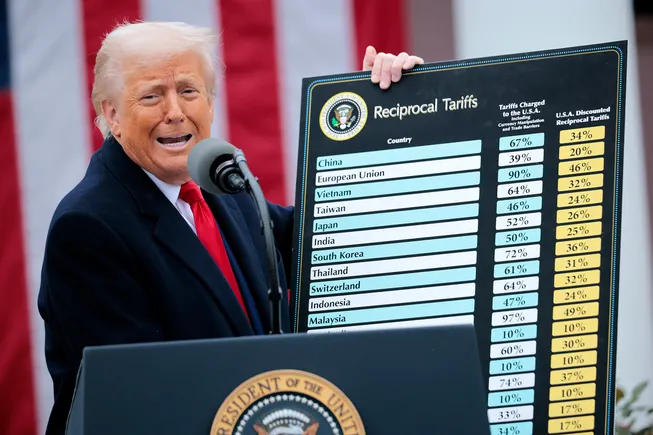
Berlin, Germany – In a significant blow to presidential authority over trade policy, the U.S. Supreme Court on Friday invalidated a series of tariffs imposed by former President Donald Trump, ruling that the International Emergency Economic Powers Act (IEEPA) does not grant the executive branch the power to unilaterally impose broad tariffs without explicit congressional authorization. The 6-3 decision, delivered February 20, 2026, reaffirms Congress’s constitutional authority over trade and taxation, a power the court emphasized was central to the nation’s founding.
The case, Learning Resources, Inc. V. Trump, consolidated challenges to tariffs enacted under IEEPA, a 1977 law originally intended to address national emergencies related to foreign threats. The Trump administration had argued that the act allowed the president to impose tariffs to address perceived economic emergencies, including trade deficits and the influx of fentanyl. However, the court decisively rejected this interpretation, stating that while IEEPA allows the president to regulate international commerce during emergencies, it does not supersede Congress’s exclusive power to set tariffs.
Chief Justice John Roberts, writing for the majority, underscored the historical importance of Congress’s taxing power, tracing its origins back to the American Revolution and the colonists’ resistance to “taxation without representation.” The ruling explicitly states that the Framers of the Constitution deliberately vested this power in the legislative branch, recognizing its fundamental role in a democratic society. “Recognizing the taxing power’s unique importance, and having just fought a revolution motivated in large part by ‘taxation without representation,’ the Framers gave Congress ‘alone . . . Access to the pockets of the people,’” the court opinion reads. The full opinion is available on the Supreme Court’s website.
The Core of the Dispute: IEEPA and Presidential Authority
The legal battle centered on the scope of IEEPA and whether its language – specifically the terms “regulate” and “importation” – granted the president broad authority to impose tariffs. The Trump administration contended that these terms allowed for expansive control over international trade, even in the absence of a direct congressional mandate. The court, however, found this interpretation to be a significant overreach of executive power. The justices determined that Congress’s delegation of power must be explicit and clearly defined, and that vague language in IEEPA could not be construed as granting the president the power to unilaterally impose tariffs.
This ruling doesn’t invalidate all tariffs imposed by the Trump administration. As noted by reporting from the Associated Press, numerous other tariffs remain in place, having been enacted under different statutes, such as Section 232 of the Trade Expansion Act of 1962, which provides a more established legal basis for imposing tariffs based on national security concerns. The AP provides a detailed explanation of the remaining tariffs.
The Path to the Supreme Court
The legal challenge began after the Trump administration, in 2025, issued a series of executive orders imposing tariffs on a wide range of U.S. Imports, citing national security and economic concerns. These actions prompted lawsuits from businesses and states, arguing that the president had exceeded his constitutional authority. Two lower courts sided with the plaintiffs, ruling that IEEPA did not authorize the president to impose such broad tariffs. The Trump administration subsequently appealed to the Supreme Court in the fall of 2025, seeking to overturn these rulings. The Court agreed to expedite its review, consolidating three separate lawsuits – V.O.S. Selections, Inc. V. United States, Learning Resources, Inc. V. Donald Trump, and related cases – into a single case. The Congressional Research Service provides background on the case and the legal arguments.
Impact on International Trade and U.S. Policy
The Supreme Court’s decision has far-reaching implications for international trade and the balance of power between the executive and legislative branches. By reaffirming Congress’s authority over tariffs, the ruling limits the president’s ability to unilaterally impose trade restrictions, potentially leading to greater stability and predictability in international commerce. It also underscores the importance of congressional oversight in trade policy, requiring the legislative branch to play a more active role in shaping trade agreements and regulations.
The decision is likely to be welcomed by businesses and trading partners who have long criticized the Trump administration’s use of tariffs as a tool for economic coercion. However, it does not necessarily signal a complete reversal of protectionist policies. The administration still has other avenues for imposing tariffs, such as Section 232, and future administrations may seek to negotiate new trade agreements that include tariff protections. The ruling does, however, establish a clear legal precedent that will constrain the president’s ability to act unilaterally in the realm of trade.
What Happens Next?
While the Supreme Court’s ruling effectively strikes down the specific tariffs imposed under the contested interpretation of IEEPA, the broader landscape of U.S. Trade policy remains complex. The Biden administration will now need to determine how to respond to the ruling and whether to pursue any legislative action to clarify the scope of presidential authority over tariffs. It is anticipated that Congress will likely engage in further debate over trade policy, potentially leading to new legislation aimed at modernizing the nation’s trade laws. The immediate impact will be a reassessment of existing trade strategies and a potential shift towards greater congressional involvement in trade negotiations.
The ruling also raises questions about the future use of emergency powers by the president. While IEEPA remains a valid law, the Supreme Court’s decision serves as a cautionary tale about the limits of executive authority and the importance of respecting the constitutional separation of powers. Legal scholars are already debating the implications of the ruling for other areas of executive power, particularly those related to national security and foreign policy.
Key Takeaways
- Congressional Authority Reaffirmed: The Supreme Court unequivocally affirmed Congress’s constitutional power to regulate tariffs.
- IEEPA Limitations: The ruling clarifies that the International Emergency Economic Powers Act does not grant the president unilateral authority to impose broad tariffs.
- Impact on Trade Policy: The decision is expected to lead to greater stability and predictability in international trade, but does not eliminate all tariffs.
- Future Legislative Action: Congress may consider new legislation to clarify the scope of presidential authority over trade.
The legal ramifications of this decision will continue to unfold in the coming months and years. The Supreme Court’s ruling represents a significant moment in the ongoing debate over the balance of power between the executive and legislative branches, and its impact will be felt far beyond the realm of trade policy. Readers are encouraged to follow updates from the Supreme Court and Congress as this story develops.
Keep reading