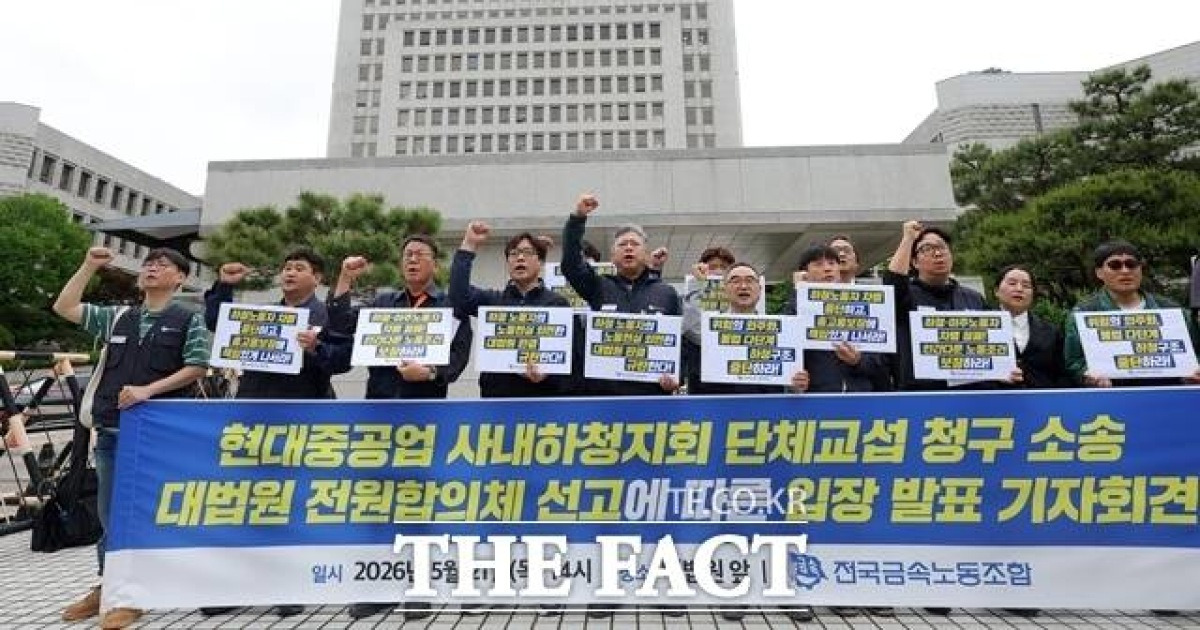
In a decision that provides a moment of relative stability for South Korea’s heavy industrial sector, the Supreme Court has ruled against a claim that a principal contractor must engage in collective bargaining with the subcontracted employees of its partners. The ruling, which centers on a high-profile dispute involving HD Hyundai Heavy Industries, reinforces the traditional legal boundaries between primary employers and subcontractors, upholding existing precedents that have long defined the nation’s industrial relations.
The court’s decision to deny the responsibility of the principal contractor to bargain with subcontracted workers marks a significant moment in the ongoing tension between labor movements seeking to modernize worker protections and industrial giants aiming to maintain clear operational and legal distinctions. For much of the global manufacturing and shipbuilding sectors, this ruling serves as a definitive, if temporary, validation of the status quo under current South Korean labor statutes.
However, while the immediate legal outcome may favor management, the decision arrives amidst a fierce legislative battle over the proposed “Yellow Envelope Law”—formally known as the amendments to the Trade Union and Labor Relations Adjustment Act. This controversial legislation seeks to fundamentally redefine the concept of an “employer” to include any entity that exercises “substantial influence” over working conditions, a move that proponents argue is necessary to protect a growing class of subcontracted workers, but which critics warn could paralyze industrial productivity.
The Core of the Dispute: HD Hyundai and the Subcontracting Model
The legal battle originated when subcontracted workers at HD Hyundai Heavy Industries sought to compel the parent company to participate in collective bargaining sessions. The workers argued that because the principal contractor exerts significant control over the working environment, safety protocols, and scheduling of the subcontracted workforce, it should be recognized as their functional employer under the spirit of modern labor relations.
/supreme-court-west-entrance-564091971-crop-595477603df78cdc29d6e89e.jpg "Supreme Court")
In its ruling, the Supreme Court maintained the strict interpretation of the existing Trade Union Act. The court held that the legal obligation to bargain is tied to the direct contractual relationship between the employer and the employee. By refusing to extend this responsibility to the principal contractor, the court effectively upheld the principle that the subcontractor remains the sole legal employer responsible for the labor relations of its staff, regardless of the degree of oversight provided by the parent company.
This decision aligns with long-standing judicial precedents in South Korea, which have historically required a direct, formal employment contract to trigger the mandatory bargaining obligations of the Trade Union Act. For companies like HD Hyundai Heavy Industries, which operate within a complex web of specialized subcontractors, the ruling provides a degree of predictability in managing large-scale industrial operations.
The ‘Yellow Envelope Law’: A Legislative Flashpoint
The HD Hyundai ruling is being viewed through the lens of the Yellow Envelope Law, a piece of legislation that has become one of the most polarizing issues in South Korean politics. The law’s name is derived from a 2009 incident involving the SsangYong Motor strike, where citizens donated money in “yellow envelopes” to help workers pay massive damage claims filed by the company.
The proposed amendments aim to address two critical areas of labor law:
- Expansion of the ‘Employer’ Definition: The bill seeks to codify the “substantial influence” test, meaning that any company that effectively controls the working conditions of subcontracted workers would be legally required to bargain with their unions.
- Limitation of Damage Claims: The law aims to restrict the ability of corporations to file massive civil lawsuits against labor unions and individual workers for damages incurred during strikes, particularly in cases where the strike is related to the scope of “legitimate” labor disputes.
The legislative path for the Yellow Envelope Law has been fraught with difficulty. While it has seen support from opposition-led legislatures, it has faced repeated vetoes from the executive branch, reflecting a deep divide in how the nation should balance labor rights against the need for industrial stability. The Supreme Court’s decision to stick to the current, narrower definition of “employer” arguably provides a legal buffer that exists independently of whether the law is eventually passed or vetoed.
Industry Reaction: Calm Amidst Legislative Uncertainty
Interestingly, the reaction from the South Korean business community following the Supreme Court’s decision has been described as remarkably measured. Rather than reacting with celebration, many industry observers have noted a sense of “calmness” or even indifference within the corporate sector.
A primary reason for this tempered reaction is the prevailing sentiment that the core challenges addressed by the Yellow Envelope Law are already being navigated through existing judicial and practical frameworks. Some industry representatives have suggested that the “impact” of the proposed law is already being felt or managed, as courts and labor boards are increasingly asked to grapple with the nuances of “substantial control” in various contexts.
From a management perspective, the ruling confirms that the current legal threshold for bargaining remains high. However, the industry remains wary of the “creeping” expansion of labor obligations. Even without the Yellow Envelope Law, the increasing complexity of the “dual labor market”—where a large segment of the workforce is employed through precarious subcontracting arrangements—means that the legal and social pressure on principal contractors will only continue to mount.
The Economic Stakes for South Korea’s Industrial Giants
The implications of this legal tug-of-war extend far beyond the walls of HD Hyundai’s shipyards. The subcontracting model is the backbone of South Korea’s most vital export industries, including shipbuilding, automotive manufacturing, and electronics. These sectors rely on a highly efficient, multi-tiered supply chain that allows for specialized production and cost management.
If the legal definition of “employer” were to expand significantly, the economic ramifications could be profound:
- Operational Complexity: Principal contractors would face the administrative and legal burden of negotiating with multiple unions representing different tiers of their supply chain.
- Cost Volatility: Increased bargaining obligations could lead to higher labor costs and more frequent industrial actions, potentially affecting the global competitiveness of South Korean exports.
- Supply Chain Restructuring: Companies might seek to further distance themselves from subcontractors or move production to jurisdictions with more traditional labor frameworks to mitigate legal risks.
Conversely, labor advocates argue that the current model creates a “race to the bottom” in terms of wages and safety. They contend that by shielding principal contractors from responsibility, the law allows for a fragmentation of labor rights that leaves a significant portion of the industrial workforce vulnerable to exploitation and without a direct voice in their working conditions.
Analyzing the ‘Substantial Control’ Doctrine
To understand why this ruling is so significant, one must look at the evolving concept of “substantial control” in labor law. In recent years, there has been a global trend—not unique to South Korea—toward recognizing that in modern, fragmented production models, the entity that holds the ultimate economic power often dictates the daily reality of the worker, even if they are not the direct employer on paper.
The Supreme Court’s refusal to adopt this doctrine in the HD Hyundai case represents a conservative judicial stance that prioritizes contractual certainty over functional reality. By adhering to the formal contract, the court provides a clear, albeit narrow, rulebook for businesses. However, this creates a growing gap between the legal framework and the socio-economic reality of the 21st-century workplace.
As global supply chains become more complex, the tension between “who signs the paycheck” and “who controls the work” is likely to become the defining legal conflict of the next decade. The HD Hyundai ruling may have settled this specific dispute, but it has not resolved the underlying question of how to regulate labor in an era of deep subcontracting.
Key Takeaways
- Ruling Summary: The South Korean Supreme Court ruled that HD Hyundai Heavy Industries is not legally required to bargain with subcontracted workers under current law.
- Legal Precedent: The decision upholds the traditional “contractual employer” definition, maintaining a high bar for collective bargaining obligations.
- Legislative Context: The ruling occurs amidst the ongoing political battle over the “Yellow Envelope Law,” which seeks to expand the definition of an employer.
- Industry Impact: While providing short-term legal clarity, the decision does not eliminate the long-term pressure to address the rights of subcontracted workers.
The next major checkpoint for this issue will be the upcoming legislative sessions in the National Assembly, where the fate of the Trade Union and Labor Relations Adjustment Act amendments will be debated. Whether the legislature can find a middle ground between industrial stability and modern labor protections remains to be seen.
What are your thoughts on the balance between principal contractor responsibility and industrial efficiency? Share your views in the comments below and share this article with your network.
- When Will the World Run Out of Oil? Why Geologists’ Predictions Were Wrong
- New 5-Year Regional Investment Plan Aims for Lifestyle Services and Settlement Support with 88.1 Billion Won
- Supreme Court Rulings on Student Protests and Police Accountability (world-today-news.com)
- Amazon Prime Video Phishing Emails Target Users With Real IBANs (archyworldys.com)