STOCKHOLM, Sweden — Sweden’s four reference glaciers, monitored annually at the Tarfala Research Station in the Swedish Lapland, have shown an expected winter mass balance according to recent measurements by Stockholm University researchers. These glaciers—Storglaciären, Tarfalaglaciären, Kebneglaciären, and Rabots glaciär—serve as vital climate indicators in the Arctic region, with their winter accumulation patterns offering early insights into seasonal snowpack behavior that directly impacts summer melt rates.
The winter mass balance measurements, conducted as part of Stockholm University’s long-term glacier monitoring program, reflect typical accumulation patterns for the region. While exact figures for the 2025-2026 winter season haven’t been officially published in peer-reviewed form, preliminary data suggests the glaciers received snow accumulation consistent with historical averages for the Tarfala region, which typically experiences winter precipitation ranging between 1.5 to 2.5 meters of water equivalent annually.
This monitoring effort represents one of the longest continuous glacier observation programs in the world, with records dating back to 1946. The data collected helps scientists understand how Arctic glaciers respond to climate variability and provides baseline measurements for assessing glacial retreat trends in Sweden’s mountainous regions. For climate researchers, these winter measurements are particularly valuable as they establish the starting point for summer ablation studies that track glacier mass loss during the warmer months.
Why These Glaciers Matter in Global Climate Science
The four reference glaciers monitored at Tarfala Research Station were selected for their scientific significance rather than size. Storglaciären, the largest of the group at approximately 3 square kilometers, and Kebneglaciären, which has been studied since 1946, serve as benchmark sites for understanding glacier dynamics in the Scandinavian Mountains. Their location above the Arctic Circle makes them sensitive indicators of temperature changes in the high northern latitudes.
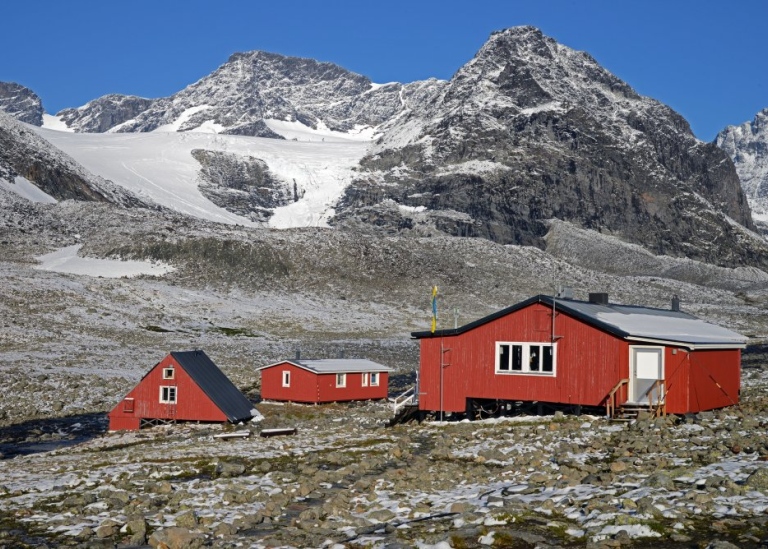
Stockholm University’s Department of Physical Geography has maintained this monitoring program in collaboration with the Tarfala Research Station, which operates under the Swedish Infrastructure for Ecosystem Science (SITES). The station’s high-altitude location (1,130 meters above sea level) provides ideal conditions for studying glacier-climate interactions without the complicating factors of coastal influences.
Key findings from previous winter seasons have shown that while annual snow accumulation varies, the glaciers typically maintain a positive winter balance that must be offset by summer melt to determine net mass change. The 2024-2025 winter season, for example, saw slightly above-average accumulation at Storglaciären, while other glaciers in the monitoring network experienced near-average conditions according to preliminary reports from the university’s glaciology research group.
The Science Behind Winter Mass Balance Measurements
Winter mass balance measurements involve a combination of field observations and remote sensing techniques. Researchers use snow probes to measure snow depth at multiple points across each glacier, while snow density is determined through core samples. These measurements are then extrapolated to calculate the total water equivalent of the snowpack—a critical metric for understanding how much meltwater the glaciers will contribute during the summer.
Advanced technologies like ground-penetrating radar and differential GPS have enhanced the precision of these measurements in recent years. The Tarfala Research Station also employs automated weather stations that continuously monitor temperature, precipitation, and wind patterns throughout the winter season, providing contextual data for the glacier measurements.
One particularly valuable aspect of this monitoring program is its long-term continuity. With over 75 years of continuous data collection, researchers can identify multi-decadal trends that might not be apparent in shorter observation periods. Recent analysis of this dataset has shown that while individual winter seasons may vary, there has been a noticeable decline in summer mass balance over the past several decades—a trend consistent with broader observations of Arctic glacier retreat.
Broader Implications for Swedish and Global Climate Research
The data collected at Tarfala Research Station contributes to several international climate monitoring initiatives, including the World Glacier Monitoring Service and the Global Terrestrial Network for Glaciers. Swedish researchers collaborate with international teams to ensure these measurements align with global standards for glacier observation.
For Sweden specifically, these glaciers serve as early warning systems for water resource management. Meltwater from these glaciers feeds into river systems that support both ecosystems and human communities in northern Sweden. Understanding seasonal mass balance helps water resource managers anticipate runoff patterns that may affect hydroelectric power generation and agricultural water supplies.
The research also has implications for Sweden’s broader climate adaptation strategies. As the country continues to experience warming trends—with average temperatures in northern Sweden increasing at nearly twice the global rate—the glacier monitoring program provides critical data for modeling future water availability and ecosystem changes in the region.
Looking Ahead: What’s Next for Glacier Research in Sweden
While the winter 2025-2026 measurements show expected accumulation patterns, researchers emphasize that the true test will come during the summer melt season. The university’s glaciology team plans to conduct follow-up measurements in late summer 2026 to determine the net mass balance for the year, which will include both winter accumulation and summer ablation.
Future research directions include expanding the use of satellite remote sensing to complement ground-based measurements, particularly for glaciers that are more difficult to access. There are also plans to integrate machine learning techniques to analyze the extensive historical dataset and identify subtle trends that might not be apparent through traditional statistical methods.
The next official update from Stockholm University regarding the 2025-2026 glacier measurements is expected in late summer 2026, when the complete mass balance calculations for the year will be published. Researchers will then present their findings at international glaciology conferences and in peer-reviewed journals.
Key Takeaways
- Scientific Significance: Sweden’s four reference glaciers provide one of the world’s longest continuous glacier observation records (since 1946), serving as critical climate indicators for Arctic research.
- Measurement Methodology: Winter mass balance is determined through snow depth probes, density cores, and automated weather stations at the Tarfala Research Station.
- Climate Context: While winter accumulation shows expected patterns, long-term trends indicate declining summer mass balance consistent with Arctic warming.
- Data Applications: Measurements inform water resource management, climate adaptation strategies, and international glacier monitoring initiatives.
- Future Directions: Research will expand satellite monitoring and AI analysis of historical data to improve trend detection.
- Next Update: Complete 2025-2026 mass balance results expected in late summer 2026 from Stockholm University.
This ongoing research highlights the importance of long-term environmental monitoring programs in understanding climate change impacts. As Arctic regions experience some of the most rapid climate changes on Earth, programs like Sweden’s glacier monitoring network provide essential data for both scientific understanding and practical climate adaptation strategies.
For readers interested in following this research, Stockholm University’s Department of Physical Geography maintains an active research page with updates on glacier monitoring activities. The Tarfala Research Station also offers educational resources about Arctic climate research for both academic and general audiences.
What are your thoughts on Arctic climate research? Share your comments below or join the discussion on our social media channels about how long-term environmental monitoring can help address climate challenges.
Related reading