
Corporate America faces a mounting financial burden as technical debt—the cumulative cost of deferred software maintenance, outdated infrastructure, and inefficient IT processes—drains trillions of dollars from the economy. Industry analysis suggests that US enterprises currently lose approximately $2.41 trillion annually due to these operational inefficiencies, with the cost to remediate these systems estimated at $1.52 trillion. Jay Roland, founder of Varex Solutions, characterizes this widespread reliance on aging or misconfigured technology as a crisis of complacency, arguing that organizations often prioritize short-term feature development over long-term system stability.
Technical debt is not merely a line item in an IT budget; it represents the interest paid on every shortcut taken during software development and infrastructure deployment. When companies defer essential updates or rely on “quick-fix” patches to maintain legacy systems, they incur mounting costs in both labor and lost productivity. According to the McKinsey & Company analysis on technology modernization, technical debt can consume up to 20% of the total budget for new product development, directly impacting a firm’s ability to innovate and respond to market shifts.
Understanding the Economic Impact of Technical Debt
The scale of the technical debt crisis is often obscured by its complexity. Unlike physical infrastructure, where degradation is visible, digital decay occurs within codebases and server configurations. The Gartner 2024 IT spending forecast highlights that while global IT spending continues to rise, a significant portion of that capital is directed toward maintaining existing systems rather than pursuing digital transformation. This pattern creates a cycle where businesses spend more to keep older, inefficient systems running, leaving less capital for strategic growth.
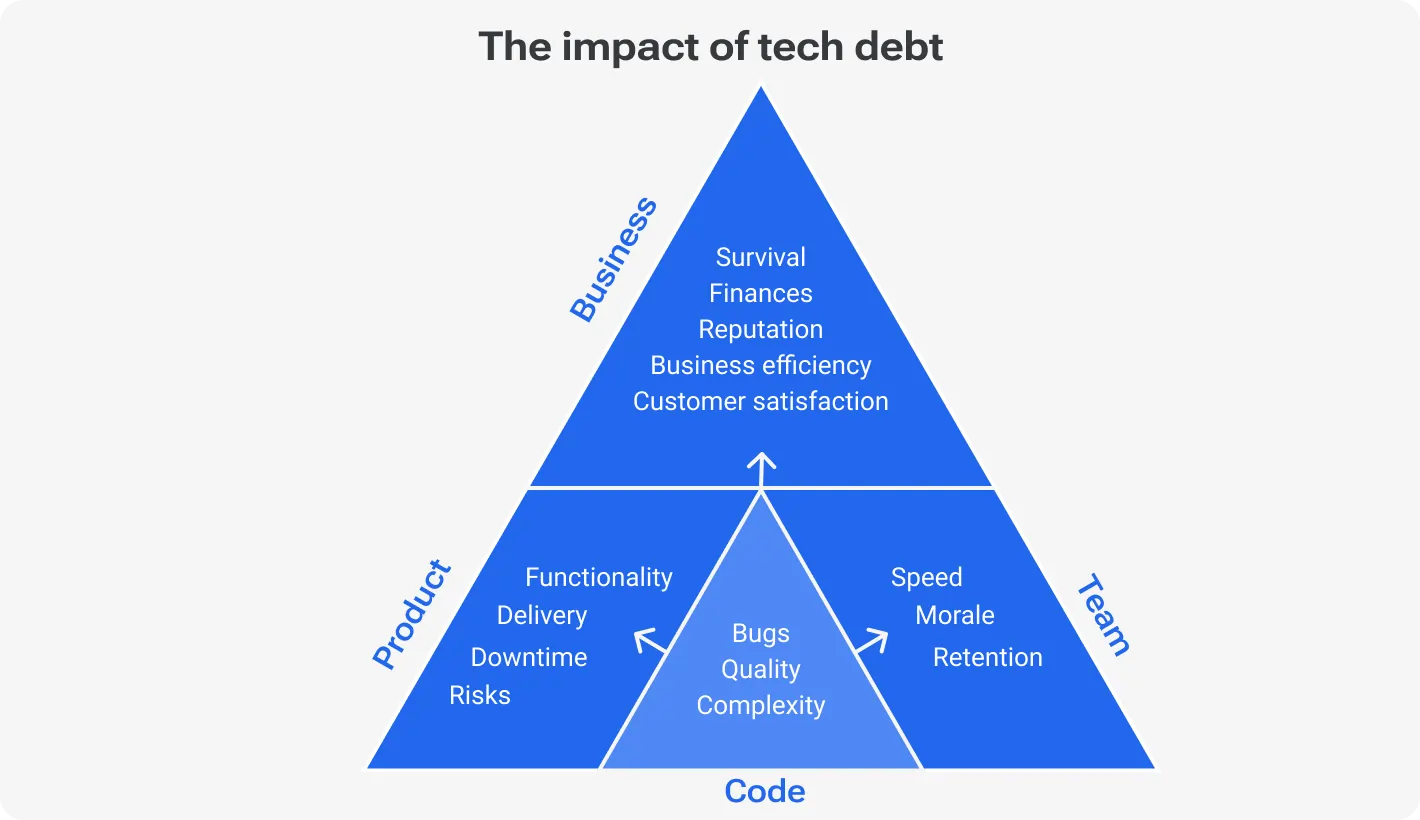
Roland’s assessment points to a cultural misalignment within corporate leadership. By treating IT as a cost center rather than a strategic asset, executives often incentivize developers to deliver features rapidly, ignoring the long-term maintenance implications. This approach creates a “debt” that eventually requires expensive “interest payments” in the form of system downtime, security vulnerabilities, and the eventual need for complete, costly platform migrations.
The Hidden Costs of Operational Inefficiency
Beyond the direct financial figures, technical debt introduces significant operational risks. Security researchers at the Cybersecurity and Infrastructure Security Agency (CISA) have repeatedly noted that many high-profile security breaches originate from unpatched, legacy systems that enterprises failed to secure due to the complexity of their internal environments. When a company cannot afford the time or resources to update its core software, it remains exposed to known vulnerabilities.

The cost of these inefficiencies extends to the workforce as well. Developers tasked with maintaining “spaghetti code”—software that is poorly structured and difficult to modify—report lower productivity and higher burnout rates. This turnover creates an additional, often unquantified cost, as institutional knowledge is lost and firms must spend resources recruiting and training new talent to manage increasingly fragile systems.
Strategic Shifts in Managing IT Infrastructure
Addressing the technical debt crisis requires a fundamental shift in how organizations measure success. Roland and other industry observers argue that IT health should be treated as a key performance indicator (KPI). This involves dedicating a fixed percentage of every development cycle to refactoring—the process of restructuring existing computer code without changing its external behavior—to ensure that systems remain sustainable.
The National Institute of Standards and Technology (NIST) provides frameworks for software maintenance that emphasize the importance of lifecycle management. By integrating these practices, businesses can move away from the “fix-on-failure” model and toward a proactive maintenance strategy. While this requires an upfront investment, it significantly reduces the long-term total cost of ownership for IT assets.
What Happens Next for US Enterprises
The pressure to address technical debt is likely to intensify as AI-driven automation and cloud-native architectures become the standard. Organizations that fail to modernize their underlying infrastructure may find themselves unable to integrate these new technologies, effectively locking themselves out of future competitive advantages. The next major checkpoint for many organizations will be their annual fiscal planning cycles, where they must decide whether to continue financing legacy maintenance or commit the necessary resources to technical debt reduction.
For those looking to evaluate their own technical standing, official guidance on digital transformation and infrastructure resilience can be found through the Federal CIO Council, which provides resources for navigating complex IT environments. As the industry continues to grapple with these staggering costs, the focus will likely shift toward transparency in reporting IT health to stakeholders and shareholders alike.
Have you seen technical debt impact your organization’s ability to innovate? Share your thoughts or professional experiences in the comments below to join the discussion on the future of corporate IT.
Worth a look