
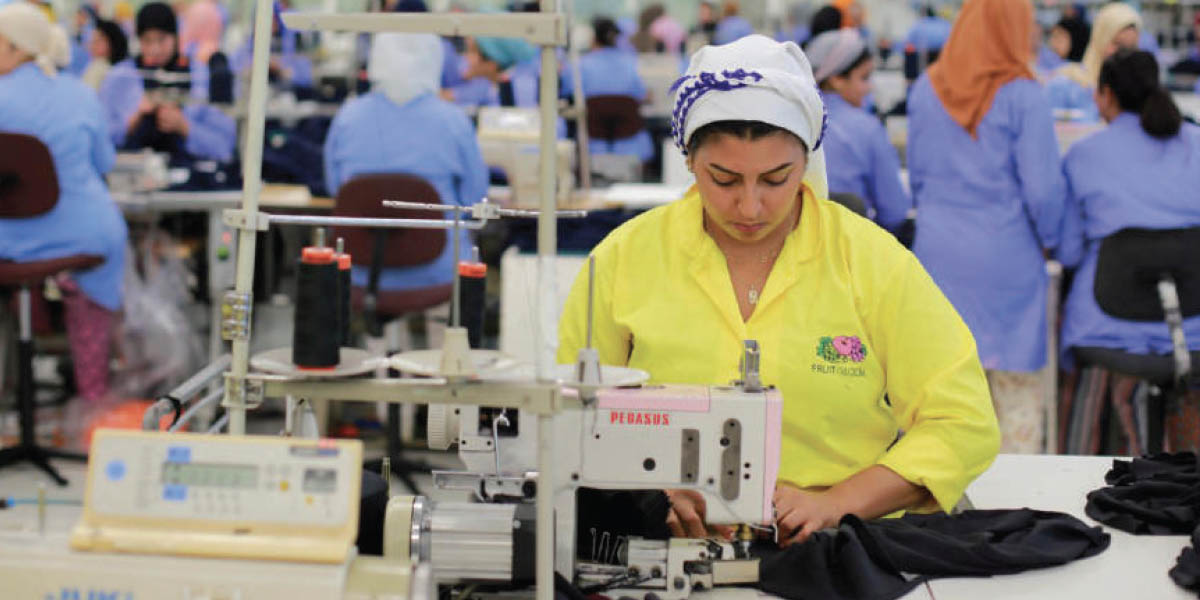
The Moroccan textile and clothing industry is currently navigating a complex transition, attempting to balance its role as a strategic industrial pillar with the urgent need for structural modernization. As a critical component of the national economy, the sector is facing a period of “measured resilience” in 2025, characterized by modest growth in European markets and an intensifying global competitive landscape.
The industry remains a cornerstone of Morocco’s industrial activity, contributing significantly to the national workforce and economic output. According to the Ministry of Industry and Commerce, the textile sector accounts for 27% of industrial employment and generates 7% of the total industrial value added.
However, this strategic importance is coupled with a precarious stability. While Morocco has maintained its position as the 8th largest sourcing base for the European Union (EU), the sector is under heavy pressure from Asian giants. Recent data indicates a stark contrast in growth rates: while Morocco saw a 7% increase in exports to the EU in 2025, competitors like China and Bangladesh saw jumps of 24% and 25% respectively, with Cambodia’s exports surging 45% since 2023.
This environment has catalyzed a push for a “strategic mutation” focused on increasing value added and diversifying markets to reduce a heavy reliance on traditional partners. Currently, Spain and France absorb nearly 60% of the sector’s exports, leaving the industry vulnerable to economic fluctuations within those specific European nations.
Navigating Global Competition and Structural Challenges
The current state of the Moroccan textile industry is defined by a tug-of-war between growth ambitions and systemic vulnerabilities. The sector is currently in a phase of “accelerated transformation,” as it attempts to pivot away from low-value production toward more sustainable and high-value-added models.
Anass El Ansari, president of the Moroccan Association of Textile and Clothing Industries (AMITH), noted that June 2025 marked significant progress in strengthening the sector’s dynamism and international influence. Despite these advances, the industry continues to grapple with a structural deficit when compared to competitors like Turkey, necessitating a shift in how the country approaches its sourcing and production strategies.
The financial scale of this competition is evident in the import figures for the EU. As of April 2025, Morocco’s position held a value of 881.7 million euros, a figure that pales in comparison to the multi-billion euro volumes handled by China (7.88 billion euros) and Bangladesh (7.54 billion euros).
Strategic Frameworks for Industrial Growth
To combat these pressures, the Moroccan state has implemented a global vision aimed at fostering sustainable growth. A key component of this strategy was the Industrial Acceleration Plan 2014-2020, which sought to integrate both the domestic market and export channels.
The government’s approach focuses on the development of “ecosystems”—a strategy designed to integrate the industrial fabric by centering production around leading companies. These leaders act as locomotives, providing visibility and perspective to smaller SMEs, which in turn contribute innovation and creativity to the chain.
Specific efforts are being directed toward creating a competitive and innovative “upstream” textile sector. The goal is to attract more Foreign Direct Investment (FDI), particularly from China, to establish mutually beneficial partnerships that enhance the local production capacity.
Key Economic Indicators of the Textile Sector
| Metric | Value/Stat | Context |
|---|---|---|
| Industrial Employment Share | 27% | Contribution to national industrial jobs |
| Industrial Value Added | 7% | Contribution to national industrial output |
| EU Export Growth (2025) | +7% | Growth toward the European Union |
| EU Sourcing Rank | 8th Place | Position among EU sourcing bases |
| Primary Market Dependence | ~60% | Exports absorbed by Spain and France |
The Path Toward Sustainability and Value Addition
The urgency for transformation is not merely economic but too tied to sustainability imperatives. The industry is increasingly required to align with global durability standards to remain attractive to EU buyers, who are placing higher premiums on ethical and sustainable production.
The transition toward “value added” involves moving beyond simple assembly and garment manufacturing into the design, development, and production of specialized textiles. This shift is intended to insulate the Moroccan industry from the “race to the bottom” on pricing that characterizes the competition with low-cost Asian hubs.
For the industry to achieve this, the government continues to provide targeted support in the form of industrial land, financing, and specialized training for workers, ensuring that the workforce can adapt to the new technological requirements of a modernized textile sector.
The next critical milestone for the sector will be the continued implementation of the transformation strategies outlined by AMITH and the Ministry of Industry to diversify export destinations and reduce the structural dependency on the Spanish and French markets.
World Today Journal encourages readers to share their perspectives on the evolution of global textile sourcing in the comments below.