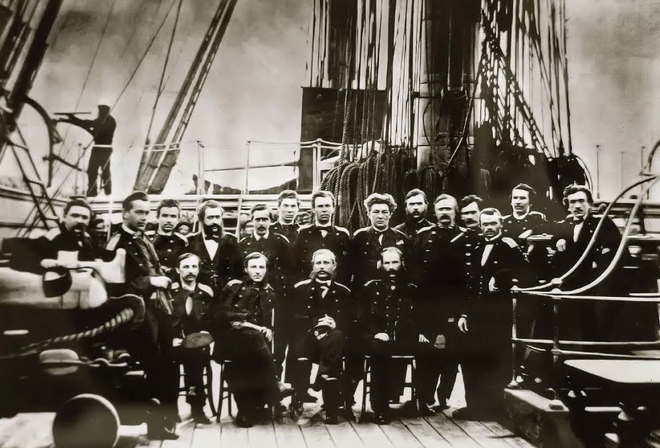
During the American Civil War, the deployment of Imperial Russian naval squadrons to New York and San Francisco in 1863 served as a powerful geopolitical signal that deterred Great Britain and France from intervening on the side of the Confederacy, according to historical records analyzed by scholars of 19th-century international diplomacy. While British and French cabinets frequently debated recognizing the Confederate government—particularly in the wake of crises such as the Trent Affair and the commerce-raiding activities of warships like the CSS Alabama—the physical presence of the Russian fleet complicated European calculations regarding a maritime war against the Union.
Archival research and diplomatic histories show that Russian Emperor Alexander II ordered the Atlantic squadron under Rear Admiral Stepan Lesovsky to New York and the Pacific squadron under Rear Admiral Andrei Popov to San Francisco during the autumn of 1863. Although domestic Russian strategic motives primarily involved positioning warships away from shallow home waters to prevent them from being bottled up in the event of a conflict with Britain or France over the Polish Uprising, the visual and political impact in North America was profound. American newspapers and federal officials widely interpreted the visits as a demonstration of friendship and a warning to potential European interventionists.
Geopolitical Tensions and the Threat of European Intervention
Relations between Washington and London grew exceptionally tense following the outbreak of the Civil War in 1861. The Union blockade of Southern ports placed severe strains on British textile mills starved of raw cotton, while incidents like the November 1861 seizure of Confederate envoys James Mason and John Slidell from the British mail steamer RMS Trent brought the two nations to the brink of armed conflict. Throughout 1862 and 1863, British Prime Minister Lord Palmerston and French Emperor Napoleon III weighed various proposals for mediation or formal diplomatic recognition of the Confederacy, steps that likely would have broken the Union blockade and triggered a wider war.
In St. Petersburg, Russian leadership faced its own severe security dilemmas. The Russian Empire was grappling with the massive internal reforms of the emancipation of the serfs, alongside the looming threat of war with Britain and France over the suppression of the Polish January Uprising of 1863. Fearing that their Baltic and Black Sea fleets would be trapped by superior British naval forces, Russian naval planners devised a strategy to deploy cruisers to the open oceans where they could menace British commerce lines in the event of an outbreak of hostilities.
The Arrival of Russian Squadrons in American Ports
The Atlantic squadron, comprising six vessels, dropped anchor in New York Harbor in September and October 1863, receiving an enthusiastic welcome from local citizens and municipal authorities. Weeks later, Admiral Popov’s Pacific squadron arrived in San Francisco, offering a reassuring defensive presence to West Coast ports vulnerable to Confederate raiders or foreign intervention. The simultaneous appearance of the Russian warships on both American coasts created deep anxiety in London and Paris regarding the security of global trade routes.
Historians note that while the Russian commanders carried secret orders to place their ships at the disposal of their own government rather than fight directly for the Union navy, the practical consequence was strategic deterrence. Had Great Britain or France entered the war against the United States, Russian cruisers positioned in major transatlantic and Pacific choke points would have presented an immediate threat to British merchant shipping, raising the economic cost of intervention to an unacceptable level.
Legacy and Historical Assessment
By late 1864, both Russian squadrons departed American waters after extended stays, leaving behind a legacy of diplomatic goodwill that contrasted sharply with the strained neutrality maintained by London and Paris during the conflict. While modern historians emphasize that St. Petersburg’s primary motivation was self-defense against Great Britain rather than altruism toward the United States, the strategic convergence of Russian naval movements and American survival remains a notable chapter in 19th-century great power politics.
Official records, diplomatic correspondence, and historical analyses concerning the 1863 naval visits remain accessible through the Library of Congress and the U.S. National Archives for researchers studying the international dimensions of the American Civil War.
Worth a look