
In the mid-20th century, the medical establishment operated largely on a foundation of tradition, clinical intuition, and the “expert opinion” of senior physicians. For decades, one of the most unquestioned tenets of hospital care was the prescription of prolonged bed rest for patients recovering from surgery, myocardial infarction, or various acute illnesses. It was a practice rooted in the belief that physical exertion was inherently dangerous to a healing body. However, as the post-war era progressed, a quiet revolution began to take shape—one that would eventually formalize the rigorous, data-driven framework we now recognize as evidence-based medicine.
The transition from anecdotal medicine to a system grounded in clinical trials is a story of skepticism and rigorous inquiry. At the heart of this shift was Dr. David Sackett, a physician whose career helped redefine the modern clinical standard. Sackett’s work, alongside contemporaries who challenged the status quo, highlighted that even the most “common sense” medical interventions could be harmful if they lacked validation through randomized, controlled testing. Today, the principles of evidence-based medicine (EBM) serve as the bedrock of global healthcare, ensuring that treatments are not merely traditional, but proven effective through systematic research and statistical analysis, as outlined by the British Medical Journal’s historical archives on the evolution of EBM.
The Myth of Absolute Bed Rest
For much of the early 20th century, the medical consensus favored immobilizing patients for extended periods. This was not merely a suggestion; it was a clinical mandate. Following surgical procedures or cardiac events, patients were often kept in bed for weeks to avoid the perceived strain on the heart and the risk of wound dehiscence. Yet, by the 1940s and 1950s, some practitioners began to notice that this practice often led to secondary complications, including deep vein thrombosis, pulmonary embolisms, and muscle atrophy. The “cure” was, in many cases, becoming the cause of further morbidity.

The pushback against this dogma did not happen overnight. It required a fundamental shift in how physicians evaluated medical literature. A landmark moment in this transition occurred when researchers began to apply the rigors of controlled trials to common bedside practices. By moving away from the assumption that “more rest equals more healing,” clinicians discovered that early mobilization—getting patients up and moving shortly after a procedure—actually reduced recovery times and diminished the incidence of life-threatening complications. This realization was a direct precursor to the development of the Cochrane Collaboration, which was later established to synthesize research and provide clinicians with the high-quality evidence needed to make informed decisions.
Defining Evidence-Based Medicine
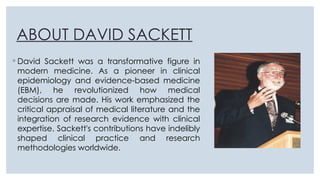
The formalization of evidence-based medicine in the 1980s and 1990s, spearheaded by figures like David Sackett at McMaster University in Canada, provided a structured approach to clinical care. Sackett defined EBM as the “conscientious, explicit, and judicious use of current best evidence in making decisions about the care of individual patients.” This approach integrates three core pillars:
- Individual Clinical Expertise: The proficiency and judgment that clinicians acquire through clinical experience and clinical practice.
- Best External Evidence: Validated research findings, typically from systematic reviews and randomized controlled trials.
- Patient Values and Preferences: The unique needs, concerns, and expectations that each patient brings to a clinical encounter.
This tripartite model ensures that medicine remains a human-centered profession while maintaining the high scientific standards required for modern patient safety. The Centre for Evidence-Based Medicine at the University of Oxford continues to promote these principles, emphasizing that EBM is not a “cookbook” approach, but a framework for lifelong learning and continuous improvement in healthcare delivery.
The Lasting Impact on Modern Healthcare Policy
The legacy of those early trials on bed rest is visible in every corner of contemporary medicine. Today, major health organizations, including the World Health Organization (WHO), utilize rigorous systematic reviews to develop clinical practice guidelines. These guidelines are essential for healthcare policy, as they inform insurance coverage, hospital protocols, and medical education. By demanding that interventions be backed by data, the medical community has drastically reduced the use of ineffective or harmful treatments that were once considered standard practice.
However, the journey is far from complete. As medical innovation accelerates, the challenge shifts from a lack of data to an overwhelming surplus of information. The current focus of health researchers is the development of advanced meta-analysis tools and digital platforms that allow clinicians to access evidence in real-time. This ensures that when a new treatment for an infectious disease or a chronic condition emerges, practitioners can quickly determine its efficacy and safety, thereby minimizing the gap between scientific discovery and bedside application.
Looking Ahead: The Future of Clinical Decision-Making
As we look toward the future, the integration of artificial intelligence and machine learning into medical research promises to further refine our understanding of clinical outcomes. By analyzing vast datasets, researchers can identify subtle patterns that might be missed in traditional trials, potentially leading to a new era of precision medicine. Yet, the core lesson of the bed rest trials remains unchanged: we must remain skeptical of “conventional wisdom” and continue to prioritize objective evidence over historical practice.
The next major milestone in this field will be the upcoming update to the WHO Guideline Development Handbook, which is slated to provide new frameworks for evaluating evidence in the digital age. As we continue to refine how we interpret scientific data, the voice of the patient remains just as vital as the data itself. We encourage our readers to engage with these topics; do you have questions about how current clinical guidelines are formed, or are you interested in how to evaluate health news through an evidence-based lens? Share your thoughts in the comments below, and stay tuned to World Today Journal for our ongoing coverage of medical innovation and public health policy.