
The modern battlefield is currently witnessing a stark mathematical imbalance. As Operation Epic Fury enters its third week, the United States military is finding itself in a costly war of attrition, utilizing multi-million-dollar interceptors to down inexpensive Iranian drones. This asymmetry has exposed a critical vulnerability in U.S. Defense readiness: the struggle to produce lethal, low-cost drones at a scale that can match the output of its adversaries.
To address this gap, the Department of War has launched the Drone Dominance Program, an ambitious effort to pivot the U.S. Military away from a reliance on a few “exquisite,” high-cost platforms toward a strategy of “unstoppable mass.” However, while the strategic intent is clear, the execution is colliding with a brittle domestic industrial base. America’s drone strategy supply chain problem is no longer a theoretical risk; it is an operational liability being tested in real-time across the Middle East.
The current conflict, characterized by a direct kinetic exchange between the U.S., Israel, and Tehran, has accelerated the necessitate for “consumable” drones—systems designed to be lost in combat without creating a fiscal or logistical crisis. Yet, as the U.S. Attempts to scale production, it is discovering that the components required to build these systems are often controlled by the very adversaries it seeks to out-innovate.
The Drone Dominance Program: A Sprint Toward Mass
The Drone Dominance Program represents a radical realignment of U.S. Defense procurement. Funded by the “Huge Beautiful Bill,” the initiative is a $1 billion plan to purchase small, lethal drones over the next two years . The goal is to rapidly arm combat units with low-cost systems, moving away from the traditional Pentagon model of multi-year requirements for a handful of expensive aircraft.
Secretary of War Pete Hegseth has framed the program as a “fight tonight” philosophy, intended to leverage private capital and commercial competition to drop prices while increasing lethality. By 2027, the program intends to purchase over 200,000 drones capable of producing lethal effects in the most challenging battlefield environments .
OVERVIEW The funding provided by the Big Beautiful Bill is ready to be used to mount an effective sprint to build combat power.We call it Drone Dominance. At the War Department, we are adopting new technologies with a “fight tonight” philosophy – so our warfighters have the… pic.twitter.com/F6UMLxmwB7 — Secretary of War Pete Hegseth (@SecWar) December 2, 2025
This shift treats drones not as traditional aircraft, but as ammunition—specifically Class V supplies. This reclassification acknowledges that in a peer conflict, industrial throughput is the primary strategy. However, the transition from a boutique industry to mass production has revealed that the U.S. Industrial base has largely forgotten how to build at scale.
The Bottleneck: Patriotic Red Tape and Supply Sovereignty
A central pillar of the Drone Dominance Program is the mandate for supply chain sovereignty. To prevent espionage and dependence on adversaries, the program requires every drone component to be Blue UAS/NDAA compliant. By August 2026, components from “covered countries”—most notably China—will be forbidden in these systems.
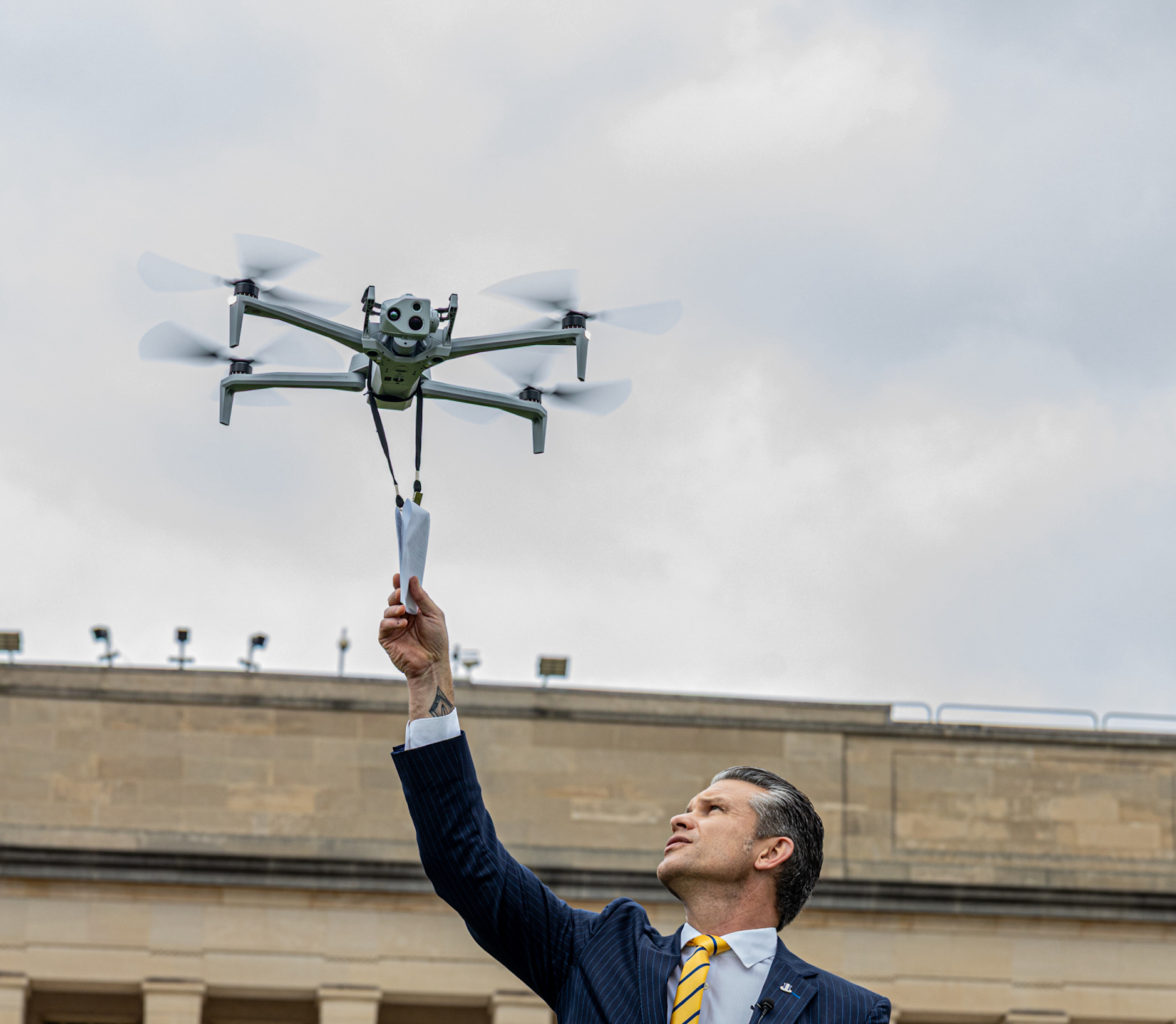
While the goal of securing the industrial base is a national security priority, the immediate reality is that the necessary domestic supply chains simply do not exist. This has created a phenomenon of “patriotic red tape,” where strict compliance requirements are outstripping the actual capacity of U.S. Manufacturers to produce parts. The result is an operationally awkward environment where the winners of initial contracts are often forced to buy stockpiled components from the companies they beat, as those firms are the only ones holding the necessary inventory.
The financial pressures are equally acute. The Pentagon has reportedly pushed for strike prices below $2,300 per unit for later phases of the program, while simultaneously demanding high-finish features such as Automatic Target Recognition (ATR), kinetic warheads, and fiber-optic tethering for electronic warfare resilience. This creates a “Cessna budget” for what are essentially F-35-level specifications.
The most significant hurdle remains the production of brushless motors. These components rely on neodymium, a rare-earth element where the global supply chain is heavily dominated by China. There is currently little market incentive for manufacturers to prioritize drone motors when the profit margins for high-performance electric vehicle (EV) drivetrains or offshore wind turbines are significantly higher. Without massive capital expenditure (CAPEX) and a revitalized domestic mining industry, the U.S. Remains throttled by a bottleneck of raw materials.
The Geopolitical Paradox: China, Russia, and the Oil Trade
The urgency of the Drone Dominance Program is highlighted by the “Ukraine Paradox.” To sustain its defense against Russian aggression, Ukraine has embraced a brutal strategic compromise: relying on Chinese drone components. Reports suggest Ukraine manufactured roughly 4,000,000 drones in 2025 and is pacing toward 7,000,000 this year. This creates a dizzying circular logic where China supports the Russian war machine with one hand while selling the critical motors to Ukraine with the other.
This cycle of dependency has mirrored the complexities of the current conflict in the Middle East. When Iran responded to U.S. And Israeli actions by closing the Straits of Hormuz, it choked off approximately 20% of the world’s oil supply, causing global energy prices to spike. In a move of realpolitik, Washington granted sanctions relief to Russia to keep global oil prices manageable, effectively making Russia a beneficiary of the war in the Middle East.
This creates a strategic absurdity. If the conflict with Iran continues, U.S. Demand for inexpensive drones could surge toward 1,000,000 units per year. The Pentagon then faces a binary choice: stick to NDAA compliance and run out of ammunition, or waive the rules and funnel money into Chinese accounts to secure the necessary components. Waiving these requirements would not only undermine domestic security but would subsidize the same actors engaging in commercial theft and strategic competition with the U.S.
The Cost of Asymmetry in Operation Epic Fury
The real-world consequences of these supply chain failures are evident in the reports coming out of the CENTCOM area of responsibility. In Erbil, Iraq, journalists have documented a daily occurrence of Iranian drones attacking U.S. Facilities . While U.S. Defense systems, including Terminal High Altitude Area Defense (THAAD) launchers, are successfully intercepting these threats, the cost ratio is unsustainable .
The U.S. Is essentially using “exquisite” interceptor missiles to fight “consumable” drones. This is the exact scenario the Drone Dominance Program was designed to avoid, yet the program’s success depends on an industrial capacity that is currently more aspirational than actual. The lesson from the Ukrainian front is that mass wins wars, but mass requires a functioning, sovereign supply chain.
Key Industrial Bottlenecks
| Component | Primary Constraint | Strategic Impact |
|---|---|---|
| Brushless Motors | Dependence on Chinese manufacturing | Limits total airframe production |
| Neodymium | Lack of domestic rare-earth mining | Increases cost and vulnerability |
| Flight Controllers | NDAA/Blue UAS compliance gaps | Slows deployment of new units |
| Kinetic Warheads | Industrial throughput limitations | Reduces overall lethality at scale |
Looking Forward: Funding the Foundations
The transition toward drone dominance marks the end of the era of the high-priced, singular platform. However, the true opportunity for national security does not lie in the drones themselves, but in the “picks and shovels” of 21st-century warfare. Capital must shift from funding the “fuselages”—the finished drones—to funding the high-complexity infrastructure of domestic manufacturing.
Historical precedent suggests that private sector pivots are what determine the outcome of total war. During World War II, the Ford Motor Company’s Willow Run plant produced a B-24 Liberator bomber every 63 minutes, overwhelming the Axis powers through sheer throughput. To achieve a similar result today, the U.S. Must focus on the unsexy but essential foundations: rare-earth processing, domestic motor production, and streamlined procurement that rewards scale over “exquisiteness.”
If the U.S. Continues to prioritize short-term wins over long-term industrial strategy, it risks a generational failure. The goal is not simply to purchase 200,000 drones by 2027, but to build a sustainable industrial engine that can produce millions of them without relying on the coffers of its primary adversaries.
The next critical checkpoint for the program will be the transition into Phase II by August 2026, where the prohibition of components from covered countries becomes absolute. Whether the U.S. Industrial base can meet this deadline without compromising operational readiness remains the central question of the current strategy.
World Today Journal encourages readers to share their perspectives on the balance between security compliance and industrial speed in the comments below.
Worth a look