
Why the Virgin Mary, as the Immaculate Conception, Became the Patron Saint of the U.S. In the 1840s
While St. Patrick’s Day and the Feast of Our Lady of Guadalupe celebrate the patron saints of Ireland and Mexico, respectively, the United States has its own—one whose patronage was formally recognized nearly two centuries ago. In May 1846, Catholic bishops and priests across America declared the Virgin Mary, under her title as the Immaculate Conception, the patroness of the nation. The Vatican formally approved this designation on February 7, 1847—seven years before the Catholic Church would officially declare the doctrine of the Immaculate Conception as dogma in 1854.
This designation reflected both deep theological conviction and a strategic response to the challenges faced by American Catholics in the 19th century. For a faith community often viewed with suspicion by the Protestant majority, invoking Mary as a unifying spiritual figure allowed Catholics to assert their patriotism while reinforcing their distinct identity. Today, as the U.S. Marks the 180th anniversary of this patronage, the story of how Mary became America’s patron saint remains a testament to faith, resilience, and the enduring power of devotion.
The Immaculate Conception: A Doctrine Rooted in Controversy
The title Immaculate Conception refers to the Catholic belief that the Virgin Mary was conceived without original sin—the stain of Adam and Eve’s disobedience inherited by all humanity, according to Christian doctrine. This doctrine, later defined as dogma by Pope Pius IX on December 8, 1854, was not universally accepted within the Church until the mid-19th century. Yet devotion to Mary in this capacity predated the official declaration, with early theologians like Duns Scotus (13th–14th century) arguing for her sinless conception based on Scripture and tradition.
The feast of the Immaculate Conception is celebrated annually on December 8, a date that aligns with the Catholic tradition of Mary’s conception nine months before her birth on September 8. Theological interpretations of the doctrine emphasize Mary’s unique role as the mother of Jesus, free from the effects of sin to better fulfill her divine mission. As the Catechism of the Catholic Church explains, saints are those who “lead a life in union with God through the grace of Christ,” and Mary’s patronage reflects her intercessory role for the faithful.
From Baltimore to the Nation: The Path to Patronage
The roots of Mary’s patronage of the U.S. Trace back to the nation’s early Catholic history. John Carroll, the first American bishop and founder of Georgetown University, was deeply devoted to Mary. In 1791, he and other clergy consecrated the Diocese of Baltimore to her, praying for her protection over the fledgling diocese. This early act set a precedent for Mary’s role in American Catholicism.
By the 1840s, American Catholicism had grown significantly, yet Catholics still faced anti-Catholic sentiment, including the rise of the Know-Nothing Party, which targeted immigrants and religious minorities. In response, bishops and priests convened in Baltimore in May 1846 to address the spiritual needs of the nation. Their decision to name Mary, as the Immaculate Conception, as the patroness of the United States was not merely symbolic but a deliberate act of unity and protection.
The Vatican’s approval on February 7, 1847, came as a response to this collective petition. Notably, this approval predated the formal declaration of the Immaculate Conception as dogma by seven years, underscoring the devotion’s popularity among American Catholics even before its official recognition by the Church.
Devotion in Art, Prayer, and Patriotism
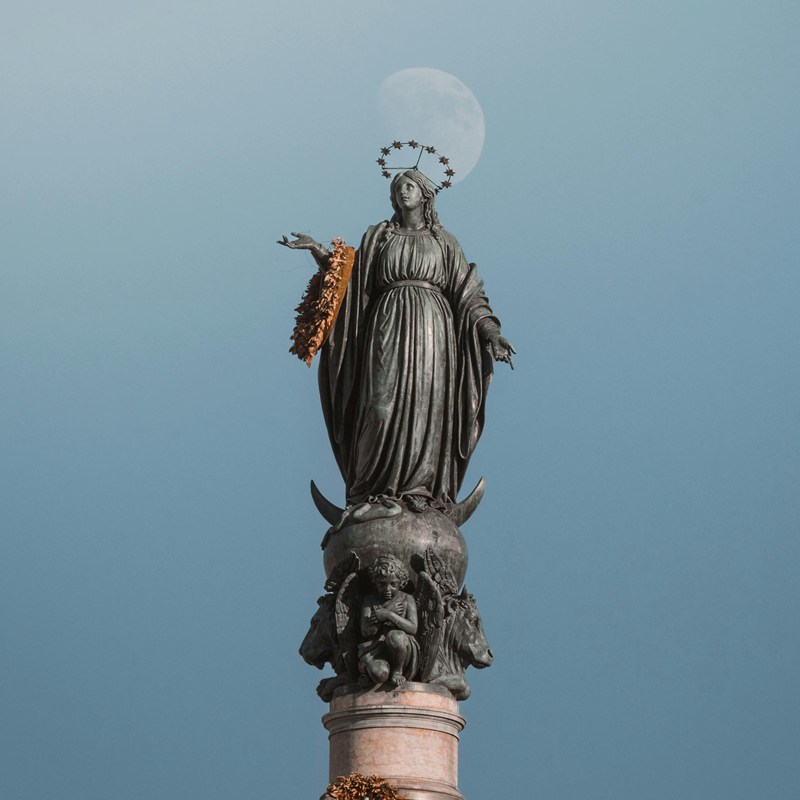
The patronage of Mary as the Immaculate Conception is reflected in American Catholic culture through art, architecture, and devotional practices. Churches across the U.S. Bear her name, including St. Patrick’s Cathedral in New York and Immaculate Conception Cathedral in Denver. Devotional objects like holy cards and rosaries often feature imagery of Mary standing on a moon, inspired by Revelation 12:1, which describes a “woman clothed with the sun, with the moon under her feet.”
The Feast of the Immaculate Conception remains a holy day of obligation in the U.S., meaning Catholics are expected to attend Mass. This tradition underscores the enduring significance of Mary’s patronage, even as modern American Catholics may not fully recognize its historical roots.
Symbolism in Art: The Moon, Stars, and the Dragon
Iconography of the Immaculate Conception often includes symbolic elements tied to Scripture. The moon beneath Mary’s feet represents her humility and purity, while the crown of twelve stars signifies her role as the mother of the Church. In some depictions, a dragon or serpent under her feet symbolizes the defeat of evil, drawing from Genesis 3:15, where God promises a future victory over sin.
One famous representation is Bartolomé Esteban Murillo’s *The Immaculate Conception of El Escorial* (17th century), housed in Madrid’s Museo del Prado. This painting, reproduced on devotional cards, shows Mary in a blue robe—a color historically reserved for the Virgin due to its association with faith and royalty. The expensive pigment made blue a rare and revered choice for Marian imagery.
Patriotism and Faith: The American Rosary and Beyond
Devotional objects like the American Rosary, designed in 1956 by Marie George of New York, blend faith with patriotism. The rosary features red, white, and blue beads, the colors of the U.S. Flag, and includes a Miraculous Medal depicting the Immaculate Conception. A card accompanying the rosary encourages prayers “for World Peace, with Justice and Charity,” reflecting the enduring hope that Mary’s intercession would guide the nation.
Even today, American Catholics continue to honor Mary as their patroness. The Feast of the Immaculate Conception remains a significant liturgical celebration, and her image appears in churches, homes, and public spaces across the country. The patronage also resonates in a broader cultural context, where Mary is seen as a unifying figure for Catholics amid diverse religious and political landscapes.
Faith Amid Prejudice: The 19th-Century Context
The designation of Mary as patroness occurred during a period of anti-Catholic sentiment in the U.S. Protestant majorities often questioned Catholics’ loyalty to the pope and their place in American society. By invoking Mary as a patroness, Catholic leaders sought to affirm their commitment to the nation while preserving their distinct identity. This act was both a spiritual and a social strategy, reinforcing the idea that Catholic faith and American patriotism were not mutually exclusive.
The 1846 Baltimore Council and the Vatican’s approval in 1847 marked a turning point. They demonstrated the growing influence of American Catholicism and its ability to navigate political and social challenges through faith. Today, as the U.S. Reflects on its history, Mary’s patronage remains a reminder of the enduring role of religion in shaping national identity.
2026: A Surge in Devotion and a New Era
In 2025, the Catholic Church elected its first American-born pope, Leo XIV, a milestone that further solidified the U.S.’s place in global Catholicism. This historic event coincides with a reported surge in Catholic conversions in the U.S., according to recent Pew Research Center data (Pew Forum). As the nation marks the 250th anniversary of its founding and the 180th anniversary of Mary’s patronage, many Catholics continue to turn to her for intercession, not only in their personal lives but also for the nation.
The Marian Library at the University of Dayton preserves artifacts like the 1976 bicentennial holy card, which features Mary as the Immaculate Conception with the inscription, “Immaculate Mary, Patroness of the United States, Pray for Us.” The reverse side includes the U.S. Motto, “In God We Trust”, reinforcing the connection between faith and national identity.

Key Takeaways
- 1846 Baltimore Council: U.S. Bishops and priests declared Mary, as the Immaculate Conception, the nation’s patroness.
- Vatican Approval (1847): The designation was ratified seven years before the doctrine became dogma (1854).
- Symbolism: Iconography includes the moon, stars, and serpent, rooted in Revelation 12 and Genesis 3:15.
- Cultural Impact: Churches, rosaries, and holy cards bear her image, blending faith with patriotism.
- Modern Relevance: The 2025 election of Pope Leo XIV and rising Catholic conversions highlight her continued significance.
As the U.S. Reflects on its religious heritage, the story of Mary’s patronage offers insights into how faith and national identity intersect. For American Catholics, her intercession remains a source of comfort and hope. What does this historical patronage mean to you? Share your thoughts in the comments below or join the conversation on Twitter.
Sources & Further Reading
- Catechism of the Catholic Church (Dogma of the Immaculate Conception)
- U.S. Conference of Catholic Bishops: History of the Immaculate Conception
- Museo del Prado: Murillo’s *The Immaculate Conception of El Escorial*
- Marian Library, University of Dayton: Devotional Artifacts
- Pew Research Center: U.S. Religious Landscape
Worth a look