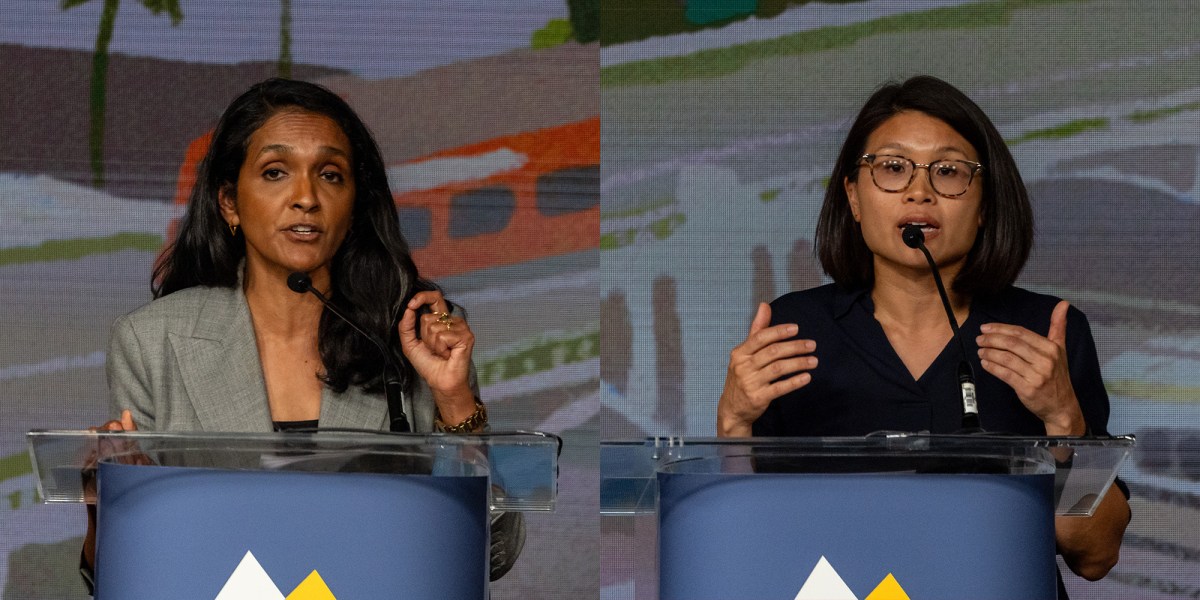
As Los Angeles approaches its nonpartisan mayoral primary, the city’s political left finds itself grappling with internal fractures that threaten to diminish its influence at City Hall. The race, which features incumbent Mayor Karen Bass as the presumptive front-runner, has become a litmus test for the viability of progressive and democratic socialist platforms in Southern California. With the top two candidates advancing to a November runoff should no individual secure more than 50 percent of the vote, voters are increasingly forced to weigh ideological purity against pragmatic electoral strategy.
Two candidates running to the left of the incumbent—City Councilmember Nithya Raman and community activist Rae Huang—have struggled to consolidate the support of the city’s diverse progressive base. While both are members of the Democratic Socialists of America (DSA), the local chapter has withheld a formal endorsement, leaving supporters to navigate a landscape defined by competing visions of governance and political efficacy. The stakes are heightened by the presence of a crowded field and the rising profile of unconventional candidates, creating a volatile environment for progressives seeking to reshape the city’s direction.
The Progressive Dilemma: Pragmatism vs. Purity
The tension within the Los Angeles left is perhaps best exemplified by the divergent strategies of Raman and Huang. Nithya Raman, who represents a district spanning neighborhoods including Los Feliz, Hollywood, and the San Fernando Valley, has faced criticism from some on the left for her legislative record. Despite her 2020 campaign centered on police reform, she has supported budget allocations for the Los Angeles Police Department in subsequent years, though she has also opposed specific police pay raises and expansion plans, according to official City Council legislative records. These shifts have left some former allies questioning her consistency, while her supporters point to her demonstrated ability to navigate the complexities of municipal government.
Conversely, Rae Huang, a Presbyterian minister, has championed a more uncompromising platform, emphasizing social housing and aggressive police accountability. However, her campaign has faced significant headwinds, including challenges in polling and recent scrutiny regarding campaign finance reporting. As noted in reports from the Los Angeles Times, questions regarding the campaign’s adherence to public matching fund requirements have prompted internal debates about the viability of her bid. For many voters, the choice between Raman’s incrementalism and Huang’s bold vision has become the defining feature of the primary.
The situation is further complicated by the fact that Raman’s colleagues on the City Council who are also aligned with the DSA have opted to endorse Mayor Bass, signaling a broader strategic realignment within the local movement. As Leslie Chang, co-chair of the Democratic Socialists of America–Los Angeles, noted in recent discussions, the focus for many is on the immediate, tangible outcomes for residents, leading some to prioritize candidates who can secure a seat at the table over those who remain strictly outside the establishment.
The Rise of Unconventional Challengers
Amidst the debate on the left, the candidacy of Spencer Pratt has introduced an unpredictable element into the mayoral contest. Pratt, known for his history in reality television, has framed his campaign around a platform of aggressive policing and a critique of the current administration’s handling of homelessness and public safety. His rhetoric, which frequently contrasts with the policy-heavy discourse of his opponents, has gained traction among voters frustrated by the city’s persistent challenges, such as the housing crisis and public infrastructure failures.
Experts note that the frustration manifesting in the support for populist candidates is a reflection of broader urban trends. Benjamin Henwood, director of the Homelessness Policy Research Institute at the University of Southern California, has emphasized that while homelessness remains a central concern, the data consistently points to housing affordability as the primary driver. According to a 2023 audit by the Los Angeles City Controller’s Office, there is a significant gap between the number of unhoused individuals and available interim shelter beds, a reality that complicates the promises made by candidates on all sides of the ideological spectrum.
The frustration is palpable among residents who have seen sales taxes increase to fund homelessness programs, yet feel the results have not met expectations. This sentiment is what candidates like Huang are attempting to capture, though they differ sharply from Pratt on the solutions—advocating for publicly owned housing rather than the enforcement-heavy approach favored by the reality star.
What Lies Ahead
As the primary election approaches, the question for the Los Angeles left is whether it can bridge its internal divides before the November runoff. The most recent polling data, such as the figures released by the Los Angeles Times and UC Berkeley, suggests that the race for the second spot in the runoff remains tight. For progressives, the outcome will serve as a bellwether for the future of the movement in the city.
For voters, the immediate next step is the primary election day. Official voter information, including polling locations and mail-in ballot drop-off sites, is available through the Los Angeles County Registrar-Recorder/County Clerk. As the dust settles on the primary, the focus will inevitably shift to the November general election, where the final two candidates will face off to determine the next mayor of Los Angeles. The city’s political trajectory, and the role of the progressive movement within it, remains one of the most closely watched narratives in local government.
We invite our readers to share their perspectives on the upcoming election in the comments section below. How do you see the shifting political landscape in Los Angeles impacting your community?
Worth a look