
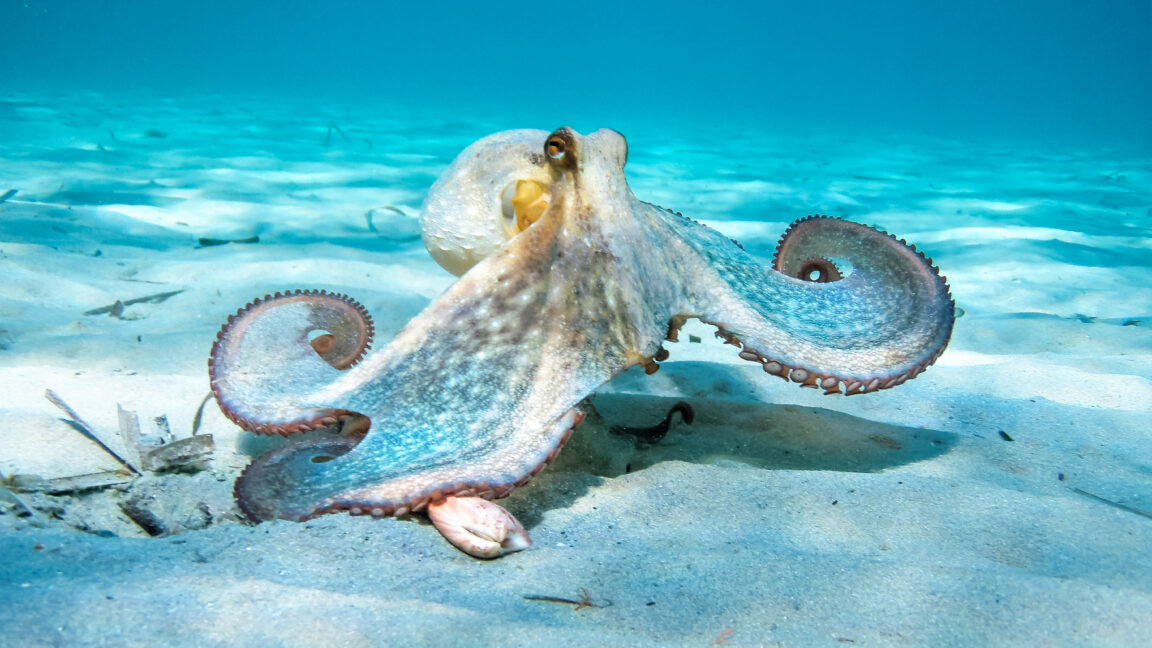
For nearly 25 years, a small, unassuming fossil from the American Midwest held a prestigious title in the world of paleontology: the oldest known octopus. Discovered in Illinois, the specimen known as Pohlsepia mazonensis seemed to push the evolutionary timeline of cephalopods back by millions of years, challenging established biological theories about when modern octopuses first appeared in the oceans.
However, new evidence has fundamentally rewritten this history. Recent high-tech imaging and analysis have revealed that the oldest octopus fossil found to not be an octopus was actually a case of prehistoric mistaken identity. The specimen, which dates back to the late Carboniferous period—roughly 311 to 306 million years ago—has been reidentified not as a crown coleoid, but as a decomposed and flattened nautiloid.
This correction resolves a long-standing “puzzle” for evolutionary biologists. Until now, Pohlsepia was a massive outlier. the vast majority of the fossil record suggests that crown coleoids—the group encompassing modern octopuses, squid, and cuttlefish—did not diverge until the Jurassic period, significantly later than the Carboniferous era. By removing this outlier, the timeline of cephalopod evolution once again aligns with broader genomic and geological data.
The re-evaluation was led by Thomas Clements, a paleontologist at the University of Leicester, and his colleagues. By applying advanced imaging techniques to the specimen, the team was able to see past the distorted surface of the fossil to understand how the creature’s body had actually decayed and compressed over hundreds of millions of years.
The Geological ‘Rorschach Test’ of Mazon Creek
The reason Pohlsepia mazonensis managed to masquerade as an octopus for over two decades lies in the unique chemistry of its resting place: the Mazon Creek Lagerstätte in Illinois. A “Lagerstätte” is a sedimentary deposit that exhibits extraordinary fossil preservation, often capturing soft tissues that would normally decay.
Around 300 million years ago, this region was a brackish, tidal marine basin. It was frequently inundated by massive surges of iron-rich river mud. When organisms died and were buried in these sediment fans, the high iron content triggered the rapid precipitation of a mineral called siderite. This process effectively locked the decaying organisms inside hard geological nodules, creating a protective stone shell around the remains.
While this process preserves detail, it can also create deceptive shapes. In the case of Pohlsepia, the combination of decay and the immense pressure of the surrounding sediment resulted in a “squashed” appearance. To the researchers in 2000, the resulting silhouette looked remarkably like the mantle and tentacles of an octopus. In reality, the team found it was more of a biological Rorschach test—the researchers saw an octopus since the distorted remains of a nautiloid happened to mimic that shape.
Understanding the Cephalopod Divide: Nautiloids vs. Coleoids
To understand why this misidentification mattered, it is necessary to distinguish between the two primary groups of cephalopods involved: the nautiloids and the coleoids.
Nautiloids are characterized by their external shells and are among the oldest cephalopods. They have a more primitive anatomy compared to the highly evolved coleoids. Coleoids—which include the octopuses, squid, and cuttlefish—evolved to internalize or completely lose their shells, allowing for greater mobility, agility, and the development of complex nervous systems. This transition was a pivotal moment in marine evolution, enabling these creatures to become some of the most intelligent invertebrates on Earth.
If Pohlsepia had truly been an octopus, it would have meant that the transition to the “shell-less” coleoid form happened nearly 150 million years earlier than previously thought. Such a discovery would have forced scientists to rethink the entire pace of evolution for the group. By confirming that the specimen is actually a nautiloid—a group already known to exist during the Carboniferous—the scientific community can maintain the current understanding of the Jurassic divergence.
How High-Tech Imaging Solved the Mystery
The breakthrough came when Thomas Clements and his team moved beyond visual inspection of the fossil’s surface. Using advanced imaging, they were able to analyze the internal structure and the specific way the organic matter had been replaced by minerals. This allowed them to identify the remnants of a shell and a body plan consistent with a nautiloid, albeit one that had been severely distorted by the siderite nodules of Mazon Creek.
This shift highlights a growing trend in paleontology: the move from “morphological” identification (looking at the shape) to “analytical” identification (using CT scans and chemical mapping). As our tools improve, many “mystery” fossils from the early 20th and 21st centuries are being re-examined, often leading to surprising corrections in the tree of life.
Key Takeaways: The Pohlsepia Correction
- The Misidentification: Pohlsepia mazonensis was hailed as the oldest octopus (dating to ~306-311 million years ago) for nearly 25 years.
- The Correction: New analysis by the University of Leicester identifies the specimen as a decomposed, flattened nautiloid.
- The Geological Cause: Siderite nodules in the Mazon Creek Lagerstätte preserved the body but distorted its shape, mimicking an octopus.
- The Evolutionary Impact: This removes a major outlier, aligning the fossil record with the theory that crown coleoids diverged during the Jurassic period.
- The Method: High-tech imaging replaced simple visual observation to reveal the true anatomy of the fossil.
What This Means for Future Paleontology
The case of Pohlsepia serves as a cautionary tale for the scientific community regarding the “preservation bias” of soft-bodied organisms. Because octopuses and squid lack bones, they are rarely preserved in the fossil record. When a specimen appears that looks like a soft-bodied cephalopod, there is a natural scientific eagerness to categorize it as a breakthrough discovery.
However, this discovery reinforces the importance of multidisciplinary approaches. By combining geology (understanding the siderite precipitation), biology (comparing nautiloid and coleoid anatomy), and technology (advanced imaging), researchers can correct the historical record.
For the global scientific community, this means that many other “outlier” fossils may eventually be reclassified. As imaging technology becomes more accessible, we can expect a wave of revisions to the fossil record, potentially refining our understanding of when various species first appeared and how they evolved to survive the planet’s various mass extinction events.
The next phase of this research will likely involve a broader re-examination of other Carboniferous fossils from the Mazon Creek site to ensure no other “masquerading” species are currently misidentified in museum archives.
Do you think technology is fundamentally changing how we understand Earth’s history? Share your thoughts in the comments below or share this article with a science enthusiast.