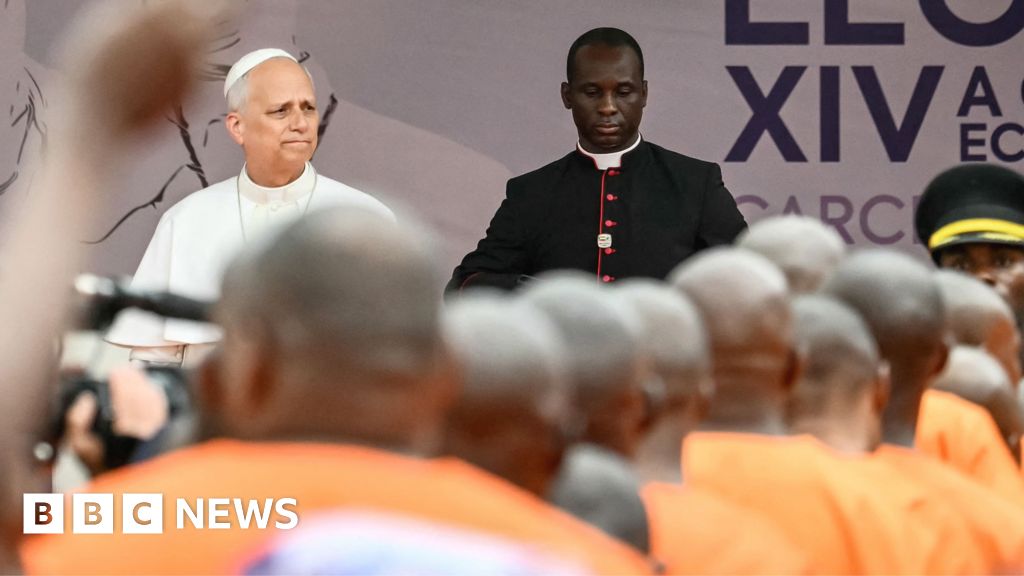
Pope Leo XIV concluded his 10-day Africa tour with a candid address in Equatorial Guinea, drawing attention to prison conditions during his final public engagement on the continent. The pontiff, who visited Algeria, Cameroon, Angola and Equatorial Guinea between April 13 and 23, 2026, used his last major speech to highlight concerns about justice systems and human dignity, consistent with themes emphasized throughout his journey.
According to verified reports from the BBC and EWTN Vatican, the Pope’s Africa tour marked his second major foreign visit since his election in May 2025 and underscored the growing significance of the continent to the Catholic Church, where more than a fifth of the world’s Catholics reside. His remarks in Equatorial Guinea came as he wound down an itinerary that included 11 cities across four nations and nearly 18,000 kilometers of travel by air.
The Holy Father’s message in Malabo, the capital of Equatorial Guinea, focused on reconciliation and the treatment of incarcerated individuals, reflecting a pattern of speaking openly about social challenges during his African visit. While the specific content of his critique was not detailed in the primary sources covering the tour’s conclusion, his broader emphasis on peace, migration and interreligious dialogue throughout the trip framed the context of his final remarks.
Pope Leo XIV, the first pontiff from the Order of Saint Augustine, has frequently referenced the teachings of the North African theologian during his papacy, particularly concepts of community and humility. This philosophical foundation was noted as influential in shaping his approach to the Africa tour, which began in Algeria—a country of deep personal significance due to its connection to St. Augustine of Hippo.
Throughout the journey, the Pope celebrated multiple public Masses and delivered numerous speeches and homilies, adapting his language to local contexts: French in Algeria and Cameroon, Portuguese in Angola, and Spanish in Equatorial Guinea, with English used consistently across all stops. The Vatican estimated he would travel more than 11,000 miles on 18 separate flights during the trip, highlighting the logistical scale of modern papal visits.
While Equatorial Guinea does not have one of the largest Catholic populations on the continent—distinctions held by Nigeria and the Democratic Republic of Congo—the Pope’s decision to include the nation in his itinerary reinforced his focus on engaging with diverse African nations beyond demographic size alone. His visit underscored a pastoral strategy centered on presence and dialogue rather than purely statistical outreach.
Prison Conditions and Papal Advocacy in Africa
During his time in Equatorial Guinea, Pope Leo XIV joined a growing chorus of international voices calling for reform in prison systems across Africa, where overcrowding, prolonged pretrial detention and limited access to healthcare remain persistent challenges. While no specific data on Equatorial Guinea’s prison population was cited in the verified sources covering the tour, regional human rights organizations have previously documented concerns about detention conditions in the country.
The Pope’s remarks aligned with his broader advocacy for restorative justice, a theme he has addressed in previous international visits. By speaking frankly about incarceration, he continued a papal tradition of using high-profile platforms to draw attention to marginalized populations, a practice evident throughout his Africa tour where migration, interfaith dialogue and social cohesion were recurring topics.
His comments in Malabo were described by observers as consistent with the “frank and passionate” tone that characterized his public addresses during the 10-day journey. This approach reflected a deliberate effort to engage with local realities while upholding Catholic social teaching on the inherent dignity of every person, regardless of their legal status.
Tour Logistics and Historical Significance
The Africa tour represented a significant undertaking in terms of both distance and diplomatic engagement. Spanning 11 days from April 13 to 23, 2026, the itinerary included stop-offs in multiple cities across Algeria, Cameroon, Angola and Equatorial Guinea. The Vatican confirmed that the Pope would celebrate eight public Masses and deliver 24 speeches and homilies during the visit, underscoring its intensity.
Pope Leo XIV’s choice to begin the tour in Algeria carried symbolic weight, as We see the birthplace of St. Augustine, whose theological contributions have deeply influenced the Pope’s own spiritual formation. As the first pontiff from the Augustinian order, Leo XIV has often cited the 4th-century theologian’s ideas on community and inner humility as foundational to his leadership.
The journey marked the Pope’s first apostolic visit to Africa and came less than a year after his election, signaling an early prioritization of the continent in his pontificate. This focus reflects broader trends within the global Catholic Church, where Africa has emerged as one of the fastest-growing regions, with over 288 million baptized Catholics recorded in 2024.
Regional Context and Church Growth in Africa
Throughout the tour, Pope Leo XIV highlighted Africa’s increasing importance to Catholicism, noting that the continent accounts for approximately 20% of the world’s Catholic population and is experiencing significant growth in priestly vocations. These demographic shifts have positioned Africa as a focal point for the Church’s future development, a reality acknowledged by Vatican officials who described the trip as a personal priority for the Pope.
Despite not visiting Nigeria or the Democratic Republic of Congo—home to the largest Catholic populations in Africa—the Pope’s selected itinerary emphasized geographical and cultural diversity. His inclusion of Algeria, a predominantly Muslim country where he visited the ruins of ancient Hippo (now Annaba), where St. Augustine once served as bishop, illustrated a deliberate effort to engage with historical and interreligious dimensions of the region.
The Pope’s utilize of multiple languages during the trip—French, Portuguese, Spanish and English—reflected both the linguistic diversity of the visited nations and the Vatican’s adaptability in multinational pastoral visits. This multilingual approach facilitated direct communication with local congregations and civil authorities across varied cultural landscapes.
Conclusion and Ongoing Papal Engagements
As Pope Leo XIV concluded his Africa tour in Equatorial Guinea, his final remarks contributed to a broader narrative of papal engagement with social justice issues on the continent. While specific follow-up actions regarding prison reform were not outlined in the verified sources covering the visit, the Pope’s history of advocacy suggests continued attention to such themes in future teachings and diplomatic efforts.
The tour ended on April 23, 2026, with the Pope departing Equatorial Guinea after completing all scheduled engagements. No immediate subsequent international trips were announced in the verified sources at the time of the tour’s conclusion, though his pattern of active international involvement indicates further travels are likely in the coming months.
For ongoing updates on Pope Leo XIV’s activities and official statements, readers are encouraged to consult the Vatican’s official news portal and reputable global news outlets that provide regular coverage of papal engagements.
We welcome your thoughts on this story. Share your perspective in the comments below and help spread awareness by sharing this article with others who may identify it informative.