
Fifty years ago this month, The Ramones released their self-titled debut album—a 26-minute sonic manifesto that would become the blueprint for punk rock. With its signature three-chord simplicity, blistering tempo, and lyrics that skewered suburban ennui, the album wasn’t just music; it was a rejection of everything rock had become by the mid-1970s. “They were the Unfab Four,” producer Craig Leon once quipped, capturing the band’s deliberate inversion of the Beatles’ polished perfection into something raw, chaotic, and utterly original.
From the opening blitz of “Blitzkrieg Bop” to the darkly humorous “Beat on the Brat,” the album’s 13 tracks distilled decades of rock into a minimalist doctrine: loud, fast, and unapologetically unpolished. What emerged was neither a protest album nor a rebellion—it was the sound of a generation refusing to grow up. And in doing so, the Ramones didn’t just create an album; they invented a movement.
The Ramones’ debut wasn’t just a product of its time—it was a time machine. Recorded in seven days at Plaza Sound Studios in New York City with a budget of $6,400 (equivalent to roughly $35,000 today), the album’s production values were as stripped-down as its music. The band’s drummer, Tommy Ramone (born Tommy Erdelyi), insisted on no overdubs, while guitarist Johnny Ramone (John Cummings) pushed for a live, unvarnished sound. The result was an album that sounded like it had been recorded in a garage—because, in many ways, it had been.
The Birth of Punk’s First Document
By 1976, rock music had splintered into a thousand subgenres—progressive rock’s sprawling epics, glam’s theatrical excess, and disco’s polished grooves. The Ramones, however, offered none of that. Their sound was a direct descendant of garage rock, New York’s proto-punk scene, and even early punk bands like the Stooges and MC5—but with a distinct, American twist. “We were the anti-Beatles,” Joey Ramone (Jeff Hyman) once said. “We were the Beatles of Bizarro World.”
The album’s production was a collaborative effort between Leon, Tommy Ramone, and engineer Rob Freeman, who later described the sessions as “a collision with a piece of two-inch magnetic tape like a downhill semi with no brakes slamming into a brick wall.” The band’s makeshift approach extended to everything from songwriting to studio time. Mickey Leigh, Joey’s younger brother and the band’s “utility player,” played guitar, sang backing vocals, and even helped copyright their songs by transcribing them from reel-to-reel tapes.

Leigh’s role was pivotal. He had taught Joey his first chords on a two-string Yamaha guitar (Joey was left-handed and refused to switch strings), and many of the band’s early songs—including “I Don’t Care” and “Here Today, Gone Tomorrow”—emerged from their bedroom rehearsals in Forest Hills, Queens. “He was playing Alice Cooper’s ‘I’m Eighteen’ like 20 times a day,” Leigh recalled. “From those chords, he wrote those songs.”
The album’s tracklist reads like a primer in punk’s DNA: the opening barrage of “Blitzkrieg Bop,” the horror-tinged “I Don’t Wanna Go Down to the Basement,” the darkly comic “53rd & 3rd” (a Dee Dee Ramone song about male prostitution and addiction), and the sentimental “I Wanna Be Your Boyfriend.” Even the B-side “Let’s Dance” was a nod to oldies radio, proving the band’s eclecticism.
A Studio Born from Chaos
The recording process was as unorthodox as the music itself. The band tracked instruments in separate rooms—bass in one, guitar in another, drums in a space larger than a typical drum booth—with Johnny Ramone’s amplifiers set up in the Rockettes’ rehearsal hall at Radio City Music Hall. The isolation created a raw, almost live feel, while the studio’s acoustics gave the album its distinctive “black and white” sound.
Leon, who had produced garage bands like the Climax Blue Band, was initially skeptical of the Ramones’ messiness. But after seeing them perform at CBGB in early 1975, he realized their energy was their greatest asset. “It was like performance art,” he said. “They’d play a song, argue, then fall apart—then do another one.” That unpredictability became the album’s signature.
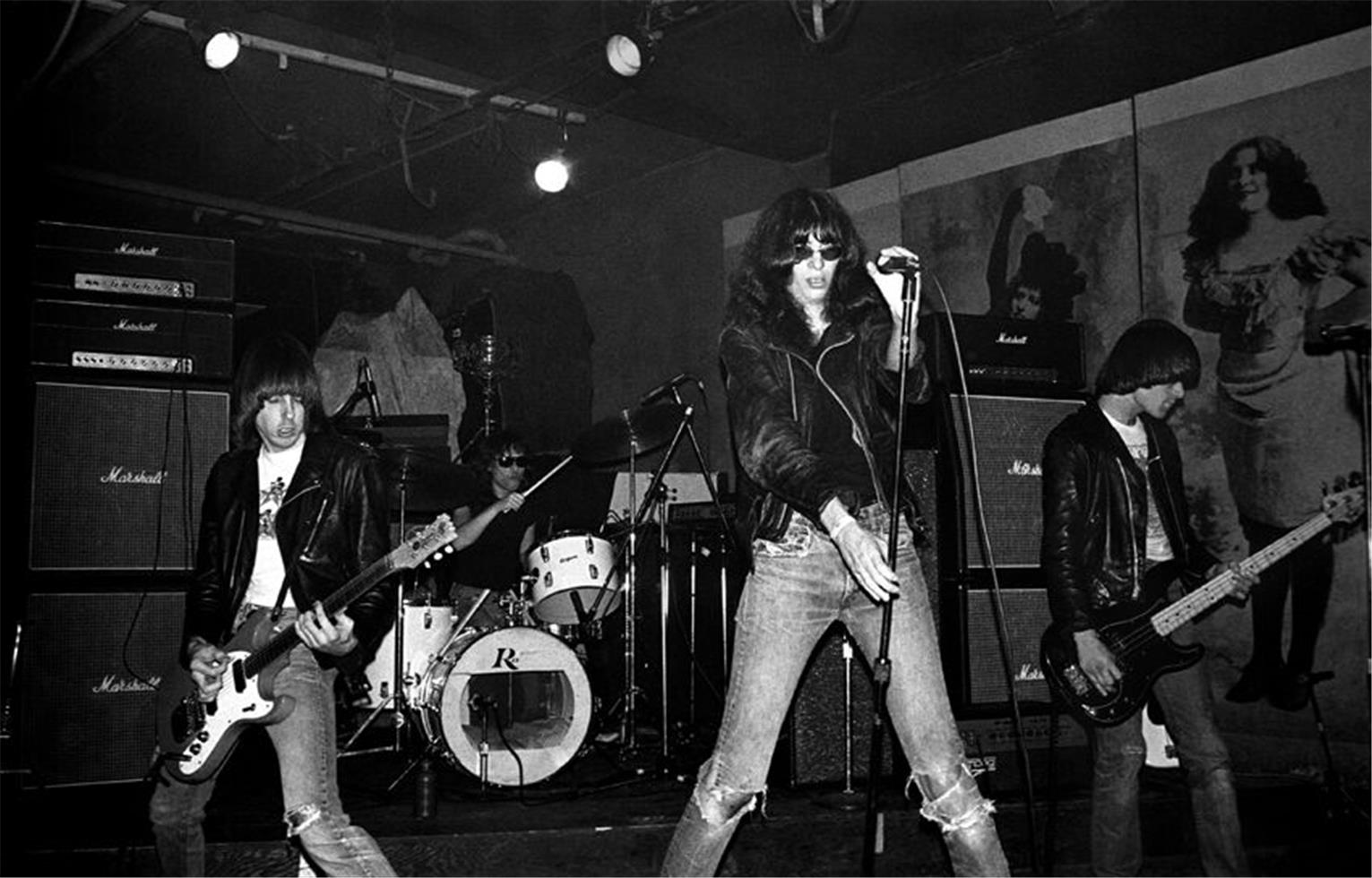
Budget constraints forced creativity. When a young vocalist from Connecticut was suggested for backing vocals, Sire Records refused to cover his train fare. Instead, Leon and Freeman layered the band’s own voices, adding hand claps and other DIY touches. Even the album’s opener, “Blitzkrieg Bop,” borrowed its opening riff from the Bay City Rollers—a detail Leon admitted with a laugh.
The final product was a masterclass in minimalism. No solos, no fills, no unnecessary flourishes—just raw, relentless energy. The Ramones had turned punk’s promise into reality: an album that sounded like it had been recorded in a garage, but with the precision of a surgical strike.

Legacy: How the ‘Unfab Four’ Shaped Generations
The Ramones’ debut wasn’t just a punk album—it was the punk album. Its influence is impossible to overstate. Bands like Metallica cited Johnny Ramone’s guitar playing as a formative influence on James Hetfield’s style, while Pearl Jam drew from the band’s raw aggression. Green Day and Blink-182 owe their three-chord hooks to the Ramones’ blueprint, and even post-punk acts like the Sex Pistols and Clash acknowledged the debt.
Leon’s production choices—split stereo, no overdubs, a live feel—became the template for punk recording. The album’s success (it peaked at No. 111 on the Billboard 200 but became a cult classic) proved that rock didn’t need prog-rock sprawl or disco’s polish to thrive. It just needed to be loud, fast, and real.
Decades later, the Ramones’ impact remains undiminished. In 2011, the band was inducted into the Rock & Roll Hall of Fame, and their debut album was preserved in the National Recording Registry by the Library of Congress. Engineers like Rob Freeman still field requests from artists trying to replicate the album’s sound, while Joey Ramone’s brother, Mickey Leigh, keeps his memory alive through the annual Joey Ramone Birthday Bash in Queens.
Leigh, who passed away in 2022, once described the album’s creation as “like waking up from a dream.” For him, the Ramones weren’t just a band—they were a family. And their music, he said, was the only thing that could keep Joey’s legacy alive.
The Ramones’ Enduring Sound
Today, the Ramones’ debut stands as a testament to the power of simplicity. In an era of hyper-produced pop and rock, its three-chord structure feels both revolutionary and timeless. The album’s tracks—each under three minutes—prove that punk wasn’t about technical prowess but attitude.
As engineer Rob Freeman put it: “When I listen to it now, I hear a solid, cohesive statement. It’s fascinating how black and white it sounds—like the studio’s acoustics made their indelible mark.” That mark is still felt today, from the indie rock revival to the resurgence of punk’s DIY ethos.
The Ramones’ debut wasn’t just music—it was a declaration. And 50 years later, its message remains as urgent as ever: rock doesn’t need to be complicated. It just needs to be real.
Why It Matters
- The Ramones’ debut album redefined rock music by stripping it down to its essentials: three chords, blistering tempo, and unfiltered energy.
- Punk’s blueprint: The album’s minimalist approach became the template for bands like Metallica, Green Day, and Blink-182.
- A collaborative effort: From Joey Ramone’s lyrics to Mickey Leigh’s behind-the-scenes work, the album was a product of collective creativity.
- Legacy of simplicity: The Ramones proved that rock didn’t need prog-rock complexity or disco polish—just raw, unfiltered energy.
- Cultural impact: The album’s influence extends beyond music, shaping fashion, attitude, and even political movements.
Where to Listen and Learn More
To experience the Ramones’ debut for yourself, stream the album on platforms like Spotify, Apple Music, or Amazon Music. For deeper dives, check out:
- The Ramones’ Rock & Roll Hall of Fame profile
- Library of Congress’s preservation of the album
- CBGB’s history and archives
As the Ramones’ music continues to inspire new generations, one thing is clear: their debut wasn’t just an album. It was a movement—and its legacy is far from over.
What’s your favorite Ramones song? Share your thoughts in the comments—and don’t forget to follow World Today Journal for more deep dives into music’s most influential stories.
Worth a look