The global automotive industry is currently navigating a fundamental shift in its operational DNA, a phenomenon frequently termed the Tesla effect
. What we have is not merely a surge in electric vehicle (EV) sales, but a systemic disruption that is forcing legacy automakers to dismantle a century of internal combustion engine (ICE) logic in favor of software-defined architectures and direct-to-consumer business models.
From the manufacturing hubs of Germany to the emerging markets of Latin America, the ripple effects of Tesla’s market entry have rewritten the rules of valuation, consumer expectation, and urban infrastructure. The pressure is no longer just about building a battery-powered car. it is about surviving a transition toward autonomous driving, integrated energy ecosystems, and a drastic reduction in the cost of ownership.
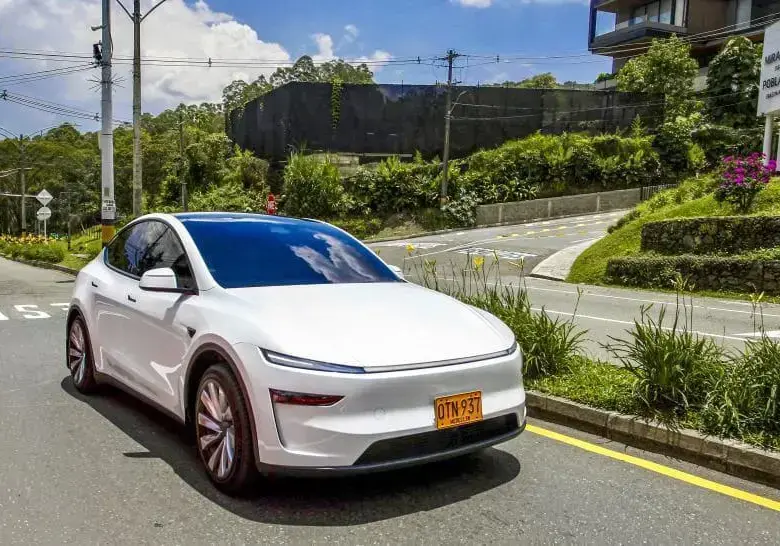
In regions like Colombia, this transition is manifesting in a visible surge of high-end EVs in cities such as Bogotá and Medellín. While Tesla does not maintain an official corporate presence in the country, the proliferation of these vehicles—imported via third-party channels—is signaling a shift in consumer appetite and is putting pressure on local infrastructure to adapt to a reality that has arrived faster than many policymakers anticipated.
As a financial journalist who has tracked global market shifts for nearly two decades, I see this as more than a trend. It is a forced evolution. The Tesla effect
is acting as a catalyst, accelerating the obsolescence of traditional dealership networks and pushing the industry toward a future where the car is viewed as a mobile device on wheels rather than a mechanical asset.
The Software-First Paradigm: Redefining the Vehicle
For decades, the value of a vehicle was tied to its mechanical engineering—the horsepower of the engine, the quality of the transmission, and the durability of the chassis. The Tesla effect has inverted this hierarchy. Today, the primary differentiator for the modern consumer is the software stack, including Over-the-Air (OTA) updates that can improve braking distance, increase battery efficiency, or add new entertainment features while the car is parked in a garage.
This shift has created a critical competency gap for legacy manufacturers. Companies that once excelled at stamping steel and managing complex supply chains are now finding themselves in a desperate race to become software companies. The challenge is not just writing code, but rethinking the entire electronic architecture of the car. Traditional vehicles employ dozens of separate Electronic Control Units (ECUs) from various suppliers; Tesla utilizes a centralized computing architecture that allows for seamless integration and rapid iteration.
This architectural difference is why legacy brands often struggle with “glitchy” infotainment systems or delayed feature rollouts. When the software is an afterthought to the hardware, the result is a fragmented user experience. By treating the vehicle as a platform, Tesla has set a benchmark that consumers now demand from every brand, regardless of whether they are buying a luxury sedan or a compact hatchback.
Economic Disruptions: Cost of Ownership and Market Valuation
One of the most potent consequences of the EV transition is the dramatic shift in the total cost of ownership (TCO). While the initial purchase price of an electric vehicle often remains higher than its gasoline counterpart, the operational expenses tell a different story. In markets like Colombia, reports indicate that operating an electric vehicle can be significantly cheaper than maintaining a gasoline-powered car, with some estimates suggesting costs can be up to 60% less
for the end user.


This economic reality is driving adoption in urban centers where stop-and-go traffic maximizes the efficiency of regenerative braking and eliminates the idling waste of internal combustion engines. However, this shift creates a paradox for the traditional automotive ecosystem. The “dealership model,” which relies heavily on the sale of parts and scheduled maintenance (oil changes, spark plugs, timing belts), is facing an existential threat. EVs have far fewer moving parts, meaning the high-margin service revenue that sustains many dealerships is evaporating.
the Tesla effect has fundamentally altered how the stock market values automotive companies. Tesla’s valuation is not based on the number of cars delivered per quarter—though that remains a key metric—but on its potential as an AI and energy company. This has forced investors to look at legacy companies through a similar lens, asking not how many cars did they sell?
but how much software revenue per vehicle are they generating?
The Latin American Context: Adoption Without Official Presence
The situation in Colombia provides a fascinating case study in market demand versus official corporate strategy. Despite the absence of an official Tesla showroom or service center in the country, the streets of Bogotá and Medellín have seen a marked increase in Tesla Model 3s and Model Ys. This “grey market” adoption proves that the brand’s prestige and the perceived utility of its technology outweigh the risks of importing a vehicle without a local manufacturer’s warranty.
This phenomenon highlights a critical gap in the global EV rollout. While the Global North focuses on subsidies and charging networks, consumers in emerging economies are often driven by a combination of status, a desire for technological modernity, and a hedge against volatile fuel prices. The presence of these vehicles in Colombia is forcing a conversation about urban planning; the “reality” of EVs has reached the city before the charging infrastructure has been fully scaled to meet it.
The pressure is now on local governments and private developers to integrate charging stations into residential buildings and commercial parking lots. The transition is no longer a theoretical goal for 2050; it is a current requirement for the residents of high-density urban areas who are already investing in the technology.
Key Impacts of the Tesla Effect on the Global Market
| Area of Impact | Traditional Model (ICE) | The “Tesla Effect” Model (EV/SDV) |
|---|---|---|
| Revenue Stream | One-time sale + Parts/Service | Sale + Software Subscriptions (SaaS) |
| Distribution | Franchised Dealership Network | Direct-to-Consumer (D2C) |
| Product Cycle | Model years / Hardware refreshes | Continuous OTA Software Updates |
| Engineering | Mechanical/Thermal Optimization | Compute/Battery/AI Optimization |
The Road Ahead: Autonomous Driving and the Energy Grid
The final and perhaps most disruptive stage of the Tesla effect is the pursuit of Full Self-Driving (FSD) and the integration of the vehicle into the wider energy grid. Tesla is not just selling a car; it is selling a node in a distributed energy network. Through products like the Powerwall and solar roof tiles, the company is attempting to control the entire energy lifecycle—from generation to storage to consumption.

For the rest of the automotive world, this is the most daunting challenge. Transitioning from a car manufacturer to an energy provider requires a level of vertical integration that most legacy brands are not equipped for. The race for autonomy is not just about the car’s ability to steer itself; it is about the data harvested from millions of vehicles to train neural networks. Tesla’s advantage lies in its massive fleet of data-collecting vehicles, creating a feedback loop that is difficult for competitors to replicate without a similarly scaled EV footprint.
As we move toward 2026 and beyond, the industry will likely see a further consolidation of “software-defined vehicles” (SDVs). The winners will not be those who build the best engine, but those who build the most intuitive, secure, and scalable operating system for the cabin.
The next critical checkpoint for the industry will be the continued rollout of the North American Charging Standard (NACS) across other manufacturers, which effectively makes Tesla’s charging infrastructure the “universal plug” for the continent—a move that further cements its role as the industry’s unofficial architect.
How is the shift to electric vehicles impacting your local infrastructure? Are you seeing the “Tesla effect” in your city? Share your thoughts in the comments below or join the conversation on our social channels.