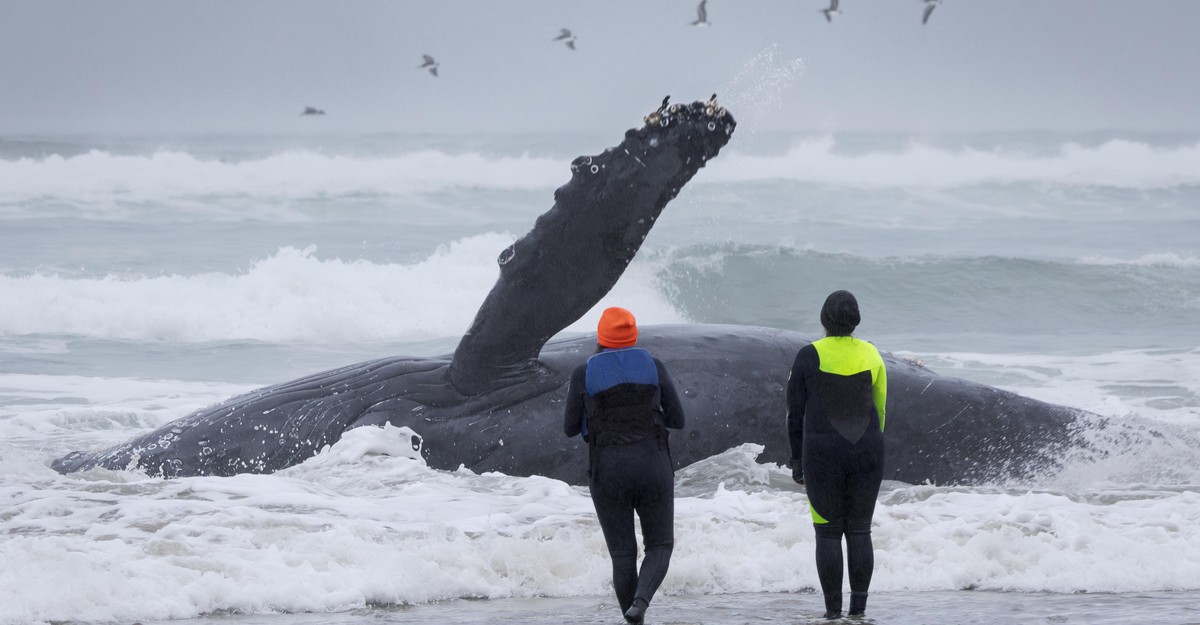
In November 2025, a juvenile humpback whale became stranded on a stretch of beach just north of Yachats, Oregon, sparking a desperate, multi-day rescue attempt that pitted citizen urgency against scientific protocol. What began as a local plea for help on social media evolved into a global digital event, drawing hundreds of volunteers and experts to the shoreline in a clash of emotional resolve and biological reality.
The whale, a female estimated to be between one and two years old, first appeared in distress half a mile offshore, entangled in gear attributed by NOAA Fisheries to the Oregon commercial Dungeness crab fishery. While a local resident managed to cut the animal free from the ropes, the whale was unable to navigate back to deep water and became lodged in the shallow surf near San Marine State Park.
As the animal lay beached, the situation became a flashpoint for the tension between “citizen science” and official wildlife management. While trained responders weighed the risks of the rough surf and the whale’s internal health, a crowd of volunteers—ranging from Navy veterans to local contractors—took matters into their own hands, attempting to manually push the 26-foot animal back into the Pacific.
The Digital Call to Action and the Citizen Response
The rescue effort gained momentum when local resident Amy Parker posted grainy images of the whale to a community Facebook page, warning that the animal would not survive the night without intervention. The plea resonated far beyond the Oregon coast, attracting people from cities like Eugene, Salem and Corvallis, and drawing suggestions from as far away as Japan and Australia.
Among those who responded was Rob Heater, a 62-year-old retired contractor and Navy veteran. Heater, who co-owns an escape room in Newport, joined a group of about six people wading into waist-high water to push the whale in tandem with the waves. For hours, volunteers formed bucket brigades to keep the whale’s skin wet and attempted to soothe the animal, which some observers described as uttering a deep, vibrating purr in response to gentle care.
Although, the enthusiasm of the crowd often conflicted with the safety mandates of the National Oceanic and Atmospheric Administration (NOAA). Under the Marine Mammal Protection Act, the public is generally prohibited from getting within 100 yards of a humpback whale. Experts warned that a full-grown humpback can weigh up to 80,000 pounds, and even a juvenile’s fluke can be lethal if the animal rolls in rough water.
The Struggle Between Expertise and Urgency
Jim Rice, program manager of the Oregon Marine Mammal Stranding Network, expressed concern over the citizen-led efforts. From a biological perspective, whales rarely beach unless they are severely ill or injured. Once ashore, the sheer weight of a whale’s blubber can crush its internal organs, meaning that even a successful refloating does not guarantee survival.
The rescue attempt transitioned to a professional operation when John Calambokidis, a NOAA-certified whale researcher from Olympia, Washington, arrived to implement a specialized refloating system. Calambokidis attempted to use a complex array of ropes, pulleys, and buried anchors—a method he had successfully used for a gray whale in 2017. However, the operation was plagued by equipment failures; several ropes were missing, the release mechanism broke, and a final sling snapped under the tension.

By Monday, November 17, 2025, the whale had been out of the water for two full days. With the animal’s condition deteriorating and rescue equipment failing, officials determined that euthanasia was the only humane option. The decision sparked vitriol online, with some critics accusing the experts of “killing the whale” after the citizens had fought to save it.
A Rare Cultural Harvest
Following the euthanasia, the event took a significant cultural turn. Oregon officials coordinated with the Confederated Tribes of Siletz Indians, allowing tribal members to perform a ceremonial harvest. This marked the first time in generations that the tribe had been able to harvest meat, blubber, and bones from a beached whale.
Tribal members formed a circle around the animal, offering tobacco and prayers of thanks. The blubber was collected for use in making soap, and the bones were preserved for traditional uses. For the Siletz Indians, the process transformed a biological tragedy into a spiritual opportunity, honoring the animal’s life and sacrifice.

Aftermath and Scientific Findings
A necropsy conducted by the Marine Mammal Institute at Oregon State University and other specialists provided further insight into the animal’s fate. While the entanglement in crab gear was the immediate cause of the stranding, a report published in April 2026 indicated that the juvenile humpback suffered from multiple chronic illnesses, suggesting that the animal may have been compromised before it ever encountered the fishing gear.
For the volunteers like Rob Heater, the experience left a lasting impact. Despite the outcome, the shared struggle created a profound sense of community among strangers. Heater noted that the event served as a “reset,” reminding him of the potency of the real world over the digital echo chambers of social media.
Key Details of the Yachats Stranding
| Detail | Information |
|---|---|
| Date of Stranding | November 15, 2025 |
| Location | North of Yachats, Oregon (San Marine State Park) |
| Species/Age | Juvenile Humpback Whale (1-2 years old) |
| Estimated Length | 26 feet |
| Primary Cause | Entanglement in commercial crab fishery gear |
| Outcome | Euthanized November 17, 2025 |
The incident serves as a stark reminder of the dangers posed by derelict fishing gear to marine mammals and the complex ethical dilemmas that arise when public emotion clashes with professional conservation protocols. Officials continue to monitor the impact of commercial fishing gear on the West Coast humpback population.
For those wishing to report a stranded marine mammal or learn more about legal requirements for rescue, official guidance is available through the NOAA Fisheries stranding network.
World Today Journal encourages readers to share their thoughts on the balance between citizen intervention and expert protocol in wildlife rescues in the comments below.