In the world of cinematic satire, few characters manage to dominate a narrative while remaining almost entirely silent. Such is the case with Joan Rubinsky in Theater Camp, the formidable founder of the AdirondACTS theater camp. Though she is physically absent for the vast majority of the film, her influence permeates every scene, serving as the spiritual and emotional anchor for a community of eccentric artists, neurotic instructors, and hopeful children.
Directed by Molly Gordon and Nick Lieberman, Theater Camp is a sharp, affectionate mockumentary that premiered at the Sundance Film Festival in 2023. The film captures the chaotic energy of a summer arts program in upstate New York, but at its core, it is a study of legacy and the maternal instinct—both biological and chosen. Joan Rubinsky, played by Amy Sedaris, embodies the paradoxical nature of a mentor who is both demanding and deeply inclusive.
The narrative irony begins almost immediately. The documentary crew arrives to profile Joan, only for her to fall into a coma just three minutes into the film. The cause is as theatrical as the setting: a strobe light-induced seizure during a middle school production of Bye Bye Birdie. From that moment on, Joan is shifted from a character to a catalyst, her absence creating a vacuum that the rest of the camp must scramble to fill.
The Presence of Absence: Joan’s Spiritual Blueprint
While Joan spends 95% of the movie in a hospital bed, her “spiritual presence,” as noted by the film’s narrative arc, is as thick as the summer humidity in upstate New York. For the campers and staff of AdirondACTS, Joan is not merely a director or a boss; she is the architect of their identity. This is evidenced by the desperate attempts of the staff to maintain her standards in her absence.

The camp’s leadership—specifically Rebecca-Diane (Molly Gordon), the head of music theory, and Amos (Ben Platt), the head of drama—operate in a state of codependency that mirrors the intensity of the theater world. In a moment of peak desperation during casting decisions, Rebecca-Diane even attempts to channel Joan through a séance, illustrating the depth of the staff’s reliance on her guidance.
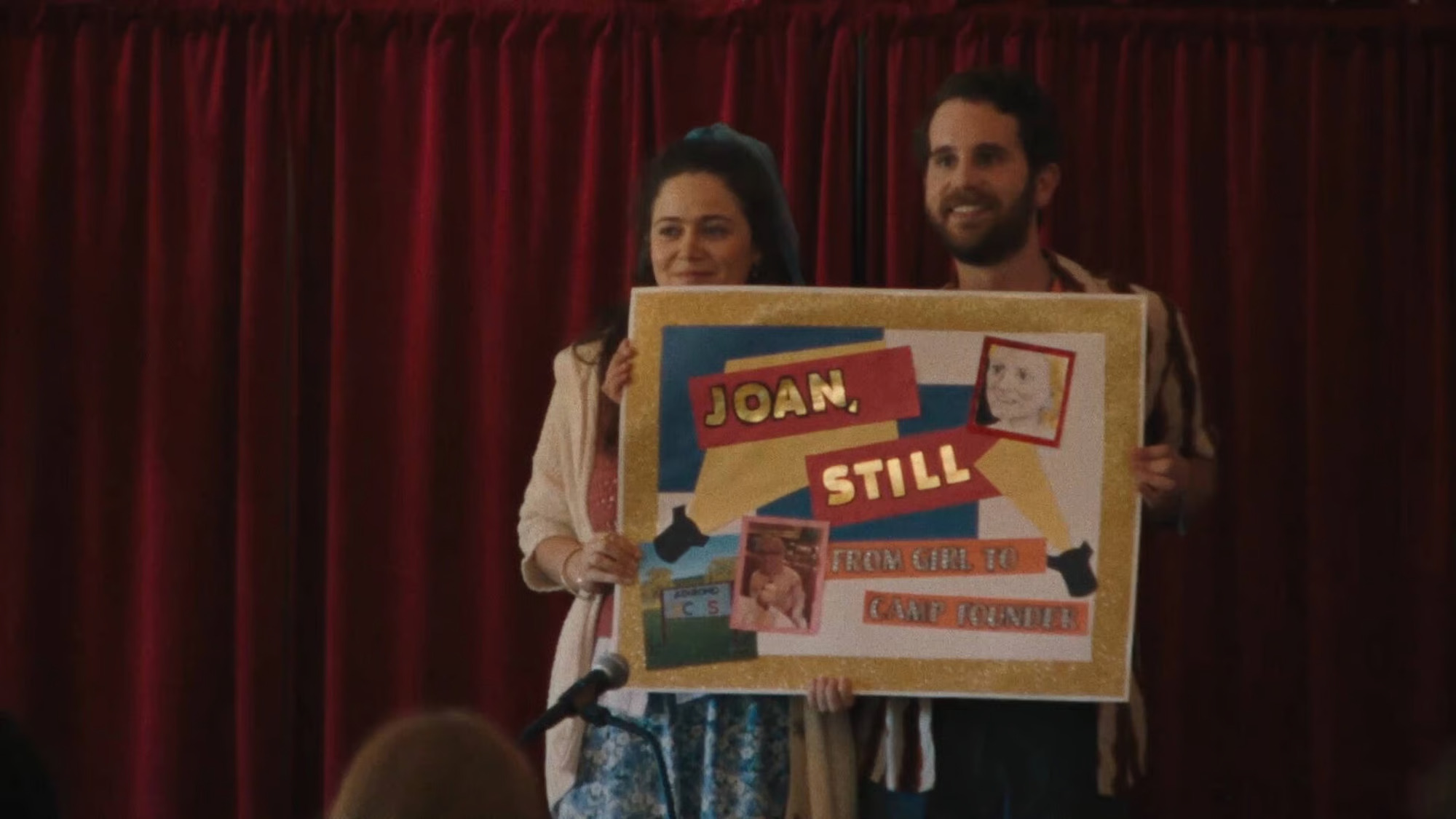
The devotion to Joan is further immortalized in the camp’s premier musical. Every year, Rebecca-Diane and Amos write and direct a new show; this year’s production is titled Joan, Still. A sweeping, tear-jerking tribute to the founder’s life, the musical features an audacious disco number set in Studio 54, complete with a giant papier-mâché nose that snorts cocaine. Through this absurdly grand spectacle, the film highlights how Joan’s life has become the primary mythology of the camp.
AdirondACTS: A Sanctuary for the Outcasts
Beyond the comedy, Theater Camp explores the vital role that specialized arts communities play in the development of marginalized youth. Joan Rubinsky did not build AdirondACTS simply to produce plays; she built it to provide a home for those who felt they didn’t fit in anywhere else. In a recording from the film’s opening minutes, Joan explains her mission: “I wanted to make a place where anyone is free to be themselves.”
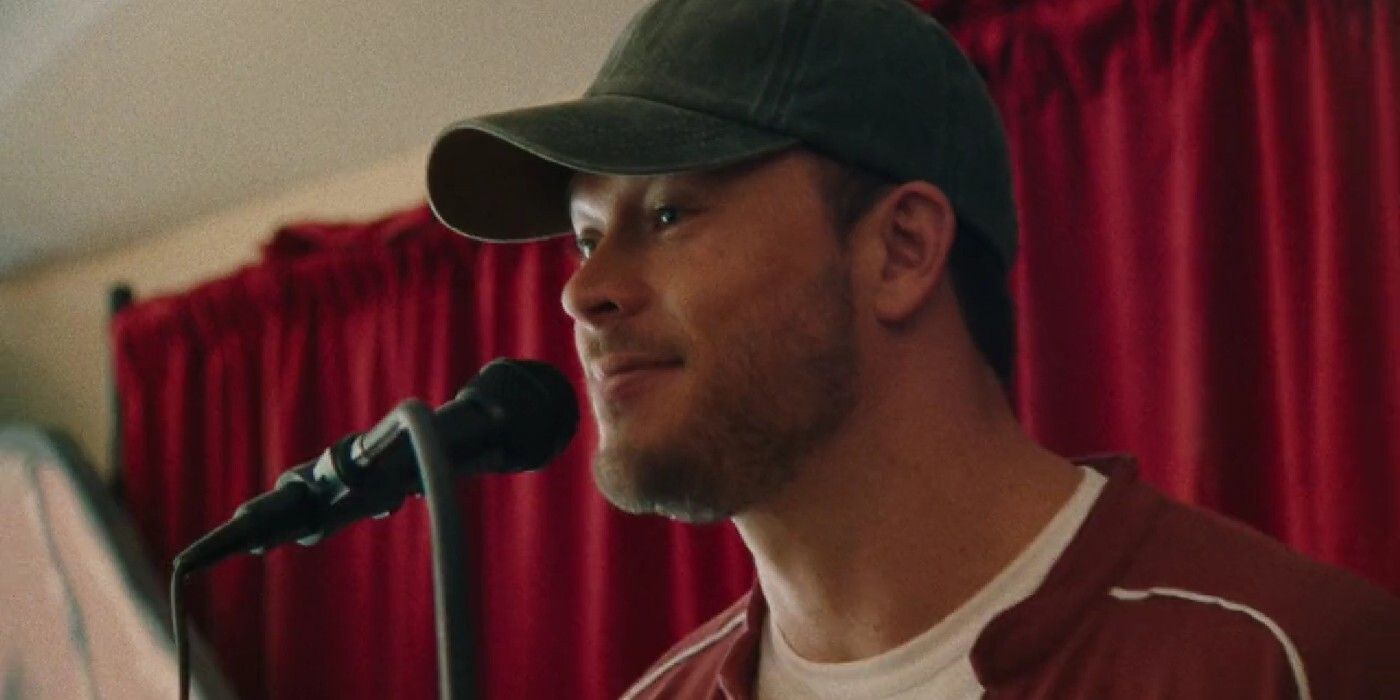
This philosophy of radical acceptance is what allows the camp to function despite its cutthroat competition for roles. By opening night, the campers transition from rivals to a family, discovering that the camp offers a place for everyone, regardless of their specific skill set. Whether a student is belting a solo, managing light cues, or sewing costumes, Joan’s blueprint ensures that every contribution is valued.
This inclusive environment extends even to the staff. Janet (Ayo Edebiri), an instructor who secured her position by fabricating a magnificent set of lies on her résumé, eventually discovers her own genuine teaching talents. The camp’s ability to absorb and empower the unqualified is a direct reflection of Joan’s belief that there is space for everyone at the table.
The Maternal Bond and the Path to Redemption
The film also examines the complex relationship between Joan and her son, Troy (Jimmy Tatro). A wannabe financial influencer with no background in theater, Troy is the antithesis of everything AdirondACTS represents. However, when he is forced to step in as the camp’s temporary leader, he discovers that the camp is on the brink of foreclosure.
Troy’s journey is one of the film’s most earnest threads. While he may not share his mother’s passion for the arts, his efforts to save the camp are driven by a profound love for Joan. He recognizes that AdirondACTS is not just a business, but his mother’s life’s work. In trying to preserve the camp, Troy begins to understand the devotion his mother had for her “chosen” children—the hundreds of campers she mentored over the years.
A Legacy of Unconventional Encouragement
Perhaps the most revealing insight into Joan Rubinsky’s character comes during a traditional, booze-fueled staff bonfire. Gigi (Owen Thiele), the camp’s costume designer, offers a toast to Joan that encapsulates her unique approach to mentorship. Gigi recalls his time as a young camper and the blunt honesty Joan provided him.

“So I was a camper here,” Gigi recounts. “And Joan said to me, she looked me in the eyes, she said, ‘You’re untalented. You can’t dance, you can’t sing. You can’t act. You’re exceptionally bad at this. But you look amazing. Your skin is glowing, and your outfit is unbelievable.’ And she was right.”
This moment defines Joan’s brilliance: she didn’t offer empty praise, but instead helped her students find their specific niche. By acknowledging Gigi’s lack of traditional performing talent while validating his aesthetic eye, she steered him toward a career in costume design. It is a poignant reminder that the most effective mentors are those who see people for who they actually are, rather than who they are expected to be.

Joan Rubinsky may be absent from the screen for the majority of the runtime, but she remains the beating heart of the story. Through her legacy at AdirondACTS, she teaches the characters—and the audience—that the most valuable thing one can provide for a child is a place where they are free to be themselves.
For those interested in the intersection of comedy and the performing arts, Theater Camp serves as both a satire and a love letter to the “theater kids” of the world. The film is currently available through Searchlight Pictures distributions.
Do you have a favorite memory from a summer camp or a mentor who helped you find your “niche”? Share your stories in the comments below and let us know how Theater Camp resonated with your own experiences in the arts.
Worth a look