
The Secrets of Biological Time: How Artificial Cells Illuminate the Mysteries of Circadian Rhythms
For millennia, humanity has been captivated by the natural rhythms of life. From the daily cycle of sleep and wakefulness to seasonal changes influencing migration and reproduction, these internal clocks govern a vast array of biological processes. Now, groundbreaking research from UC Merced is bringing us closer to understanding the fundamental mechanisms behind these “circadian rhythms,” not through studying living organisms directly, but through remarkably accurate artificial cells. This work isn’t just a scientific curiosity; it has profound implications for fields ranging from medicine and agriculture to our understanding of life itself.
Decoding the Biological Clock
Circadian rhythms - derived from the Latin circa diem, meaning “about a day” – are approximately 24-hour cycles that regulate crucial physiological functions in nearly all living beings. These rhythms influence sleep-wake cycles, hormone release, body temperature, and even cognitive performance.Disruptions to these rhythms, caused by factors like jet lag or shift work, are linked to a host of health problems, including sleep disorders, metabolic syndrome, and increased risk of certain cancers.
But how do these clocks maintain such precise timing, especially considering the inherent randomness at the molecular level within cells? This is the question that drove a team led by bioengineering Professor Anand Bala Subramaniam and chemistry and biochemistry Professor Andy LiWang at UC Merced. Thier innovative approach, recently published in Nature Communications, offers compelling new insights.
Building a Clock from the Ground Up: The Vesicle Approach
the researchers focused on the circadian rhythms of cyanobacteria, a type of bacteria known for its robust internal clock. Rather of dissecting the complex machinery within a living cyanobacterial cell, they opted for a simplified model: vesicles. These are essentially tiny,cell-like structures,devoid of the usual cellular complexities.
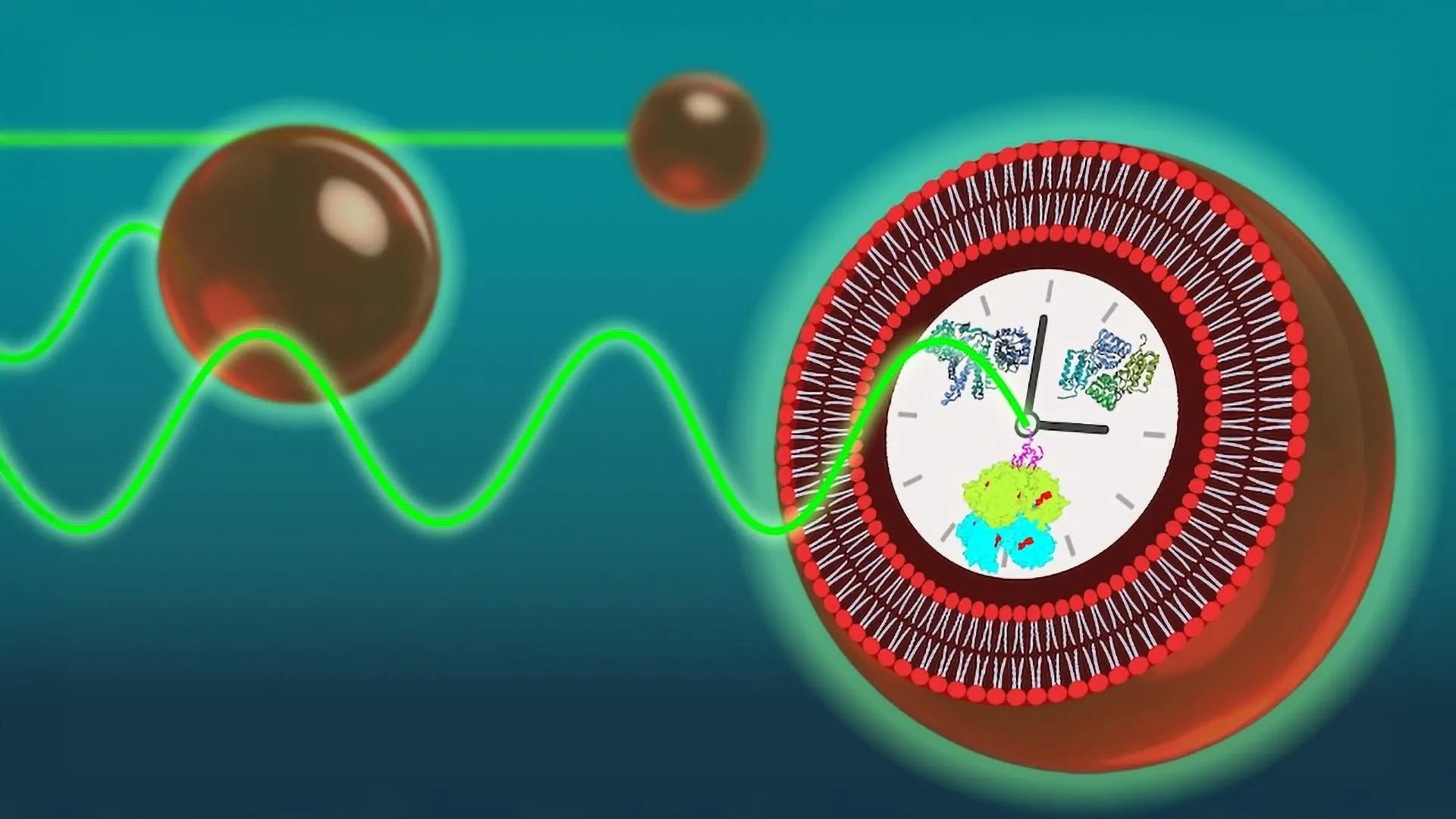
The team meticulously reconstructed the core components of the cyanobacterial clockwork within these vesicles, loading them with key clock proteins. Crucially, one of these proteins was tagged with a fluorescent marker, allowing the researchers to visually track the clock’s activity.The result? The artificial cells glowed with a remarkably consistent 24-hour rhythm for at least four days.
This wasn’t merely a exhibition of replication; it was a controlled experiment. By systematically altering the conditions – reducing the number of clock proteins or shrinking the size of the vesicles – the researchers observed a predictable breakdown of the rhythmic glow. This loss of rhythm wasn’t random; it followed a distinct pattern, providing valuable clues about the underlying principles of biological timekeeping.
The Power of Numbers: A Computational Model Reveals Key Insights
To decipher the observed patterns, the team developed a refined computational model. This model revealed a critical factor in maintaining clock robustness: protein concentration. The simulations showed that higher concentrations of clock proteins acted as a buffer against molecular noise,allowing the vesicles to maintain accurate timing even with slight variations in protein levels.Essentially, a larger “pool” of proteins ensures the clock doesn’t falter due to random fluctuations.
Interestingly, the model also suggested that another component of the natural circadian system – the machinery responsible for gene expression (turning genes on and off) – isn’t essential for maintaining the rhythm within individual cells. However, it plays a vital role in synchronizing the timing of clocks across a population of cells. This highlights a hierarchical association of the circadian system, with individual cell clocks operating independently but coordinated by broader signaling mechanisms.
Further examination revealed a practical consideration: clock proteins have a tendency to adhere to the vesicle walls. This means a higher overall protein count is necessary to ensure sufficient proteins remain “free” to participate in the clock’s cyclical process.
implications and Future Directions
this research represents a meaningful methodological advancement in the study of biological clocks. As Mingxu Fang, a microbiology professor at Ohio State University and an expert in circadian clocks, notes, “This new study introduces a method to observe reconstituted clock reactions within size-adjustable vesicles that mimic cellular dimensions.This powerful tool enables direct testing of how and why organisms with different cell sizes may adopt distinct timing strategies, thereby deepening our understanding of biological timekeeping mechanisms across life forms.”
The ability to dissect and understand the core principles of biological timekeeping using simplified, synthetic systems opens up exciting possibilities. Researchers can now explore how different environmental factors influence clock function,test the effects of potential drug targets,and even design artificial biological systems with customized circadian rhythms.
The work by Subramaniam and LiWang, supported by grants from the National Science Foundation, National Institutes of Health, and Army Research Office, is a testament to the power of interdisciplinary collaboration and innovative experimental design. It’s a crucial step towards unraveling one of life’s most fundamental mysteries – the enduring rhythm that governs us all.
Timeless Insights: The Broader Significance of Circadian Research
The study of circadian rhythms extends far beyond the realm of basic





