For decades, cosmologists have grappled with a fundamental contradiction at the heart of our existence: the missing antimatter. According to standard physics, the Big Bang should have produced equal amounts of matter and antimatter, which would have promptly annihilated one another, leaving behind a universe filled with nothing but radiation. Yet, we live in a world dominated by matter.
Recent scientific hypotheses suggest that exploding black holes could explain an antimatter mystery that has long puzzled the global research community. By examining the earliest moments of the universe, researchers are exploring how tiny, primordial black holes may have tipped the scales in favor of the matter that eventually formed stars, planets and people.
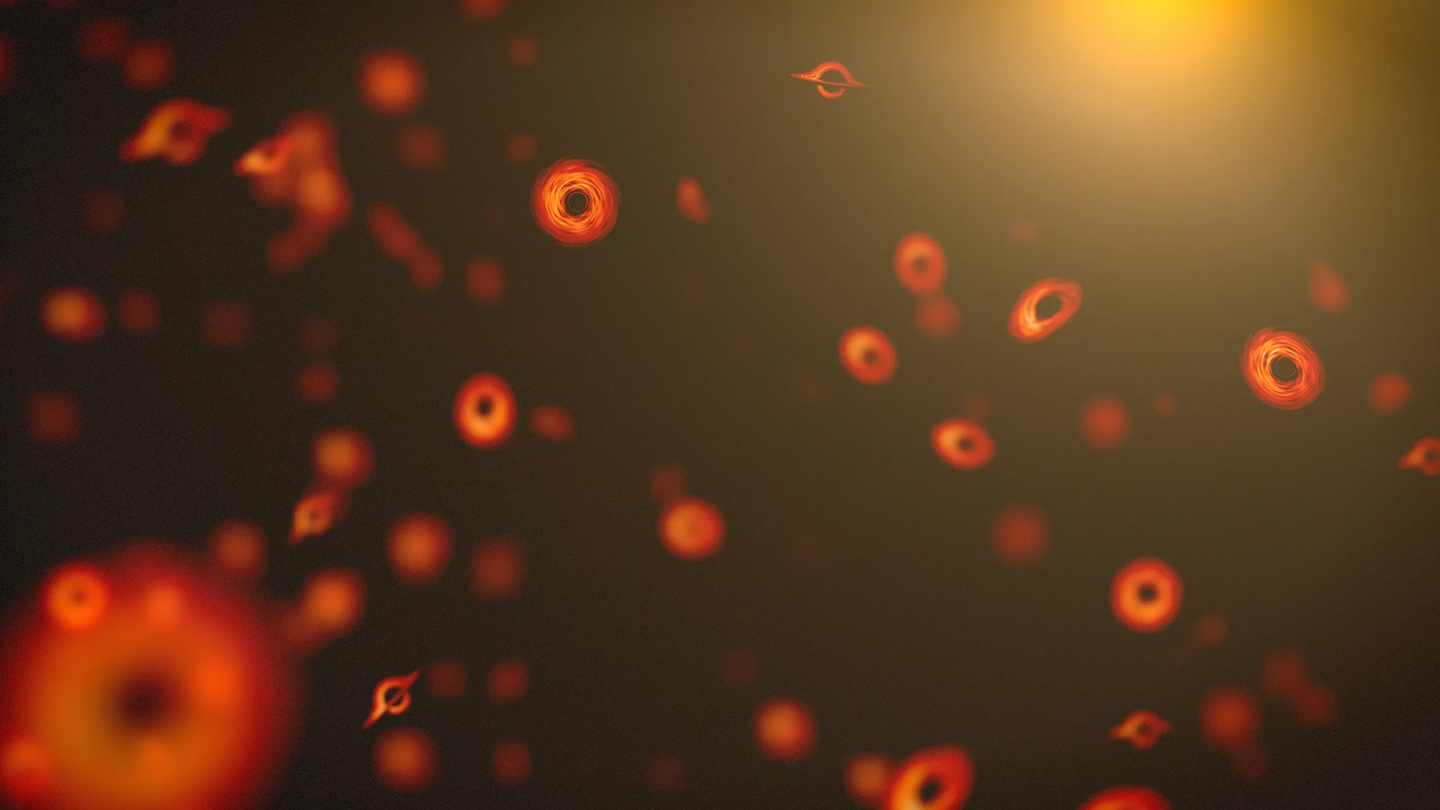
This theory centers on the behavior of “primordial” black holes—objects born not from the collapse of massive stars, but from the extreme density of the Big Bang itself. The potential discovery of these objects provides a novel lens through which to view the evolution of the early cosmos.
Spacetime Ripples and the Evidence for Tiny Black Holes
The search for primordial black holes has long been theoretical, but new data suggests we may be closer to physical proof. Evidence indicates that ripples in spacetime may have revealed the first evidence of tiny black holes born during the Big Bang, according to reporting from Space.
These ripples, known as gravitational waves, act as a cosmic record. Given that primordial black holes would have been significantly smaller than the stellar-mass black holes observed today, their signatures in spacetime are distinct. Identifying these tiny remnants allows scientists to reconstruct the conditions of the early universe and test theories regarding why matter prevailed over antimatter.
How Exploding Black Holes Reshaped the Universe
The mechanism proposed to solve the antimatter mystery involves the violent end of these primordial black holes. Unlike larger black holes that persist for trillions of years, tiny black holes are theorized to evaporate and eventually explode.
According to Phys.org, exploding primordial black holes might have reshaped the early universe and created all matter as we know it. The process likely involved the emission of shock waves during these explosions.
These shock waves may have created the necessary conditions to disrupt the symmetry between matter and antimatter. By favoring the production or survival of matter particles over their antimatter counterparts, these explosions could explain why antimatter became so rare while matter became the dominant building block of the cosmos.
What This Means for Modern Physics
If this theory is confirmed, it would resolve one of the most significant gaps in the Standard Model of physics. The “antimatter mystery” is not merely a theoretical curiosity; it is a question of why anything exists at all. If the balance had remained equal, the universe would have remained a void of light with no solid structures.
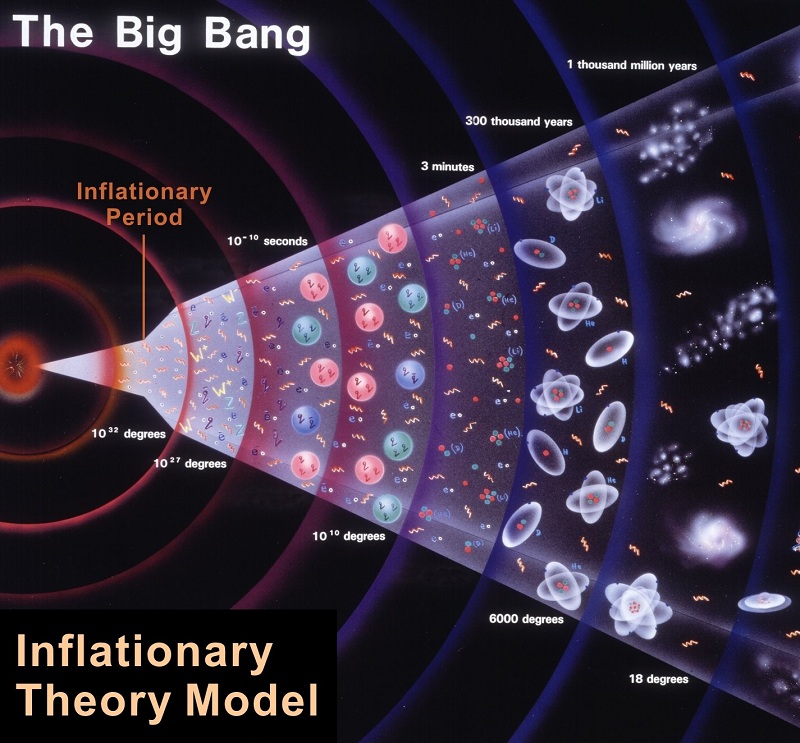
The intersection of black hole thermodynamics and early-universe cosmology suggests that exploding black holes could explain an antimatter mystery by providing a physical mechanism for “baryogenesis”—the process that produced the imbalance of matter over antimatter.
Key Takeaways on Primordial Black Holes
- Origin: Primordial black holes were born in the immediate aftermath of the Big Bang, rather than from dying stars.
- Evidence: Ripples in spacetime (gravitational waves) are being analyzed as the first potential evidence of these tiny objects.
- The Mechanism: Shock waves from the explosions of these black holes may have created the matter-antimatter imbalance.
- Impact: This process potentially explains the existence of all observable matter in the current universe.
Further verification of this theory relies on the continued detection and analysis of gravitational waves. As sensors become more sensitive, astronomers hope to locate more definitive signatures of these primordial explosions to confirm how our matter-dominated universe came to be, as detailed by Science News.
We encourage our readers to share their thoughts on these cosmic discoveries in the comments below.