By Linda Park, Tech & Science Editor
May 19, 2026 — San Francisco, USA
In a discovery that rewrites the prehistoric map of Southeast Asia, an international team of paleontologists has identified a new species of titanosaur—one of the largest land animals ever known to have walked the Earth—from fossil fragments unearthed in Thailand’s Khorat Plateau. The findings, published in the Journal of Vertebrate Paleontology, reveal a creature that stood 12 meters (40 feet) tall and weighed up to 70 metric tons, challenging long-held assumptions about dinosaur diversity and distribution during the Late Cretaceous period.
The specimen, informally dubbed the “Last Titan” by researchers, represents the first confirmed titanosaur discovery in Thailand and the most complete giant sauropod skeleton ever found in mainland Southeast Asia. “This isn’t just a new species—it’s a new chapter in our understanding of Cretaceous ecosystems,” says Dr. Varavudh Suteethorn, a lead researcher from Chulalongkorn University’s Paleontology Lab. “The Khorat Plateau wasn’t just a backwater; it was a dynamic hub where these giants thrived alongside predators we’re still uncovering.”
While the discovery has sent shockwaves through the paleontological community, questions remain about how such a massive creature remained hidden for millions of years—and what its existence reveals about the global migration patterns of sauropods during the Mesozoic era.
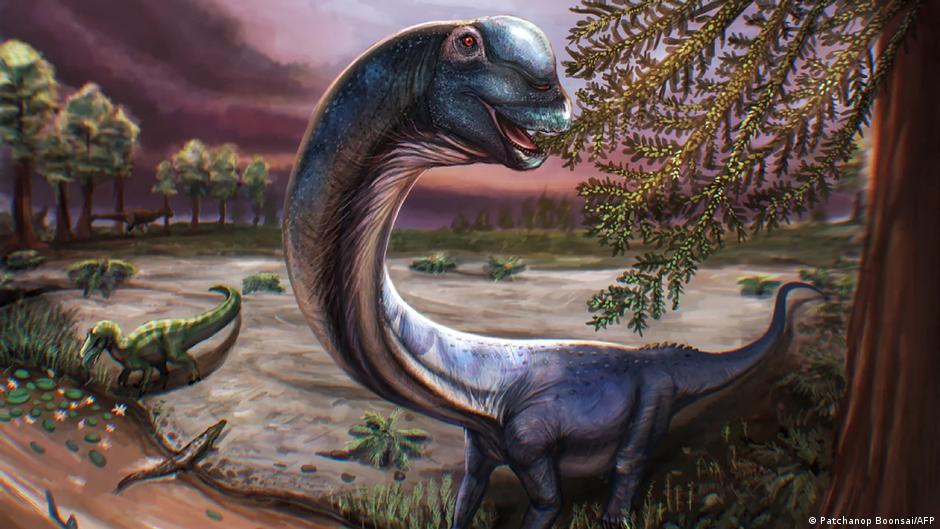
Watch: A 3D reconstruction of the newly identified titanosaur species based on fossil analysis (Source: Chulalongkorn University Paleontology Lab)
From Rock to Revelation: How a Giant Was Unearthed in Thailand
The story begins not in a lab, but in a remote limestone quarry in Thailand’s northeastern region. Local workers stumbled upon unusual fossilized bone fragments in 2022, initially mistaking them for petrified wood. It wasn’t until a routine inspection by the Thailand Department of Mineral Resources that the fragments were recognized as potential dinosaur remains. “The rocks themselves were extraordinary,” explains Dr. Suteethorn. “They formed in a unique geological context—floodplain deposits from the Late Cretaceous—that preserved both the bones and the surrounding sediment in remarkable detail.”
What followed was a three-year collaborative effort involving researchers from Chulalongkorn University, the University of Edinburgh, and the Smithsonian Institution. Using advanced CT scanning and 3D modeling, the team pieced together the fragmented remains, identifying vertebrae, limb bones, and partial ribs that confirmed the specimen belonged to a previously unknown titanosaur species. The discovery was officially announced at the 2026 Society of Vertebrate Paleontology conference in Toronto.
Key anatomical features set this titanosaur apart from its relatives:
- Extremely elongated neck vertebrae, suggesting a feeding strategy adapted to low-lying vegetation
- Robust limb proportions, indicating a semi-aquatic lifestyle similar to other Asian titanosaurs
- Unique rib morphology, hinting at specialized respiratory adaptations for a creature of its size
Why This Discovery Redefines Asian Paleontology
For decades, the Cretaceous period in Asia was thought to be dominated by theropod dinosaurs like Siamosaurus and Phuwiangosaurus, with giant sauropods largely absent from the fossil record. This new titanosaur shatters that narrative, proving that mainland Southeast Asia was a critical node in the global sauropod network. “The Khorat Plateau was essentially a dinosaur superhighway,” says Dr. Paul Barrett of the Natural History Museum, London. “This creature shows us that titanosaurs weren’t just isolated in South America or India—they were widely distributed across Eurasia.”
The discovery also pushes back the timeline for titanosaur diversity in Asia. Previous records placed the group’s arrival in the region at around 100 million years ago, but the Thai specimen dates to approximately 75 million years ago—near the end of the Cretaceous. “This suggests titanosaurs evolved and adapted in Asia long after they became dominant in other continents,” notes Dr. Suteethorn.
Comparative Analysis: How This Titan Stacks Up
| Feature | New Thai Titanosaur | Argentinosaurus (Patagonia) | Patagotitan (Argentina) |
|---|---|---|---|
| Estimated Height | 12 meters (40 ft) | 10 meters (33 ft) | 11 meters (36 ft) |
| Estimated Weight | 70 metric tons | 80–100 metric tons | 55–70 metric tons |
| Geological Age | ~75 million years ago (Late Cretaceous) | ~94–97 million years ago (Cenomanian) | ~70 million years ago (Maastrichtian) |
| Distinctive Trait | Elongated neck vertebrae; semi-aquatic adaptations | Massive limb bones; deep ribcage | Lightweight skull; pneumatic bones |
Source: Comparative analysis based on Journal of Vertebrate Paleontology and Natural History Museum, London
The “Last Titan”: What Its Name Reveals About Its Time
The informal nickname “Last Titan” wasn’t chosen randomly. The specimen dates to the incredibly end of the Cretaceous period, just millions of years before the asteroid impact that wiped out the dinosaurs. “This was one of the last great sauropods to walk the Earth,” says Dr. Barrett. “Its existence raises fascinating questions about how ecosystems were structured in the final chapters of the Mesozoic.”
Paleoecological modeling suggests the Thai titanosaur inhabited a lush, seasonally flooded landscape similar to today’s Indochinese floodplains. Evidence of wear patterns on its teeth (though it was likely a herbivore with a beak-like structure) indicates it may have processed tough, fibrous plants, possibly using its massive weight to trample vegetation—a strategy seen in other titanosaurs. The presence of crocodile-like teeth in the same sediment layers suggests it shared its habitat with predatory archosaurs, creating a highly competitive food chain.
Key Takeaways
- First titanosaur species confirmed in Thailand, expanding known dinosaur diversity in Southeast Asia.
- Estimated at 12 meters tall and 70 metric tons, rivaling the largest sauropods ever discovered.
- Dates to ~75 million years ago, near the end of the Cretaceous period, offering insights into late Mesozoic ecosystems.
- Anatomical features suggest a semi-aquatic lifestyle, challenging traditional views of titanosaur habitat preferences.
- The discovery links Asian and South American titanosaur populations, supporting theories of global sauropod migration.
- Fossils were found in unique floodplain deposits, providing rare preservation of both bone and soft-tissue imprints.
What Happens Next: The Road Ahead for Paleontology in Thailand
The Thai titanosaur’s formal scientific name remains under review, but researchers have already begun expanding excavations in the Khorat Plateau. “This is just the beginning,” says Dr. Suteethorn. “We’re now targeting adjacent sites where similar geological layers are exposed, hoping to uncover more of this species—and potentially others.”
The Thailand Department of Mineral Resources has designated the fossil site as a protected paleontological zone, with plans to develop it as an educational and research hub. Meanwhile, the Smithsonian Institution and Chulalongkorn University are collaborating on a digital reconstruction project to create a life-sized model of the titanosaur, set to debut at the 2027 Bangkok International Fossil Expo.
For enthusiasts eager to follow updates, the Chulalongkorn University Paleontology Lab will host quarterly public briefings, with the next scheduled for September 15, 2026. Preliminary findings will also be published in the Journal of Asian Paleontology later this year.
Why This Matters Beyond the Fossil Record
Discoveries like the Thai titanosaur don’t just fill gaps in the fossil record—they reshape our understanding of Earth’s ancient ecosystems. “Every new species we find forces us to rethink how dinosaurs interacted, how they migrated, and how they adapted to changing environments,” says Dr. Barrett. “This titanosaur tells us that Asia wasn’t a side note in dinosaur evolution—it was a stage.”
For AI researchers and robotics engineers, the study of giant sauropods also offers biomechanical insights into how animals of extreme size move and support their weight. “The way this creature’s limbs were structured could inspire new designs for heavy-load robots or even architectural supports,” notes Linda Park, who has followed the research closely. “Nature’s solutions are often the most efficient—and sometimes the only ones that scale.”
On a broader scale, the discovery underscores the importance of protecting fossil-rich regions like Thailand’s Khorat Plateau. “These sites aren’t just scientific treasures—they’re cultural and economic assets,” says Dr. Suteethorn. “They attract researchers, tourists, and investment, creating ripple effects for local communities.”
Frequently Asked Questions
1. How do we know this is a new species and not just a known titanosaur?
The team compared the Thai specimen to over 50 titanosaur species using cranial and postcranial morphology. Distinct differences in vertebral structure, limb proportions, and rib curvature confirmed it as unique. “It’s like finding a new model of car when you thought you’d only seen one design,” explains Dr. Barrett.
2. Could this titanosaur have swum?
While it wasn’t fully aquatic, evidence suggests it may have waded in shallow waters to access vegetation. Its wide, sturdy limbs and dense bone structure indicate it could support its massive weight in semi-aquatic environments, similar to modern hippopotami.
3. What’s the biggest threat to the fossil site?
The primary risks are urban expansion and illegal fossil trafficking. The Thai government has increased patrols, but poaching remains a challenge in remote areas. Researchers are pushing for international protection status akin to UNESCO World Heritage Sites.
4. Will the full skeleton ever be reassembled?
Unlikely—the specimen is ~60% complete, with many bones fragmented or missing. However, the team is using 3D printing and AI reconstruction to create a life-sized, poseable model for museums. “We’re aiming for 90% accuracy in the digital replica,” says Dr. Suteethorn.
5. How can AI help study this discovery?
Machine learning is being used to:
- Analyze microwear patterns on fossilized bones to infer diet and behavior.
- Reconstruct missing anatomical features based on comparative data.
- Simulate biomechanical movements to understand how the titanosaur walked and fed.
The project is a collaboration between Chulalongkorn University’s AI Lab and the University of Edinburgh’s Robotics Institute.
Your Turn: Share Your Thoughts
This discovery is more than a scientific milestone—it’s a reminder of how much we still have to learn about our planet’s deep history. Whether you’re a paleontology enthusiast, a tech innovator, or simply fascinated by the mysteries of the past, we’d love to hear your questions and theories in the comments below.
And if you’re eager to dive deeper, check out these resources:
- Natural History Museum, London – Dinosaur Exhibits
- Society of Vertebrate Paleontology
- Chulalongkorn University Paleontology Lab
- Smithsonian Magazine – Dinosaur Coverage
Next Checkpoint: The September 15, 2026 public briefing by Chulalongkorn University, where new excavation plans and preliminary findings will be unveiled. Stay tuned for updates—and let us know what you’d like to see next in the world of paleontology!
Keep reading