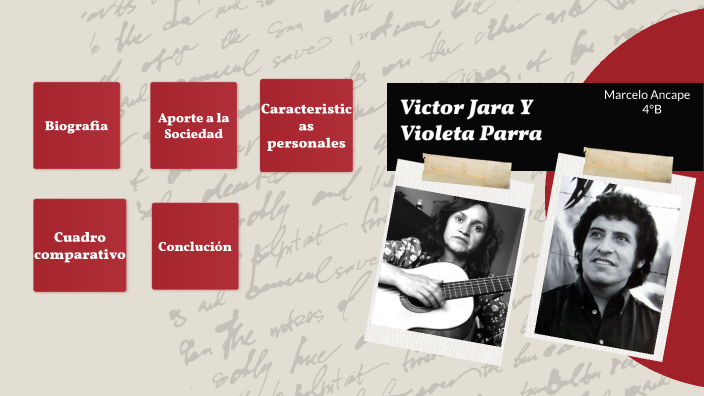
When it comes to sharing Chilean music with international friends, few artists carry the weight and warmth of Violeta Parra and Victor Jara. Their function, deeply rooted in folk traditions and social consciousness, continues to resonate across generations and borders. For listeners discovering Chile’s rich musical heritage, these names often serve as the essential starting point—a gateway into a sound that is both historically profound and emotionally immediate.
Violeta Parra, widely regarded as the mother of Nueva Canción Chilena (New Chilean Song), dedicated her life to collecting, preserving, and reimagining traditional folk music from across Chile. Her efforts were not merely archival. she transformed ancient melodies and rural poetry into powerful original compositions that spoke to identity, struggle, and beauty. Songs like “Gracias a la Vida” and “Volver a los 17” have been covered by artists worldwide, yet their origins lie in Parra’s fieldwork during the 1950s and 1960s, when she traveled extensively to document indigenous and campesino (peasant) musical expressions.
Victor Jara, a contemporary and collaborator in spirit with Parra, brought a theatrical intensity and unwavering political commitment to the movement. A teacher, director, and singer-songwriter, Jara used his art to amplify the voices of the marginalized. His repertoire blended traditional forms with original songs that addressed labor rights, inequality, and hope. Tracks such as “Te Recuerdo Amanda” and “El Derecho de Vivir en Paz” remain anthems of dignity and resistance, performed in solidarity movements from Latin America to Europe.
The legacy of both artists is preserved not only in recordings but in ongoing efforts to protect their intellectual property. In recent years, heirs and cultural advocates in Chile have worked to reclaim control over master recordings and publishing rights that had fallen into unclear or fragmented ownership. This struggle mirrors broader global conversations about artists’ rights, particularly in the digital age, where access to cultural heritage often depends on complex licensing agreements.
Beyond Parra and Jara, Los Jaivas represent another cornerstone of Chilean musical innovation. Formed in the 1960s, the band began as a folk-rock ensemble before evolving into a pioneering force in Andean fusion. Their incorporation of traditional instruments like the quena, zampoña, and charango with electric guitars and experimental structures created a distinctive sound that bridged ancestral rhythms with psychedelic and progressive rock influences. Albums such as “Alturas de Macchu Picchu,” based on the poem by Pablo Neruda, are considered masterpieces of Latin American rock.
For foreign listeners seeking an authentic introduction, a curated playlist might initiate with Parra’s “Arauco Tiene una Pena,” a haunting tribute to the Mapuche resistance; Jara’s “Plegaria a un Labrador,” a simple yet devastating song about a farmer’s life; and Los Jaivas’ “Mira Niñita,” which blends folk melody with intricate orchestration. These tracks offer not only musical richness but insight into Chile’s cultural landscape—its indigenous roots, rural realities, and enduring spirit of artistic resistance.
Streaming platforms have made this music more accessible than ever, though availability can vary by region due to licensing restrictions. Official channels maintained by foundations such as the Violeta Parra Museum and the Victor Jara Foundation often provide curated content, including rare recordings, interviews, and documentaries. These resources assist contextualize the music within its historical moment, ensuring that listeners understand not just the sound, but the stories behind it.
recommending Chilean music to friends abroad is about sharing more than melodies—it’s about inviting them into a narrative of memory, resilience, and creative courage. Whether through the raw sincerity of a solo voice and guitar or the expansive textures of a band like Los Jaivas, Chile’s musical tradition offers a profound listening experience that transcends language.
Related reading