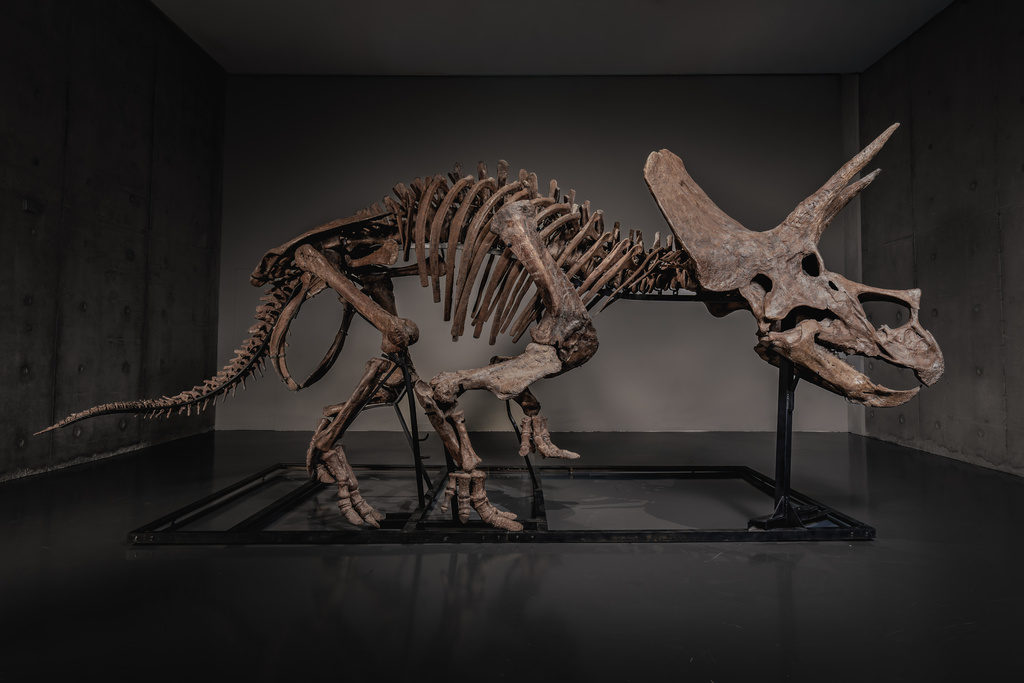
The market for dinosaur fossils continues its meteoric rise, with a rare Triceratops skeleton, nicknamed “Trey,” poised to hit the auction block this month. The fossil, which once graced the Wyoming Dinosaur Center, represents a significant offering in a sector increasingly attracting high-profile investors and collectors. The auction, scheduled to run from March 17 to 31 on the online platform Joopiter, founded by Grammy-winning musician Pharrell Williams, has a pre-auction estimate of $4.5 million to $5.5 million.
This sale is particularly noteworthy as it involves a dinosaur that was previously on public display. For nearly three decades, “Trey” served as a centerpiece at the Wyoming Dinosaur Center in Thermopolis, captivating visitors since the museum’s 1995 opening. The skeleton remained on loan to the center until 2023, becoming a beloved fixture and potentially inspiring a new generation of paleontologists. The increasing frequency of museum-exhibited fossils appearing at auction signals a shift in the landscape of paleontological collecting, raising questions about access to these important scientific resources.
A Cretaceous Giant Heads to Auction
“Trey” dates back to the late Cretaceous period, more than 66 million years ago. Discovered in 1993 near Lusk, Wyoming, by Lee Campbell and the late Allen Graffham, a respected commercial paleontologist known for numerous significant finds, the 17-foot-long herbivore is now in Singapore, available for private viewings until the end of March, according to Joopiter. The fossil’s journey from the Wyoming landscape to an international auction house underscores the growing global demand for these prehistoric relics.
Paleontologist Andre LuJan, who collaborated with Joopiter in preparing the fossil for auction, emphasized the cultural significance of “Trey.” “Trey has this cultural aspect that a lot of fossils that go to auction these days just simply don’t have,” LuJan stated. “This one is connected to people and undoubtedly has inspired young children who’ve seen it to pursue a career in paleontology.” This connection to the public, LuJan believes, adds to the fossil’s appeal and value.
The Rising Value of Dinosaur Fossils
The auction of “Trey” occurs against a backdrop of escalating prices for dinosaur fossils. In 2024, the remains of “Apex,” a Stegosaurus, fetched a record-breaking $44.6 million at auction, surpassing the previous high of $31.8 million paid for “Stan,” a Tyrannosaurus rex skeleton, in 2020. A Sotheby’s auction in July of the same year saw a young dinosaur skeleton sell for over $30 million, exceeding its initial estimate of $4 million to $6 million. These sales demonstrate a clear trend: dinosaur fossils are increasingly viewed not just as scientific specimens, but as valuable investments.
Caitlin Donovan, Joopiter’s global head of sales, attributes this surge in interest to a broader shift in collecting preferences. “Some discoveries transcend category, reminders of how vast time really is,” Donovan said. “Joopiter is proud to present a piece of history truly millions of years in the making.” She noted a move away from traditional investments like old master paintings towards objects possessing “cultural resonance,” and dinosaurs, with their enduring fascination, clearly fit that bill.
Concerns Over Access and Preservation
However, the booming market for dinosaur fossils isn’t without its critics. Some paleontologists express concern that the escalating prices could price museums and universities out of the market, leading to important specimens disappearing into private collections. Kristi Curry Rogers, a paleontologist at Minnesota’s Macalester College, warned that public museums are “getting totally priced out of an exploding market.”
The core issue revolves around access to these fossils for scientific research. “If a fossil goes into a private collection without guaranteed access forever, that data is essentially lost to science,” Curry Rogers explained. The ability to study these fossils is crucial for understanding prehistoric life, evolution and the Earth’s history. Without access, valuable scientific information could be lost.
LuJan acknowledged these concerns, emphasizing that “Trey” has always been privately owned. He expressed hope that the new owner will follow the example set by the buyer of “Apex,” who secured a long-term loan agreement with the American Museum of Natural History in New York, ensuring continued scientific study of the specimen. “Given that we’ve had this paradigm shift in what owning dinosaurs means to society, people are naturally gravitating toward these benevolent situations where they loan them long-term to museums or they end up donating them to a new museum that’s just being born,” LuJan stated.
Joopiter and the New Landscape of Fossil Auctions
The auction of “Trey” is being handled by Joopiter, an online auction platform founded by Pharrell Williams. Williams, a Grammy-winning artist and producer, launched the platform with a vision of connecting collectors with unique and culturally significant items. Joopiter’s entry into the dinosaur fossil market signals a broadening of the auction landscape and a potential appeal to a new demographic of collectors. The platform aims to present fossils not just as scientific artifacts, but as works of art and historical treasures.
The increasing commercialization of paleontology raises complex questions about the balance between private ownership, scientific research, and public access. As dinosaur fossils continue to command ever-higher prices, the debate over their fate is likely to intensify. The outcome of the “Trey” auction will undoubtedly be closely watched by paleontologists, collectors, and museum professionals alike, offering a glimpse into the future of this fascinating and increasingly valuable market.
The auction for “Trey” is scheduled to conclude on March 31st. Interested parties can find more information about the auction and view the fossil in Singapore through the end of March via the Joopiter website: https://joopiter.com/.
What are your thoughts on the increasing commercialization of dinosaur fossils? Share your opinions in the comments below, and be sure to share this article with anyone interested in paleontology and the evolving world of collectible investments.
Related reading