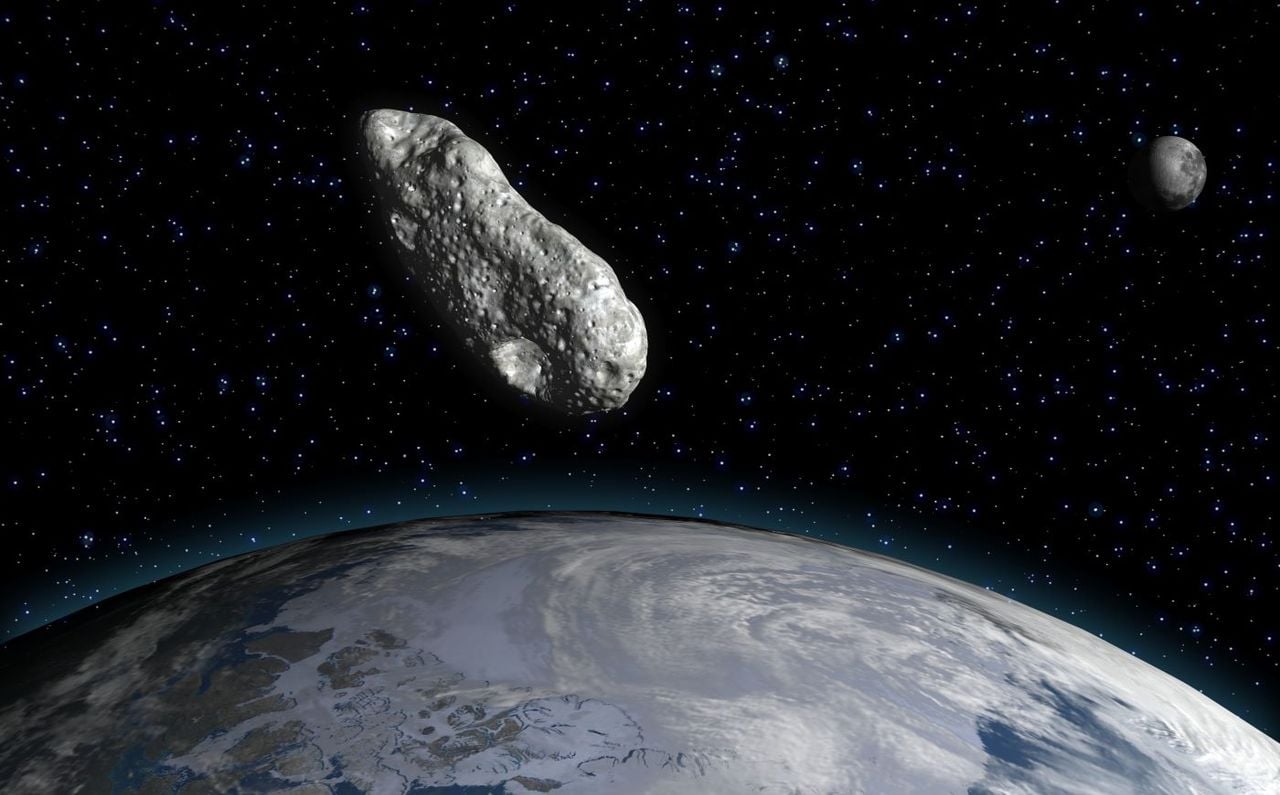
Trojan asteroids are small celestial bodies that share the same orbital path as a planet, remaining trapped in stable gravitational pockets known as Lagrange points. These asteroids do not collide with the host planet because they are locked into specific locations—specifically the L4 and L5 points—where the gravitational pull of the planet and the Sun balance out, allowing the objects to lead or follow the planet in its journey around the star. These stable regions act as gravitational pockets, keeping the asteroids in a synchronized dance.
While Earth has at least two known Trojan asteroids, the term originates from the study of Jupiter, which hosts thousands of these objects. Jupiter’s massive gravitational influence creates significant Trojan populations in our solar system. The study of these bodies provides researchers with a better understanding of the universe, as their composition often reflects the primordial material present when the planets were still forming. Understanding these stable orbits is a focus for planetary scientists who monitor near-Earth objects to ensure long-term orbital safety.
The Mechanics of Stability: How Trojan Asteroids Stay Put
The existence of Trojan asteroids is governed by the principles of celestial mechanics. In any system consisting of two large bodies, such as the Sun and a planet, there are points in space where a third, smaller object can maintain a fixed position relative to the two larger ones. These are the Lagrange points. The L4 and L5 points are unique because they are stable, meaning that if an object is nudged slightly, it will naturally oscillate around the point rather than drifting away.

Trojan asteroids are not “captured” in the traditional sense of an object being pulled into orbit by a planet’s gravity alone. Instead, they are remnants of the material that occupied the orbital path during the planet’s formation. Because they reside at these specific points, they maintain a constant angular distance of 60 degrees ahead of or behind the planet. This orbital configuration ensures that they remain safely separated from the planet itself, effectively shielding the planet from direct impact by these specific objects.
Planetary Defense and Near-Earth Objects
While Trojan asteroids are generally stable and pose no immediate threat to Earth, the broader study of asteroids remains a critical component of planetary defense. NASA leads the global effort to detect and track near-Earth objects (NEOs) that could potentially intersect with our planet’s path. Unlike Trojan asteroids, which are locked into stable configurations, NEOs are often influenced by the gravitational tugs of various planets, which can alter their trajectories over time.

In recent years, the focus of planetary defense has shifted from mere observation to active mitigation. The successful 2022 Double Asteroid Redirection Test (DART) mission demonstrated that humanity possesses the capability to alter the trajectory of an asteroid through kinetic impact. The DART spacecraft successfully changed the orbit of the asteroid moonlet Dimorphos, confirming that a deflection strategy is viable if a hazardous object is identified early enough.
Why Scientists Study Trojan Populations
Beyond the concerns of planetary defense, Trojan asteroids serve as tools for researchers. Because these objects have remained in stable orbits, they have been largely shielded from the thermal processing and collisions that have altered other bodies in the asteroid belt. By analyzing the composition of these asteroids, scientists can gain insights into the chemical environment of the solar system during its infancy. This is the objective of missions like the NASA Lucy mission, which is surveying multiple Jupiter Trojans to characterize their surface properties and internal structures.
The Lucy mission, which launched in October 2021, represents space exploration of these Trojan populations. By conducting flybys of several different Trojans, the mission aims to test models of solar system formation and evolution. The diversity of the objects being visited—ranging from different sizes to varied spectral types—will provide data on Trojan asteroids, helping scientists understand how the migration of giant planets early in the solar system’s history influenced the distribution of these bodies.
Future Observations and Public Engagement
Public interest in asteroid research often spikes around the annual International Asteroid Day, observed on June 30. This date commemorates the 1908 Tunguska event, a massive airburst in Siberia caused by a small asteroid or comet. Organizations like the United Nations and various planetariums worldwide use this day to promote education regarding the ongoing efforts to map the solar system and mitigate the risks posed by hazardous asteroids.

As technology advances, the precision of our orbital models continues to improve, allowing for earlier detection of potential threats and more detailed analysis of stable populations like the Trojans. The scientific community remains committed to a transparent, global approach to asteroid monitoring, ensuring that the study of these celestial bodies contributes both to our fundamental understanding of the universe and to the long-term safety of our planet. Readers are encouraged to follow the latest updates from official space agencies and participate in local educational events hosted at observatories and planetariums to learn more about the ongoing exploration of our solar system.