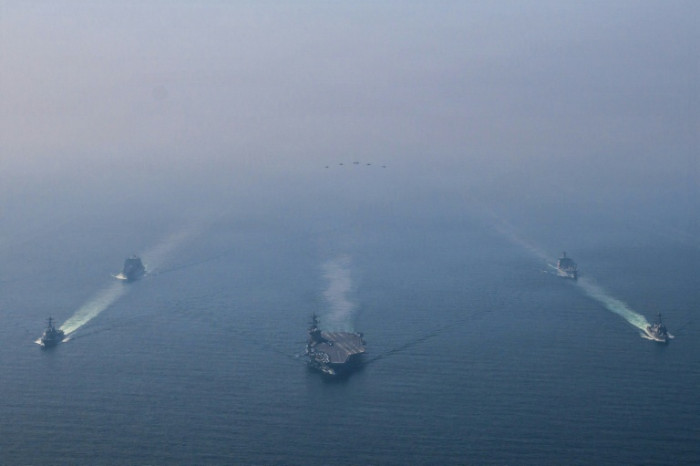
Washington D.C. – The specter of military conflict in the Middle East looms large as President Donald Trump continues to weigh options regarding Iran’s nuclear program and its response to recent domestic unrest. Amidst escalating tensions, the U.S. Navy has significantly bolstered its presence in the region, with the arrival of the USS Abraham Lincoln carrier strike group and the potential deployment of a second carrier, the USS Gerald Ford. This show of force comes as negotiations between the U.S. And Iran, aimed at curbing Iran’s nuclear ambitions, appear to be reaching a critical juncture, with both sides reportedly preparing draft proposals for a potential agreement. The situation is further complicated by conflicting reports regarding the scope of those negotiations, particularly concerning Iran’s uranium enrichment activities.
The current standoff is rooted in a complex history of strained relations, punctuated by the 2018 withdrawal of the United States from the Joint Comprehensive Plan of Action (JCPOA), commonly known as the Iran nuclear deal. That decision, under the previous administration, led to the reimposition of sanctions on Iran, severely impacting its economy and prompting a gradual rollback of its commitments under the agreement. The economic hardship fueled widespread protests in Iran, beginning in December 2023 and intensifying in recent weeks, met with a forceful crackdown by Iranian authorities. These protests, and the subsequent human rights concerns, have added another layer of complexity to the already fraught diplomatic efforts. The potential for miscalculation and escalation remains high, prompting international calls for restraint and a renewed commitment to dialogue.
President Trump’s recent rhetoric has further heightened anxieties. He initially suggested that “bad things” would happen if a deal wasn’t reached within ten days, a timeframe he later extended to fifteen. When directly asked on Friday whether he was contemplating a limited military strike, Trump responded, “The most I can say – I am considering it.” This ambiguous statement, coupled with the ongoing naval buildup, underscores the seriousness of the situation and the potential for a rapid deterioration in relations. The deployment of two aircraft carrier strike groups to the region represents a substantial commitment of U.S. Military resources and signals a willingness to apply force if diplomatic efforts fail. The USS Abraham Lincoln arrived in the Middle East in January, and the potential addition of the USS Gerald Ford would further amplify the U.S. Military presence.
Negotiations at a Crossroads: Differing Accounts from Washington and Tehran
Whereas both Washington and Tehran acknowledge ongoing negotiations, significant discrepancies exist in their public accounts of the discussions. Iranian Foreign Minister Abbas Araghchi stated that a draft proposal for an agreement could be ready within “two, three days,” to be submitted to Steve Witkoff, Trump’s main Middle East negotiator. Araghchi also asserted that U.S. Negotiators have not requested Iran to halt its uranium enrichment program, a claim that directly contradicts statements from American officials. “We have not offered any suspension, and the US side has not asked for zero enrichment,” Araghchi said in an interview with MS NOW, adding that discussions are focused on ensuring Iran’s nuclear program remains peaceful. The Associated Press reported on the arrival of the USS Abraham Lincoln and the ongoing tensions.
This assertion stands in stark contrast to President Trump’s repeated insistence that Iran must not be allowed to enrich uranium at any level. Western countries have long accused Iran of seeking to develop nuclear weapons, a charge that Tehran vehemently denies, maintaining its right to enrichment for civilian purposes. The core disagreement centers on the level of enrichment permitted and the safeguards necessary to ensure that Iran’s nuclear program remains solely for peaceful applications. The International Atomic Energy Agency (IAEA) plays a crucial role in monitoring Iran’s nuclear facilities and verifying compliance with international agreements. The agency’s reports are often cited by both sides in the dispute, but interpretations of those reports can differ significantly.
Economic Pressures and Domestic Unrest Fueling Tensions
Iran’s economic woes are a central factor driving its willingness to negotiate. The sanctions imposed by the United States have crippled Iran’s oil exports, its primary source of revenue, and have contributed to a sharp decline in the value of its currency. These economic hardships sparked widespread protests in December 2023, which escalated into a nationwide anti-government movement last month. Reports from human rights organizations indicate that Iranian authorities responded to the protests with a brutal crackdown, resulting in a significant number of deaths and arrests. While precise figures remain difficult to verify, estimates suggest that thousands may have been killed in the unrest. BBC Verify has been tracking the U.S. Military buildup in the Gulf and the situation surrounding the protests.
The Iranian government has blamed foreign powers, including the United States and Israel, for instigating the protests, accusing them of seeking to destabilize the country. These accusations have further inflamed tensions and hardened the government’s stance in negotiations. The protests also highlight the deep-seated grievances within Iranian society, including economic inequality, political repression, and social restrictions. Addressing these underlying issues will be crucial for achieving a lasting resolution to the crisis. The potential for further unrest remains high, particularly if economic conditions do not improve and political reforms are not implemented.
Regional Implications and International Responses
The escalating tensions between the U.S. And Iran have significant implications for regional stability. Israel, a staunch U.S. Ally, has consistently advocated for a hard line against Iran and has expressed concerns about its nuclear program and its support for militant groups in the region. The Israeli army has stated it is on “defensive alert” regarding the situation with Iran, but has maintained that its public guidelines remain unchanged. Other regional powers, including Saudi Arabia and the United Arab Emirates, also have a vested interest in the outcome of the negotiations, as they are directly affected by the geopolitical dynamics in the Middle East.
The international community has largely urged both sides to exercise restraint and to return to the negotiating table. European powers, who were signatories to the JCPOA, have expressed concern about the potential collapse of the agreement and have called for a diplomatic solution. However, efforts to mediate between the U.S. And Iran have been hampered by deep-seated mistrust and conflicting agendas. The potential for a military confrontation remains a serious concern, and the consequences of such a conflict could be devastating for the region and beyond. The presence of the USS Abraham Lincoln and the potential deployment of the USS Gerald Ford underscore the U.S.’s commitment to maintaining a strong military presence in the Middle East and its willingness to use force if necessary. Forbes reported on President Trump warning of a potential second aircraft carrier deployment.
The coming days will be critical in determining whether a diplomatic solution can be reached. The submission of draft proposals by both sides represents a potential breakthrough, but significant obstacles remain. The key sticking points include the scope of Iran’s uranium enrichment program, the duration of any agreement, and the lifting of sanctions. The international community will be closely watching developments and urging both sides to engage in constructive dialogue. The stakes are high, and the consequences of failure could be far-reaching.
As of today, February 20, 2026, the next key development to watch for is the reported delivery of draft proposals to Steve Witkoff, President Trump’s Middle East negotiator, within the next two to three days, as indicated by Iranian Foreign Minister Abbas Araghchi. Further updates are expected following a review of these drafts by both Washington and Tehran. We encourage readers to share their perspectives and engage in constructive discussion in the comments section below.
Worth a look