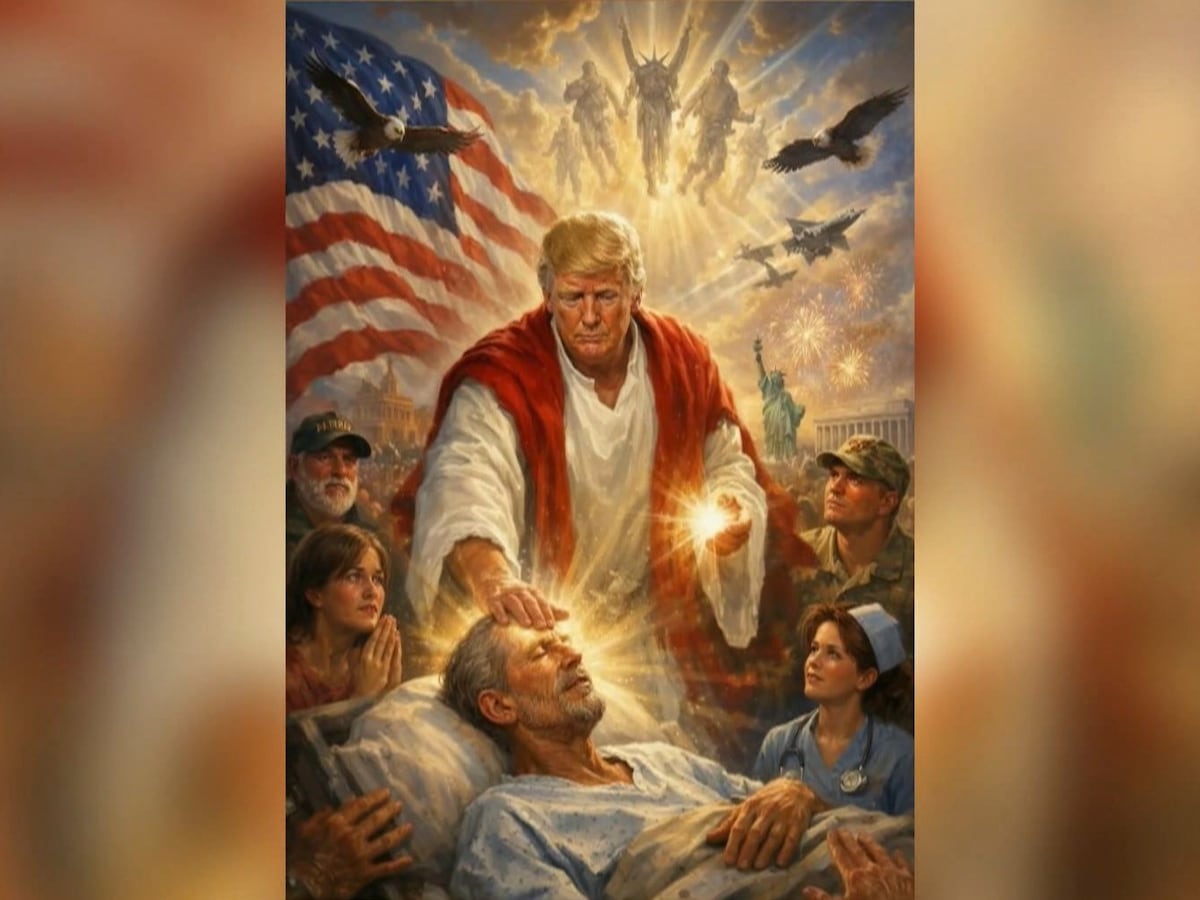
President Donald Trump has removed a controversial artificial intelligence-generated image of himself depicted as Jesus Christ from his Truth Social account. The image, which was posted on Sunday, April 12, was deleted this Monday, April 13, following a significant wave of criticism from Catholic associations, religious representatives, and various conservative organizations aligned with the president.
The removal of the image comes at a moment of heightened tension between the White House and the Vatican. The AI-generated depiction portrayed President Trump as Jesus Christ in the act of healing a sick individual, a visual that sparked immediate backlash among religious groups who viewed the representation as inappropriate.
This digital controversy coincides with an unprecedented public confrontation between the U.S. President and Pope Leo XIV. In a series of statements over the last 48 hours, President Trump has launched sharp critiques against the pontiff, signaling a volatile shift in the relationship between the United States and the Holy See.
Backlash Over AI-Generated Imagery
The decision to delete the post follows intense pressure from the president’s own base of support, specifically Catholic and conservative stakeholders. While the image was intended to resonate with religious followers, it instead triggered condemnation from those who found the comparison between a political leader and the central figure of Christianity to be crossing a theological line.
The image was part of a broader social media presence on Truth Social that has recently been characterized by aggressive rhetoric toward international and religious leaders. By removing the depiction on Monday, the administration appears to be attempting to mitigate the fallout from religious allies who expressed discomfort with the imagery.
Escalating Feud with Pope Leo XIV
The removal of the image is the latest development in a widening rift between President Trump and Pope Leo XIV. On Sunday, April 12, Trump posted a lengthy message on Truth Social criticizing the pope, calling him “weak on crime” and “terrible for foreign policy.”
Speaking later to reporters at Joint Base Andrews in Maryland, the president further clarified his stance, stating, “I don’t think he’s doing a incredibly good job. … I am not a fan of Pope Leo.” Trump characterized the pontiff as “a very liberal person.” Even after the initial outcry, the president doubled down on his comments Monday morning, stating he would not apologize as “Pope Leo said things that are wrong” according to reports on the global reaction.
The friction appears to stem from Pope Leo XIV’s recent diplomatic efforts regarding the conflict in Iran. On April 11, while presiding over a vigil for peace at St. Peter’s Basilica at the Vatican, the pope issued an urgent plea for an end to hostilities. “Stop! It’s time for peace! Sit at tables of dialogue and mediation, not at tables where rearmament is planned and death actions are deliberated,” the pope declared, crying out, “Enough of war!”
Global Implications and the Iran Conflict
The clash between the U.S. President and the pope has resonated far beyond the Vatican, drawing reactions from the Iranian leadership. Iranian President Masoud Pezeshkian issued a statement on April 13 condemning the insults directed at the pontiff. In a social media post, Pezeshkian wrote: “His Holiness Pope Leo XIV, I condemn the insult to Your Excellency on behalf of the great nation of Iran and declare that the desecration of Jesus, the prophet of peace and brotherhood, is not acceptable to any free person.”
This diplomatic friction occurs against a backdrop of failing peace negotiations. On April 12, peace talks involving Vice President JD Vance collapsed. Vance, an Iraq War veteran and Catholic convert, attributed the failure of the talks to Iran’s refusal to commit to the abandonment of its nuclear program as detailed in recent coverage of the diplomatic breakdown.
The intersection of religious imagery, personal attacks on the papacy, and the collapse of nuclear negotiations has created a volatile diplomatic environment. As the administration navigates the backlash from its domestic religious base and the condemnation from international actors, the stability of U.S.-Vatican relations remains uncertain.
You’ll see currently no scheduled official meetings between the White House and the Vatican to resolve these tensions. Further updates on the status of Iran peace talks or official responses from the Holy See are expected as the situation evolves.
World Today Journal encourages readers to share their perspectives on the intersection of political leadership and religious imagery in the comments section below.