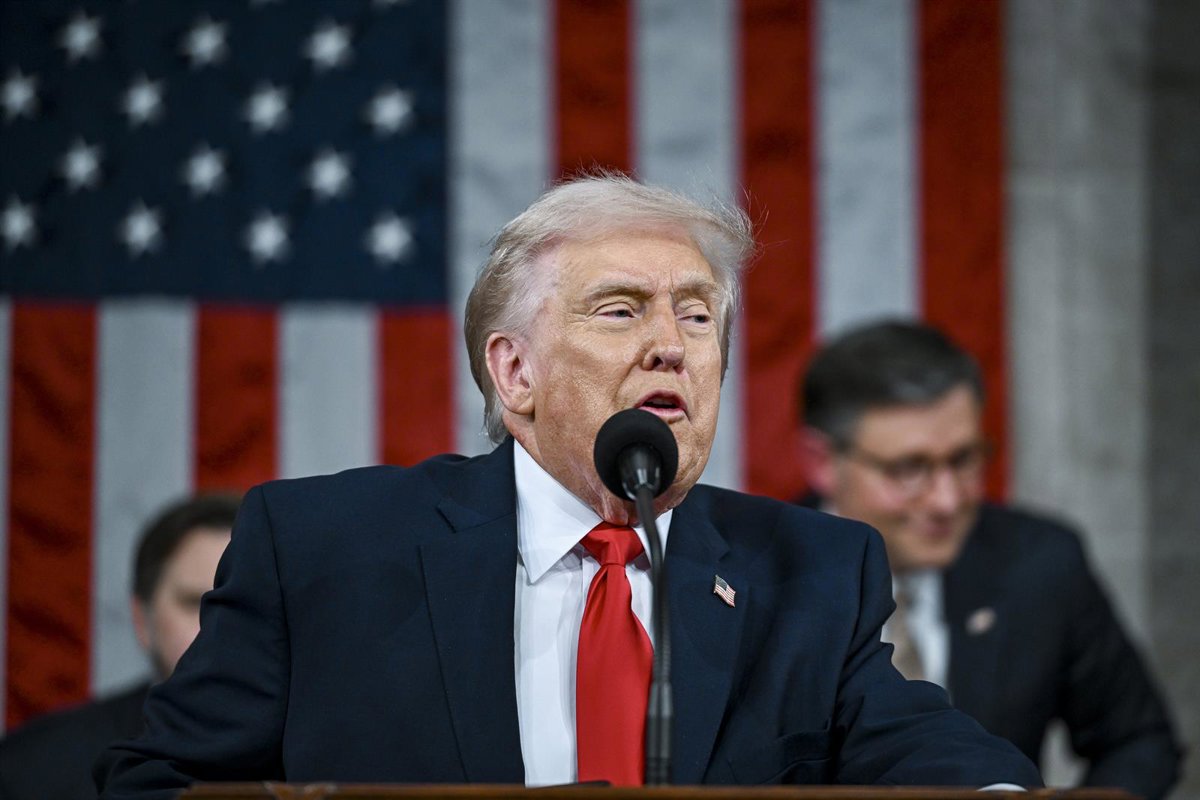
Washington D.C. – In his State of the Union address on Tuesday, February 24, 2026, President Donald Trump reaffirmed his administration’s desire for a diplomatic resolution to tensions with Iran, while simultaneously issuing a stern warning regarding Tehran’s continued pursuit of nuclear capabilities. The address, delivered before a joint session of Congress, underscored a complex and evolving U.S. Policy toward the Middle Eastern nation, balancing a stated preference for negotiation with a firm commitment to preventing Iran from acquiring a nuclear weapon. This delicate balancing act comes after a period of heightened conflict, including reported U.S. Military action against Iranian nuclear facilities in June 2025.
The President’s remarks come at a critical juncture in ongoing, indirect negotiations between the United States and Iran, mediated by Oman in Geneva, aimed at reviving some form of agreement regarding Iran’s nuclear program. These talks are occurring against a backdrop of deep distrust, fueled by the U.S. Withdrawal from the Joint Comprehensive Plan of Action (JCPOA) in 2018 – a decision made by President Trump – and subsequent reimposition of sanctions. The JCPOA, originally agreed upon in 2015 between Iran and the P5+1 (China, France, Germany, Russia, the United Kingdom and the United States), aimed to limit Iran’s nuclear program in exchange for sanctions relief. The current negotiations seek to establish a new framework, but progress has been hampered by mutual accusations and a lack of concrete commitments.
– Europa Press/Contacto/Kenny Holston – Pool via CNP
Trump’s Warning: “Siniestras Ambiciones” and Missile Development
President Trump specifically warned that Iran continues to pursue what he termed “siniestras ambiciones” – sinister ambitions – in the realm of nuclear weapons development. He asserted that despite previous setbacks, Iran is actively working to rebuild its nuclear program “starting from zero.” This claim echoes concerns voiced by U.S. Intelligence agencies and international observers regarding Iran’s continued enrichment of uranium and advancements in centrifuge technology. According to reports from El Comercio, Trump stated, “They have been warned not to attempt to rebuild their weapons program, particularly the nuclear one. However, they are starting from scratch.”
Beyond nuclear concerns, the President also highlighted Iran’s ballistic missile program, alleging that Iran has already developed missiles capable of threatening Europe and U.S. Bases abroad. He further warned that Iran is actively developing missiles with the range to reach the continental United States. This assertion underscores a growing U.S. Concern about Iran’s long-range missile capabilities and their potential to destabilize the region. The development of such weapons systems would represent a significant escalation in Iran’s military posture and could further complicate efforts to achieve a diplomatic resolution.
The June 2025 Offensive and the Path to Diplomacy
President Trump reminded his audience that the U.S. Military had “aniquilado” – annihilated – Iran’s nuclear program following attacks in June 2025. While the specifics of these attacks remain classified, reports suggest they targeted key Iranian nuclear facilities, including enrichment plants and research centers. As reported by El Tiempo, the attacks occurred amidst a previous attempt at diplomatic engagement, raising questions about the timing and strategic rationale behind the military action. The offensive significantly damaged Iran’s nuclear infrastructure, but did not entirely eliminate its nuclear ambitions, according to U.S. Assessments.
Despite the military action, President Trump reiterated his preference for a diplomatic solution. He acknowledged Iran’s stated desire to reach an agreement, but emphasized the necessitate for a firm commitment from Tehran that it will never pursue a nuclear weapon. “I prefer to resolve this problem through the diplomatic route,” he stated. “But one thing is certain: I will never allow the world’s leading sponsor of terrorism – and it is, by far – to possess a nuclear weapon. It cannot be.” This stance reflects a long-held U.S. Policy of preventing Iran from acquiring nuclear weapons, a position supported by a broad bipartisan consensus in Washington.
Iran’s Response and the Geneva Negotiations
Responding to President Trump’s address, Iranian Foreign Minister Abbas Araqchi affirmed Iran’s willingness to reach a nuclear agreement with Washington “as soon as possible.” Araqchi stated that Iran is prepared to “do everything necessary” to achieve a resolution within the framework of ongoing negotiations in Geneva, which are being mediated by Oman. However, he also reiterated Iran’s firm stance that it will not abandon its right to utilize nuclear technology for peaceful purposes. Ecoportal reports that Araqchi emphasized on social media that Tehran will not develop a nuclear weapon “under any circumstances.”
Despite this stated willingness to negotiate, Iran remains deeply skeptical of U.S. Intentions, particularly in light of the June 2025 offensive. Tehran views the attacks as a betrayal of trust and a demonstration of U.S. Unwillingness to engage in good-faith negotiations. This distrust has complicated efforts to revive the JCPOA and establish a new framework for regulating Iran’s nuclear program. The current negotiations are further complicated by disagreements over sanctions relief, verification mechanisms, and the scope of Iran’s nuclear activities.
The Role of Oman and International Mediation
Oman has emerged as a key mediator in the indirect negotiations between the United States and Iran. The Sultanate has maintained relatively neutral relations with both countries and has provided a discreet and secure venue for talks. Oman’s role is crucial in facilitating communication and bridging the gap between the two sides. Other international actors, including European powers and Russia, are also closely monitoring the negotiations and offering diplomatic support. However, the success of these efforts remains uncertain, and the risk of further escalation remains a significant concern.
Looking Ahead: Potential Scenarios and Key Dates
The coming weeks and months will be critical in determining the future of U.S.-Iran relations. The ongoing negotiations in Geneva represent a potential pathway to de-escalation and a renewed diplomatic framework. However, the talks face significant obstacles, and a breakthrough is not guaranteed. Should negotiations fail, the risk of further military confrontation could increase. The White House has stated that while diplomacy is the “first option,” the possibility of using “lethal force” remains on the table.
The next key checkpoint will be the outcome of the current round of negotiations in Geneva, expected to conclude in early March 2026. Following that, both sides will need to decide whether to continue negotiations or pursue alternative strategies. The international community will be closely watching these developments, as the situation has far-reaching implications for regional stability and global security. Continued engagement and a commitment to dialogue will be essential to prevent a further escalation of tensions and to achieve a lasting resolution to the Iranian nuclear issue.
The situation remains fluid and complex. Readers are encouraged to stay informed through reliable news sources and to engage in constructive dialogue about the challenges and opportunities facing U.S.-Iran relations. Share your thoughts and perspectives in the comments below.