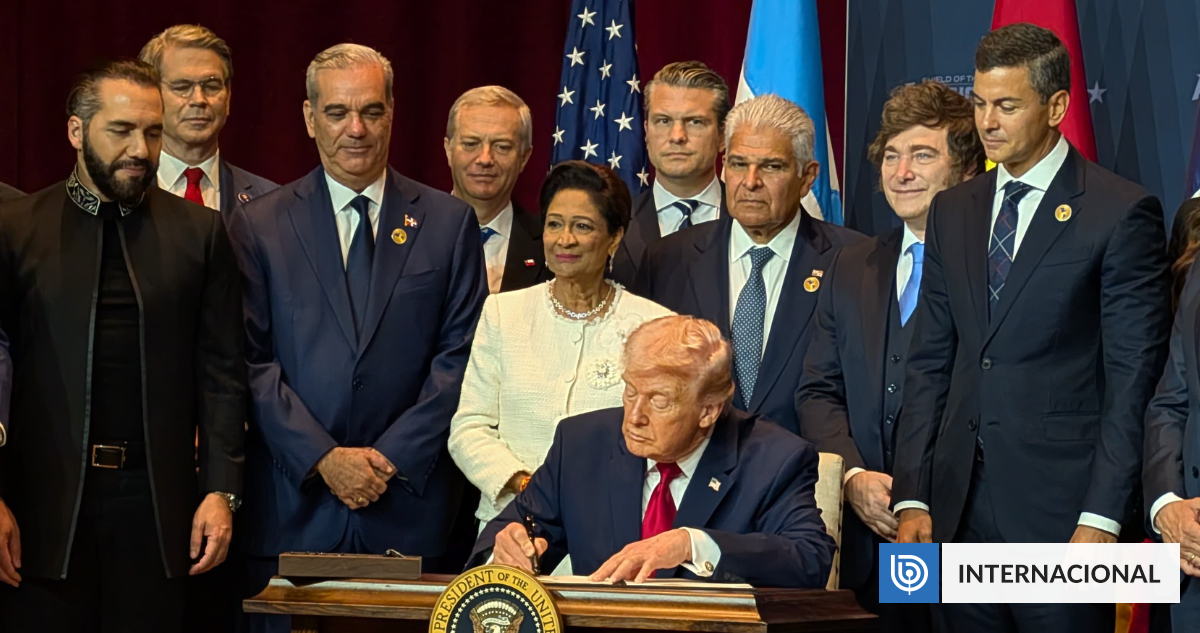
MIAMI, FL – Former U.S. President Donald Trump sparked a moment of levity, and potential diplomatic friction, at a summit with Latin American leaders in Miami this weekend, stating he has “no time” to learn Spanish. The remarks came during the “Shield of the Americas” summit, convened to discuss regional security concerns, including organized crime, illegal immigration, and foreign influence. The incident underscores the complex dynamics at play as Trump seeks to reassert influence in the region and build alliances with right-leaning governments.
The summit, held at Trump’s golf club in Doral, Florida, brought together a dozen heads of state from across Latin America and the Caribbean. Among those in attendance were Argentinian President Javier Milei and Salvadoran President Nayib Bukele, both of whom have cultivated close ties with the former U.S. President. The gathering is framed by Trump as the implementation of what he calls the “Monroe Doctrine,” a revised approach to U.S. Foreign policy in the Western Hemisphere, aiming to promote Washington’s interests and counter the influence of countries like China. Recent actions cited as examples of this doctrine include the January capture of Venezuelan President Nicolás Maduro in Caracas and restrictions on oil deliveries to Cuba, though details surrounding Maduro’s capture remain limited and have not been independently confirmed by all international observers.
Trump’s Remarks and Regional Reactions
According to reports, Trump made the comment about learning Spanish during his address to the assembled leaders. He reportedly stated, “I’m not going to learn your damn language. I don’t have time,” eliciting laughter from some attendees. He further emphasized that his Secretary of State, Marco Rubio, a Cuban-American, possesses a “linguistic advantage” due to his fluency in Spanish. Trump then recounted an anecdote about a previous conversation with a foreign leader where he suspected a mistranslation by an interpreter, despite not understanding the language himself. He argued that even successful negotiations with leaders like China’s Xi Jinping and Russia’s Vladimir Putin can be undermined by a poor interpreter.
The remarks, while intended as a lighthearted aside, have drawn attention to the potential for communication barriers and cultural sensitivities in international diplomacy. While Trump’s reliance on interpreters is not unusual for U.S. Presidents, the bluntness of his statement has been noted by observers. The incident also highlights the broader issue of language access and inclusivity in international forums. According to the U.S. State Department, Spanish is the second most spoken language in the United States, with over 41 million speakers as of 2023. More information on languages and U.S. Foreign policy can be found on the State Department website.
Following Trump’s comments, Secretary of Defense Pete Hegseth reportedly quipped, also in jest, that he only speaks “American.” This statement, while likely intended as a continuation of the humorous tone, could be interpreted as dismissive of other languages and cultures. Hegseth’s role at the summit was not explicitly defined in available reports, but his presence suggests a focus on security and defense cooperation.
The “Shield of the Americas” Summit: A Focus on Security and Geopolitics
The “Shield of the Americas” summit is intended to foster collaboration on addressing shared security challenges facing the region. A key concern is the rise of organized crime, which is increasingly impacting countries previously considered relatively safe, such as Chile and Ecuador. Irene Mia, an expert on Latin America at the International Institute of Strategic Studies (IISS), noted the growing threat posed by criminal organizations in the region. The IISS website provides further analysis on Latin American security issues.
Beyond security, the summit also aims to counter illegal immigration and perceived foreign interference in the Americas. Trump’s “Monroe Doctrine” framework seeks to limit the influence of external actors, particularly China, in the region. The administration has reportedly been working to secure agreements with countries in the region to distance themselves from Chinese investment and influence, particularly in the areas of natural resources and food production. In February 2026, Argentina, Bolivia, and Paraguay signed agreements with the U.S. Department of State to signal a shift away from Chinese economic ties, in exchange for preferential investment treatment.
The invitation list for the summit reflects Trump’s focus on aligning with right-leaning leaders in Latin America. In addition to Milei and Bukele, attendees included Presidents Rodrigo Paz of Bolivia, Rodrigo Chaves of Costa Rica, Daniel Noboa of Ecuador, Nasry Asfura of Honduras, and Santiago Peña of Paraguay. These leaders share a generally conservative ideological alignment with Trump and are seen as potential strategic partners in the region. The inclusion of these leaders signals a deliberate effort to build a regional bloc that can counter Chinese influence and promote U.S. Interests.
Nayib Bukele and the El Salvador Model
President Nayib Bukele of El Salvador has been a particularly vocal supporter of Trump’s policies and has gained international attention for his controversial crackdown on gang violence. Trump has publicly praised Bukele’s efforts, despite concerns raised by human rights organizations regarding due process and civil liberties. Bukele’s government has implemented a state of exception, suspending certain constitutional rights and allowing for mass arrests of suspected gang members. While the measures have led to a significant reduction in homicides, they have also been criticized for arbitrary detentions and abuses of power. Human Rights Watch provides ongoing reporting on the human rights situation in El Salvador.
The “El Salvador model” of tackling gang violence has become a subject of debate, with some arguing that it offers a viable solution to the security challenges facing other countries in the region. Still, critics caution against replicating the approach without addressing the underlying issues of poverty, inequality, and institutional weakness. The long-term sustainability and human rights implications of Bukele’s policies remain uncertain.
Looking Ahead: Implications for U.S.-Latin American Relations
The “Shield of the Americas” summit represents a significant effort by Donald Trump to re-engage with Latin America and reassert U.S. Influence in the region. The success of this effort will depend on a number of factors, including the ability to build genuine partnerships with regional leaders, address shared security concerns, and offer viable economic alternatives to Chinese investment. The incident involving Trump’s comments on learning Spanish, while seemingly minor, underscores the importance of cultural sensitivity and effective communication in international diplomacy.
The summit’s focus on countering Chinese influence is likely to remain a key priority for the U.S. In the coming months. The administration is expected to continue to pursue agreements with countries in the region to limit Chinese access to strategic resources and markets. However, balancing these efforts with the need to address regional development needs and promote human rights will be a crucial challenge. The next major development to watch will be the implementation of the agreements signed with Argentina, Bolivia, and Paraguay, and the extent to which they translate into concrete economic benefits for those countries.
The long-term impact of the “Shield of the Americas” initiative remains to be seen. However, it signals a clear shift in U.S. Policy towards a more assertive and transactional approach to Latin America. The coming months will be critical in determining whether this approach will be successful in achieving its stated goals.
Jonathan Reed is Editor, News at World Today Journal.