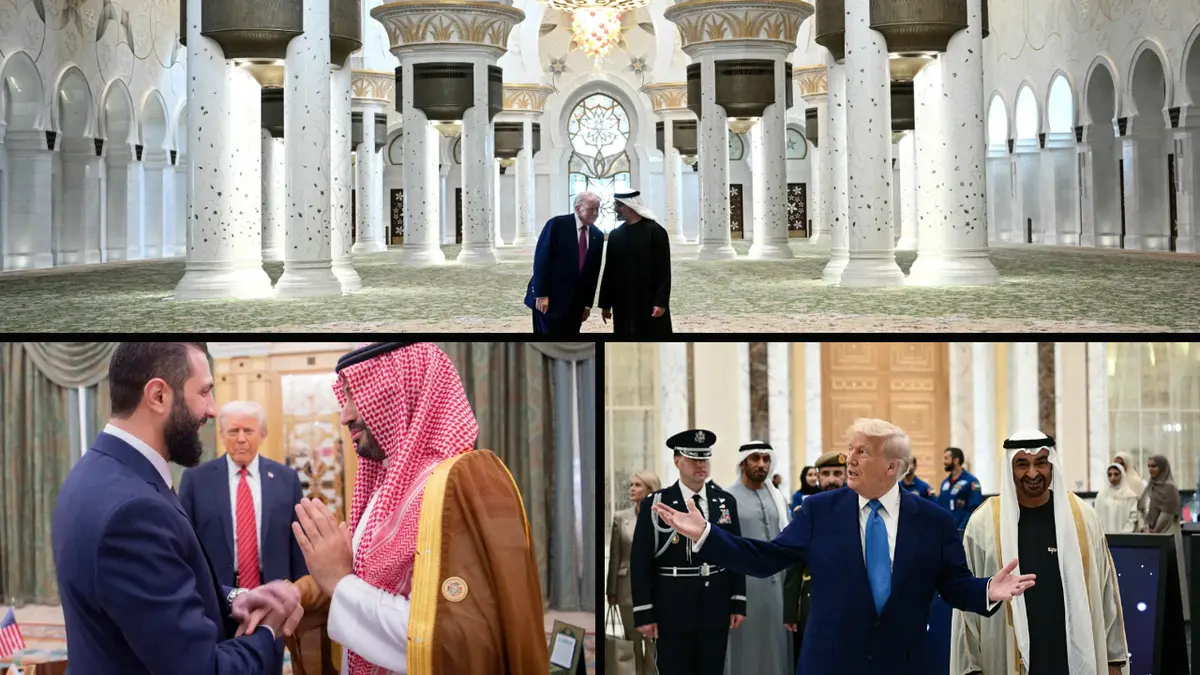
President Donald Trump returned to Washington following a high-stakes Middle East tour that paired multibillion-dollar aviation and defense agreements with sudden diplomatic friction, as new civilian nuclear talks with Saudi Arabia collided with normalisation demands and ongoing de-escalation efforts with Iran.
Gulf Investment Deals Span Aviation, Defense, and Technology
During a three-nation swing through Saudi Arabia, Qatar, and the United Arab Emirates, President Donald Trump secured a series of massive commercial and defense agreements that center heavily on energy, aviation, and advanced technology.
Beyond aviation, the delegations signed sweeping economic and security frameworks. Trump announced defence deals in Riyadh and said that the total investments from the three nations he visited could reach as high as $4 trillion. Qatar and the US agreed on a $1.2 trillion economic exchange,
while Saudi Arabia promised to invest $600 billion. Major projects were also signed with the United Arab Emirates, after Abu Dhabi in March committed to a 10-year, $1.4 trillion investment framework in the US.
The Diplomatic Deadlock Over the U.S.-Saudi Nuclear Pact
Despite the commercial momentum, the diplomatic landscape shifted abruptly over civilian nuclear cooperation. United States Energy Secretary Chris Wright and Saudi Energy Minister Prince Abdulaziz bin Salman formally signed a 30-year peaceful nuclear cooperation pact structured as a Section 123 Agreement under the U.S. Atomic Energy Act. The agreement aims to give American manufacturers, including reactor builder Westinghouse, priority access to Saudi Arabia’s growing civilian energy infrastructure.
The agreement was thrown into diplomatic limbo just a day after its signing when President Trump declared that its final approval strictly depends on Saudi Arabia normalising relations with Israel under the Abraham Accords. Riyadh has consistently maintained that diplomatic recognition cannot proceed without a clear pathway toward an independent Palestinian state based on 1967 borders with East Jerusalem as its capital.
Strait of Hormuz Talks and De-escalation Efforts with Iran
Parallel to the Gulf economic agreements, the White House addressed regional security involving Iran and the vital Strait of Hormuz. President Trump stated that he stepped back from executing a large-scale military strike at the urging of regional leaders in Qatar, Saudi Arabia, and the United Arab Emirates, choosing instead to give diplomacy an opening.

“Iranian Leadership is unbelievably duplicitous!”
President Donald Trump
While the White House maintained that direct talks were underway to end the conflict and revive cargo traffic through the Strait of Hormuz, Iranian Foreign Ministry spokesperson Esmail Baghaei countered that discussions were focused exclusively with Oman regarding safe navigation routes. Trade data showed nine vessels transiting the channel, primarily utilizing an Iranian-controlled route.
Geopolitical Realignment in Damascus and Regional Security
The presidential tour also marked an unexpected diplomatic milestone in Syria. In Riyadh, President Trump met with Syrian leader Ahmed al-Sharaa, marking the first encounter between a sitting U.S. president and a Syrian leader in 25 years. During the meeting, Trump announced the lifting of Assad-era sanctions on Syria and publicly evaluated the Syrian leader.

President Donald Trump stated via WION that the Syrian leader was a young, attractive, and tough guy with a strong past and fighter background, adding that he had a real chance of pulling things together.
Domestically and regionally, allied movements continued to intersect with the shifting diplomatic architecture. In Iran, the judiciary reported the execution of two men convicted of spying for Israel, identified as Omid Behzad and Pouria Safvat. Meanwhile, in Damascus, interim President al-Sharaa met with Iraq’s Kurdish regional president Nechirvan Barzani to address cross-border security concerns, capping a dense period of political and economic realignment across the Middle East.
Worth a look
- Saving the Digital Revolution: The Growing Thrill of Vintage Computer Collecting in the Age of AI
- Shark Drags Lifeguard Underwater at Scarborough Beach in Maine
- Trump Adopts Wait-And-See Approach To Iran Amid Strait Of Hormuz Talks (archyworldys.com)
- Trump’s National Guard Deployment in DC Extended to 2029 Amid Autonomy Concerns (archynewsy.com)