
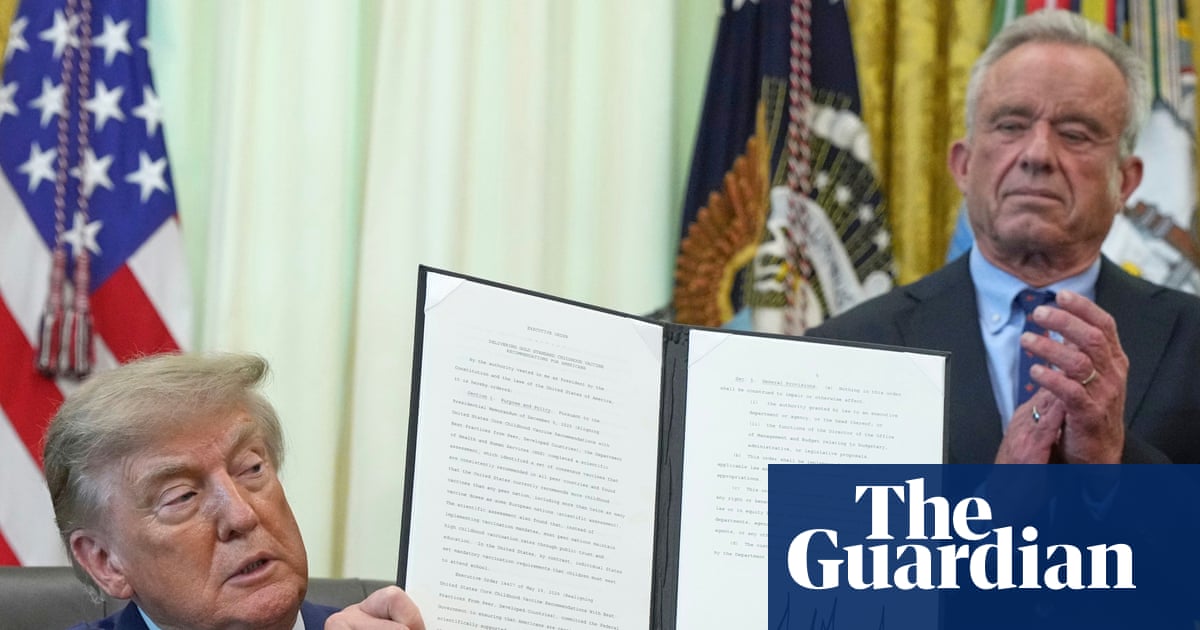
The Trump administration has shifted its approach to national public health, with President Donald Trump signing an executive order from the Oval Office that attempts to alter the federal childhood vaccination schedule and challenge the authority of the US Centers for Disease Control and Prevention (CDC). According to reporting by The Guardian, the newly unveiled federal agenda promotes a skeptical stance on immunizations, pushing recommendations down to 11 diseases compared to 18 at the end of 2024, and seeking to divide combination shots.
The executive order relies heavily on a Department of Health and Human Services (HHS) scientific assessment published in January 2026, which examined international peer comparisons regarding childhood immunizations. White House officials stated on a press call that the directive aims to give parents greater choice and flexibility, despite pushback from mainstream public health organizations regarding the safety and efficacy of established inoculation protocols.
Overhauling the Childhood Immunization Schedule
Under the remade federal framework, only six of the 17 vaccines routinely recommended for all children in the United States will retain full recommendations. These include the measles, mumps, and rubella (MMR) vaccine, diphtheria, tetanus, and pertussis (DTaP) shots, polio, Hib, pneumococcal disease, HPV, and varicella, as noted by The Guardian.
Five other immunizations are now recommended exclusively for high-risk groups. This tier includes monoclonal antibodies designed to protect against respiratory syncytial virus (RSV), alongside vaccines for hepatitis A, hepatitis B, and meningococcal ACWY. Meanwhile, six additional shots—covering hepatitis A, hepatitis B, rotavirus, meningococcal disease, influenza, and Covid-19—have been shifted into a category termed “shared clinical decision-making.” This designation requires healthcare providers to actively weigh risks and benefits with families, even though robust scientific data supports the safety of these preventatives.
Logistical Hurdles and Split Vaccine Requirements
A notable mandate within the executive order requires that the MMR vaccine be administered in three separate shots rather than a single combined dose. According to reporting from The Guardian, executing this change presents immediate practical challenges because separately licensed individual vaccines for measles, mumps, and rubella are not currently available in the United States, and the federal licensing process typically takes years.
Furthermore, the directive dictates that all childhood immunizations should be administered at separate medical visits to the maximum extent feasible. Medical professionals and family advocacy groups point out that this provision will introduce significant financial and logistical strains on households and clinical practices by multiplying the number of required appointments.
Legal Confrontations and State Mandates
Because the United States maintains no federal vaccination mandates—leaving school attendance requirements strictly to state and local jurisdictions—the executive order tasks the US attorney general with challenging state laws that conflict with the new federal guidelines. During the signing ceremony, President Trump and health secretary Robert F Kennedy repeatedly invoked a link between vaccines and autism, a connection that has been thoroughly discredited by numerous comprehensive scientific studies.
As federal agencies prepare to defend or implement the directive, medical organizations continue to emphasize established safety baselines for childhood health.
Worth a look
- CDC Investigates Suspected Lassa Fever Death in Iowa Resident Returning from West Africa
- Second Rabies-Infected Cat Confirmed in Quebec’s Montérégie Region as Public Health Urges Vigilance
- Trump Adopts Wait-And-See Approach To Iran Amid Strait Of Hormuz Talks (archyworldys.com)
- Trump’s National Guard Deployment in DC Extended to 2029 Amid Autonomy Concerns (archynewsy.com)