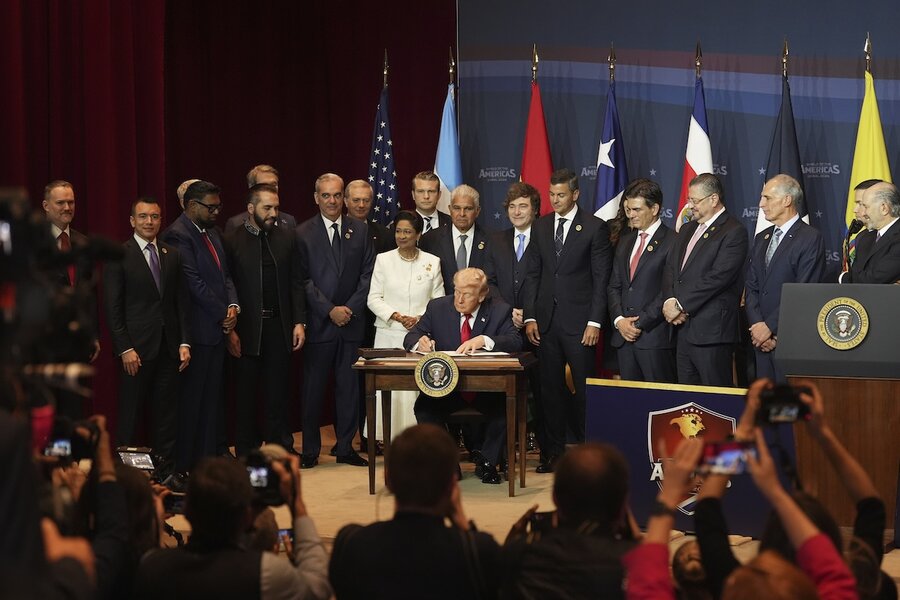
Miami, Florida – In a move signaling a potential shift in U.S. Foreign policy, former President Donald Trump convened a meeting with leaders from across Latin America at his golf club in Doral, Florida, on Saturday. The gathering, dubbed the “Shield of the Americas” summit, centered on a proposal for increased collaboration in combating powerful drug cartels that Trump characterized as an “unacceptable threat” to regional security. The initiative comes amidst a complex geopolitical landscape, with ongoing conflicts in the Middle East and increasing concerns over Chinese influence in the Western Hemisphere.
Trump urged the assembled leaders to take decisive military action against these criminal organizations, drawing a parallel to the U.S.-led coalition against the Islamic State group. He argued that a robust military response is the only effective way to dismantle the cartels’ operations and restore stability to the region. This call for action reflects a broader commitment, as stated by Trump, to reassert U.S. Dominance in Latin America and counter what he perceives as years of economic encroachment by China. The situation is further complicated by existing U.S. Involvement in other international crises, including a recent military campaign with Israel against Iran and a prior, though unconfirmed, operation targeting Venezuelan President Nicolás Maduro.
The summit brought together leaders from Argentina, Bolivia, Chile, Costa Rica, the Dominican Republic, Ecuador, El Salvador, Guyana, Honduras, Panama, Paraguay, and Trinidad and Tobago. However, notable absences included representatives from Brazil, Mexico, and Colombia – countries traditionally considered key partners in U.S. Anti-narcotics efforts. Trump publicly criticized Mexico as the “epicenter of cartel violence,” alleging that drug kingpins operating within the country are responsible for much of the instability in the region. This rhetoric underscores a potentially confrontational approach to addressing the issue, raising questions about the feasibility and potential consequences of a coordinated military response.
The “Shield of the Americas” Initiative: A New Approach to Regional Security?
The “Shield of the Americas” summit represents a departure from traditional U.S. Policy in Latin America, which has historically focused on economic aid and law enforcement cooperation. Trump’s emphasis on military intervention signals a willingness to adopt a more assertive stance, potentially mirroring the “Trump Corollary” to the Monroe Doctrine – a strategy focused on countering Chinese influence through targeted actions against infrastructure projects and military cooperation in the region. Financial Times reports that this approach aims to reassert U.S. Dominance and push back against perceived Chinese encroachment.
Ecuador has already taken steps toward implementing this new strategy, conducting joint military operations with the United States against organized crime groups. Ecuadorian President Daniel Noboa stated that this collaborative effort is “only the beginning” of a broader campaign to combat drug trafficking. Al Jazeera details these operations, highlighting the increasing willingness of regional governments to collaborate with the U.S. On security matters.
Challenges and Concerns
Despite the stated goals of the “Shield of the Americas” initiative, several challenges and concerns remain. The absence of key regional players like Brazil, Mexico, and Colombia raises questions about the initiative’s potential effectiveness and broad-based support. Mexico, in particular, has been a focal point of Trump’s criticism, with the former president accusing the country of being overrun by cartels. This antagonistic rhetoric could hinder cooperation and complicate efforts to address the root causes of drug trafficking and organized crime.
the proposed military approach raises concerns about potential human rights violations and the risk of escalating violence. Critics argue that a purely military solution is unlikely to address the complex socio-economic factors that contribute to the growth of cartels, such as poverty, corruption, and lack of opportunity. A comprehensive strategy, they contend, should include investments in education, healthcare, and economic development, as well as strengthening governance and the rule of law.
The Broader Geopolitical Context
The “Shield of the Americas” summit took place against a backdrop of escalating geopolitical tensions, including the ongoing conflict between the U.S. And Israel against Iran. Trump’s administration is simultaneously navigating this crisis while attempting to refocus its attention on Latin America. The timing of the summit, coupled with reports of a prior, unconfirmed operation targeting Venezuelan President Nicolás Maduro, suggests a willingness to take bold and potentially risky actions to advance U.S. Interests in the region.
Adding to the complexity is the growing influence of China in Latin America. Trump has repeatedly expressed concern about China’s economic and political ties to countries in the region, viewing it as a challenge to U.S. Hegemony. His administration has sought to counter this influence through a combination of economic pressure and diplomatic outreach, including efforts to persuade Panama to withdraw from China’s Belt and Road Initiative. Politico details these efforts, highlighting the administration’s focus on countering Chinese influence in the Western Hemisphere.
Cuba and the Future of U.S.-Latin American Relations
During the summit, Trump also signaled a potential shift in U.S. Policy toward Cuba, suggesting that his administration would pursue a deal with Havana and that “great change” was coming to the island nation. This statement underscores a more aggressive stance toward the Cuban government, which Trump has repeatedly criticized for its communist ideology. While Cuban officials have expressed openness to dialogue with the U.S., they have consistently emphasized the need for respect for Cuban sovereignty. The prospect of a new agreement between the two countries remains uncertain, particularly given the current geopolitical climate and the complex history of U.S.-Cuba relations.
Following the summit, Trump traveled to Dover Air Force Base in Delaware to attend the dignified transfer of six U.S. Troops killed in a drone strike in Kuwait, a somber reminder of the human cost of the ongoing conflicts in the Middle East. This event underscored the challenges of balancing competing priorities and maintaining a consistent foreign policy agenda. Secretary of State Marco Rubio hosted the Latin American leaders for a working lunch, where Kristi Noem, recently dismissed as homeland security secretary, made her debut as a special envoy for the “Shield of the Americas” initiative.
The long-term implications of the “Shield of the Americas” initiative remain to be seen. Whether it will lead to a more secure and stable Latin America, or further exacerbate existing tensions and conflicts, will depend on a variety of factors, including the willingness of regional governments to cooperate, the effectiveness of U.S. Military and economic assistance, and the broader geopolitical context. The next steps will likely involve further consultations between the U.S. And its Latin American partners, as well as the development of a concrete plan of action to address the challenges posed by drug cartels and organized crime.
Key Takeaways:
- Former President Trump proposed a new initiative, “Shield of the Americas,” to combat drug cartels in Latin America through increased military collaboration.
- The summit saw participation from leaders across the region, but notably excluded representatives from Brazil, Mexico, and Colombia.
- The initiative is occurring amidst broader geopolitical tensions, including the conflict with Iran and concerns about Chinese influence in the Western Hemisphere.
- The success of the initiative hinges on regional cooperation and a comprehensive approach that addresses the root causes of organized crime.
As the situation evolves, continued monitoring of U.S. Policy toward Latin America and the responses from regional governments will be crucial. Further developments are expected in the coming months as the “Shield of the Americas” initiative takes shape. Share your thoughts on this developing story in the comments below.