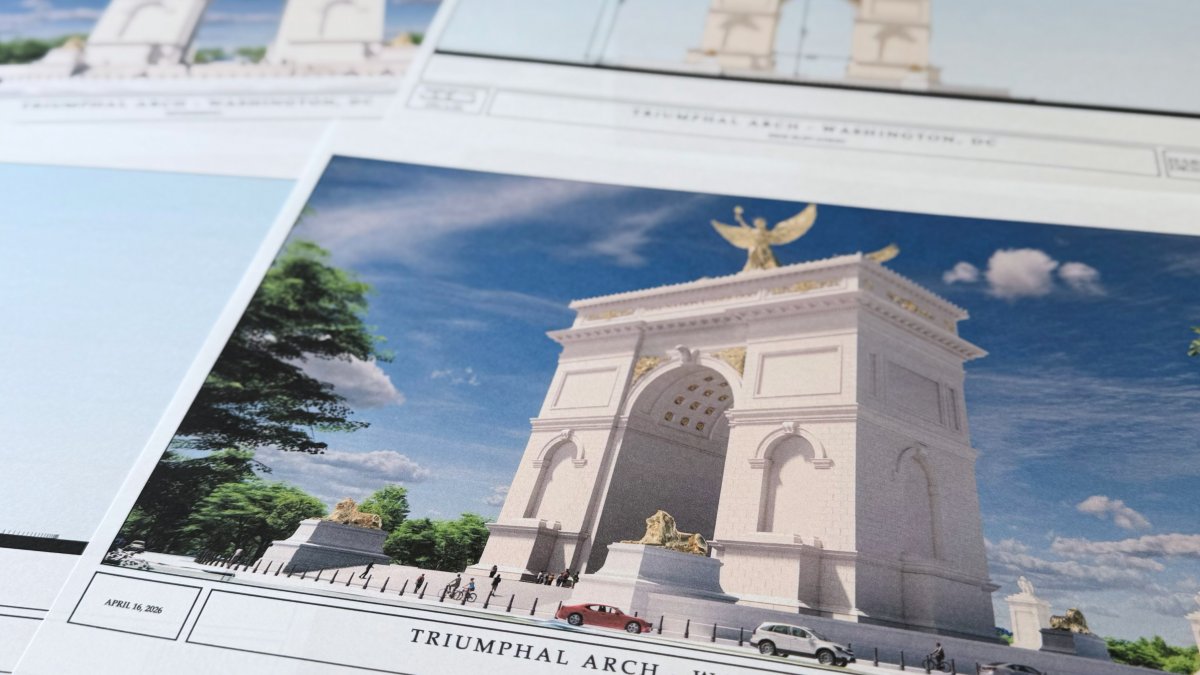
President Donald Trump has unveiled ambitious architectural plans for a new triumphal arch in the United States capital, proposing a massive structure designed to reshape the landscape of Washington, D.C. The proposal, which includes gold-accented detailing and towering figures, marks one of the most significant efforts by the administration to leave a permanent architectural mark on the city.
The Trump administration’s Trump Washington arch plan involves a 250-foot tall structure that would feature a gilded winged figure holding a crown and a torch, reminiscent of the Statue of Liberty. According to official renderings submitted to the U.S. Commission of Fine Arts, the monument would be flanked by two eagles and guarded by four lions, all of which are intended to be gilded released by CNBC.
The proposed site for the monument is strategically positioned between the Lincoln Memorial to the east and Arlington National Cemetery to the west, situated within a traffic circle that connects Washington with northern Virginia. At 250 feet (76.2 meters) from its base to the tip of the winged figure’s torch, the arch would significantly dwarf the nearby Lincoln Memorial, which stands at 99 feet tall (30.2 meters).
The project is currently facing a rigorous review process. The architectural renderings have been shared with the U.S. Commission of Fine Arts, the government agency responsible for approving designs within the capital as reported by CNN. Beyond the aesthetic approval, the proposal must navigate significant legal and congressional hurdles before construction can begin via Politico.
Symbolism and Design Details of the Proposed Monument
The 12-page plan released by the U.S. Commission on Fine Arts outlines a structure rich in nationalistic and religious symbolism. The arch is designed to feature gold inscriptions on either side of the monument, specifically the phrases “One Nation Under God” and “Liberty and Justice for All.”
The visual scale of the project is intended to be world-leading. President Trump stated on social media that the structure “will be the GREATEST and MOST BEAUTIFUL Triumphal Arch, anywhere in the World,” adding that it would serve as a “wonderful addition to the Washington D.C. Area for all Americans to enjoy for many decades to arrive!”
The administration’s rationale for the arch is based on the claim that Washington is the only major global city lacking such a monument. President Trump has argued that the capital originally sought a triumphal arch approximately 200 years ago, but the effort was “interrupted by a thing called the Civil War.” He further noted in February that another attempt to build such a structure almost occurred in 1902, but ultimately failed.
Broader Architectural Changes in the Second Term
The triumphal arch is not an isolated project but part of a broader series of architectural modifications being implemented by the President during his second term. These changes extend from the city’s public spaces to the interior of the executive residence.
Within the White House complex, the administration has undertaken several modifications, including:
- The construction of a large ballroom.
- Changes to the interior design of the Oval Office.
- The conversion of the Rose Garden into a stone-covered patio.
Beyond the White House walls, the President has expressed a desire to “spruce up” the city of Washington. This vision includes replacing “tired” grasses, repairing broken signage, and renovating street medians, suggesting a wider initiative to modernize and beautify the capital’s infrastructure alongside the construction of the arch.
Administrative and Legal Hurdles
Although the renderings provide a visual blueprint, the path to completion is complex. The U.S. Commission of Fine Arts must first review and approve the designs. Because the proposed location involves a traffic circle connecting the District of Columbia with northern Virginia, the project may involve interstate coordination and environmental reviews.
The project’s scale and location—specifically its proximity to the Lincoln Memorial and Arlington National Cemetery—are likely to trigger legal challenges regarding land utilize and the preservation of the capital’s historic vistas. Congressional approval may also be required depending on the funding mechanism used for the construction.
The next confirmed step in the process is the review of the official architectural renderings by the U.S. Commission of Fine Arts.
World Today Journal encourages readers to share their thoughts on the proposed monument in the comments section below.