
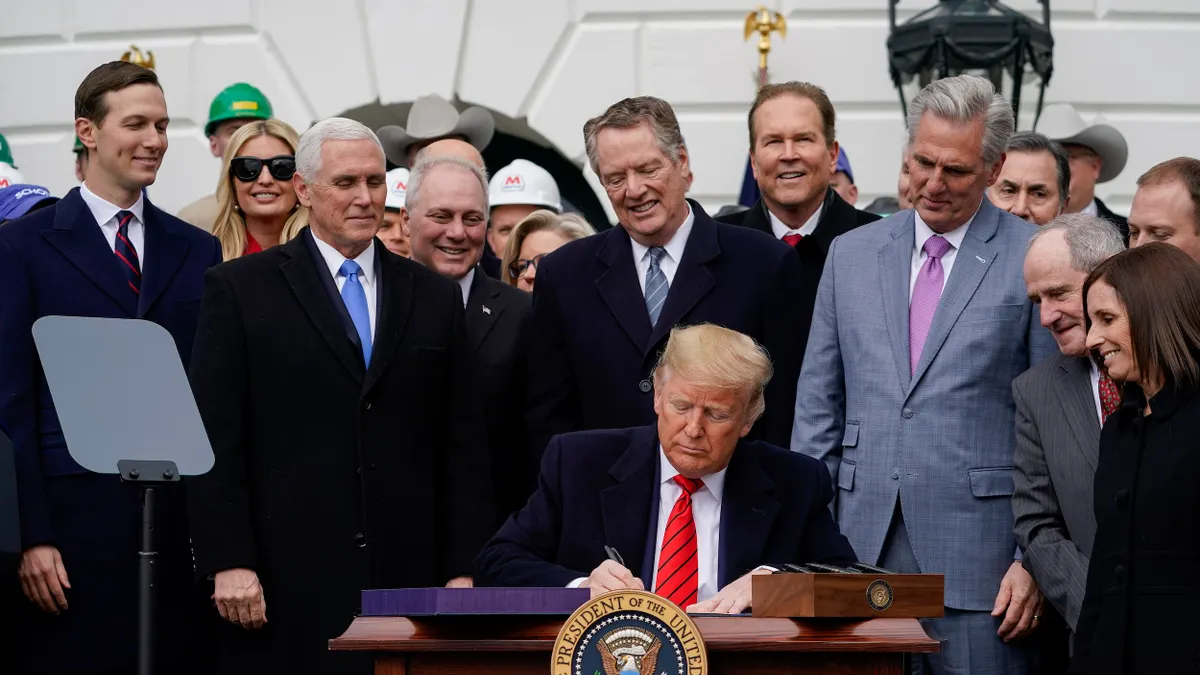
Canadian officials are maintaining a focus on the stability of the Canada-United States-Mexico Agreement (CUSMA) as the trade bloc faces looming uncertainty regarding its long-term future. Despite public rhetoric from President-elect Donald Trump regarding the potential for non-renewal or significant renegotiation of the deal, Canadian diplomatic efforts remain centered on emphasizing the mutual economic benefits of the integrated North American market.
The trilateral trade agreement, known in Canada as the Canada-United States-Mexico Agreement (CUSMA), is scheduled for a mandatory joint review in 2026. This process, established under Article 34.7 of the agreement, requires the three nations to determine whether they wish to extend the deal for another 16-year term or initiate revisions to the existing framework. According to the Government of Canada, the agreement currently supports a highly integrated supply chain that accounts for over $1 trillion in annual trade between the three nations.
The 2026 Review and North American Trade Policy
The upcoming review process serves as a critical juncture for North American economic policy. While the agreement is technically set to expire in 2036, the 2026 checkpoint allows any of the three parties to signal a desire to withdraw or demand changes. President-elect Trump, during his transition period, has frequently characterized the current trade arrangements as unfavorable to American interests, suggesting that the upcoming review will be used as leverage to extract new concessions from Ottawa and Mexico City.

Canadian diplomatic representatives have consistently argued that the agreement provides a necessary framework for predictability in global markets. Speaking to business leaders, officials have underscored that the disruption of these trade flows would carry significant costs for both Canadian and American manufacturers, particularly in the automotive, agricultural, and energy sectors. Data from the U.S. Census Bureau consistently lists Canada as one of the top trading partners for the United States, highlighting the deep interdependence of the two economies.
Economic Interdependence and Supply Chain Resilience
The integration of North American supply chains remains a focal point for economic analysts examining the potential impacts of a trade shift. Industries such as automotive manufacturing rely on parts crossing the border multiple times before a final vehicle is assembled. Any move to impose new tariffs or restrictive trade barriers could, according to reports from the International Monetary Fund, lead to increased production costs and inflationary pressures across the continent.
Canadian business groups have urged the federal government to continue emphasizing the “win-win” nature of the current trade relationship. The strategy appears to be one of quiet diplomacy, focusing on direct engagement with U.S. policymakers to demonstrate the value of Canadian energy exports, mineral resources, and cross-border labor mobility. By highlighting how Canadian inputs support U.S. manufacturing jobs, Ottawa aims to frame the trade agreement as a pillar of American industrial competitiveness rather than a burden.
What Happens Next?
The formal lead-up to the 2026 review is expected to involve extensive consultations between the three member nations. While the rhetoric surrounding the agreement may fluctuate based on domestic political pressures in each country, the legal reality remains that the agreement stays in effect unless one of the parties formally invokes withdrawal procedures.

The next major checkpoint for stakeholders will be the transition of the new U.S. administration and the subsequent appointment of key trade officials. Businesses operating within the CUSMA framework are advised to monitor official updates from the Office of the United States Trade Representative for guidance on upcoming consultations or proposed regulatory adjustments. As the situation evolves, maintaining a clear understanding of the legal requirements under the agreement will be essential for identifying risks and opportunities in the North American market. We encourage our readers to share their perspectives on the future of North American trade in the comments section below.