
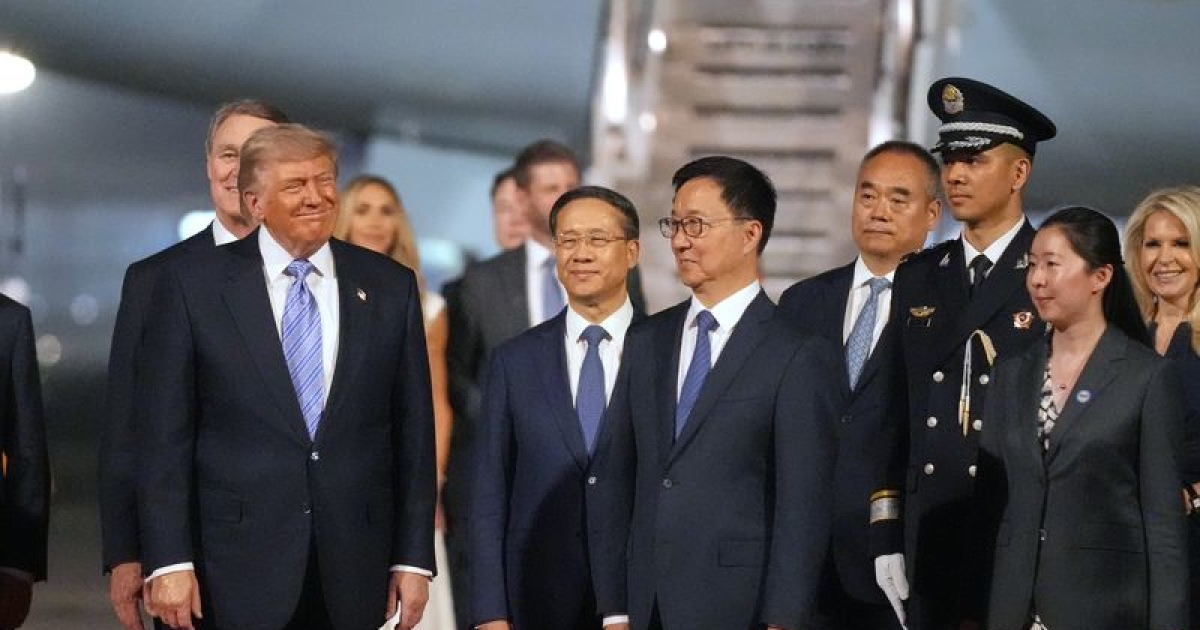
In a diplomatic maneuver that has sent ripples through global capitals, U.S. President Donald Trump arrived in Beijing on May 13, 2026, for what was billed as a high-stakes visit to China. What unfolded at Beijing’s West Airport was not merely a ceremonial welcome, but a carefully calibrated display of protocol—one that has sparked intense speculation about the unspoken messages exchanged between Washington and Beijing. While the Chinese government described the reception as a standard state visit, U.S. Officials and analysts are dissecting the subtle shifts in protocol to uncover the deeper implications for Sino-American relations.
The most striking detail: Chinese Vice President Han Zheng—ranked second in the Communist Party’s hierarchy—personally greeted Trump at the airport, a departure from past practice where lower-ranking officials often handled foreign dignitaries. This elevation in protocol, combined with the absence of President Xi Jinping from the official welcome, has left diplomats and political observers scrambling to interpret Beijing’s intentions. The timing of the visit, just days after Trump’s blunt remarks about Iran’s “garbage” peace proposals and threats to restart military operations in the Strait of Hormuz, adds another layer of complexity.
Trump’s own rhetoric in recent days has framed his foreign policy as one of unyielding strength, particularly toward adversaries like Iran and China. Yet the Chinese reception—while warm—lacked the customary fanfare and top-tier engagement that would typically accompany a visit from a U.S. President. Analysts suggest this could signal Beijing’s attempt to balance strategic engagement with a measured response to Trump’s aggressive posturing. Meanwhile, Trump’s team has downplayed the significance of the protocol shift, emphasizing the “productive” nature of the discussions that followed.
What is clear is that this visit is not just about optics. With tensions simmering over trade, technology, and Taiwan, the two superpowers are navigating a delicate dance. The question on everyone’s mind: Is China’s restrained welcome a sign of caution, or a calculated move to test Trump’s resolve before deeper negotiations begin?
Why Protocol Matters: A Diplomatic Language Without Words
Diplomatic protocol is rarely arbitrary. Every handshake, every step taken or omitted, every official present or absent carries meaning. In the case of Trump’s arrival in Beijing, the most notable deviation from tradition was the absence of President Xi Jinping from the airport welcome ceremony. While Xi has historically greeted foreign leaders of Trump’s stature—including Barack Obama and Joe Biden—his absence this time sent a signal that was both subtle and deliberate.

According to Chinese state media, Xi was “engaged in other important state affairs” at the time of Trump’s arrival. Yet the timing of these “affairs” aligns suspiciously with Trump’s recent hardline rhetoric on Iran and his threats to expand military operations in the Strait of Hormuz. Analysts at the Brookings Institution suggest that Beijing may be signaling its reluctance to engage on issues where Trump’s position appears inflexible, particularly regarding Iran’s nuclear program and regional military posture.

Meanwhile, the presence of Vice President Han Zheng—often described as Xi’s “heir apparent”—was not coincidental. Han’s role in the Communist Party’s leadership structure makes his appearance at the airport a deliberate choice. Some U.S. Officials, speaking on condition of anonymity, have interpreted this as Beijing’s way of acknowledging Trump’s status while also sending a message: that while engagement is possible, it must be on terms acceptable to China.
The Trump Factor: A President Who Thinks in Tweets and Tit-for-Tat
Trump’s approach to diplomacy has always been transactional, often communicated through bold statements and rapid-fire negotiations. His recent remarks about Iran—calling its peace proposals “garbage” and suggesting that the ceasefire is “on life support”—have set the tone for his engagement with Beijing. Yet his arrival in China was met with a reception that, while polite, lacked the usual grandeur.

One U.S. Official, who requested anonymity, told Reuters that the “toned-down” welcome was a response to Trump’s “combative” stance on global issues. “China is not going to roll out the red carpet for someone who has just threatened military action in the Strait of Hormuz,” the official said. “But they’re also not shutting the door.”
Trump’s own team has framed the visit as a success, pointing to “constructive” discussions on trade and technology. However, the lack of a joint press conference or a formal agreement—both staples of high-level diplomatic visits—has left some analysts questioning whether substantive progress was made. The absence of Xi Jinping from the public portions of the visit further fuels speculation that China may be adopting a “wait-and-see” approach, assessing Trump’s intentions before committing to deeper engagement.
What’s Next? The Road Ahead for U.S.-China Relations
The next critical checkpoint for this diplomatic engagement will be the scheduled U.S.-China Strategic and Economic Dialogue, set to take place in Washington later this summer. While no official dates have been confirmed, sources close to the White House suggest that the dialogue could be rescheduled or expanded to include additional topics if progress is made during Trump’s Beijing visit.
In the meantime, both sides are likely to continue testing each other’s resolve. Trump’s threats to restart military operations in the Strait of Hormuz—part of his “Operation Freedom” initiative—could further strain relations, particularly if Iran escalates its responses. Meanwhile, China’s restrained welcome may be a sign that Beijing is prioritizing stability over immediate concessions.
For now, the focus remains on the unspoken messages exchanged during Trump’s brief but high-profile visit. Whether this marks the beginning of a new era of engagement or a prolonged period of strategic tension remains to be seen. One thing is certain: the language of diplomacy, in this case, was spoken not in words, but in the careful choreography of protocol.
Key Takeaways
- Protocol as Power Play: China’s decision to send Vice President Han Zheng instead of President Xi Jinping signals a measured but deliberate approach to engaging with Trump.
- Trump’s Hardline Stance: Recent threats to restart military operations in the Strait of Hormuz have set a combative tone, influencing Beijing’s reception.
- No Grand Gestures: The absence of a joint press conference or formal agreements suggests limited immediate progress, leaving room for future negotiations.
- Economic and Technological Focus: While trade and technology remain key topics, the visit did not produce any immediate breakthroughs.
- Next Steps Unclear: The U.S.-China Strategic and Economic Dialogue later this year will be critical in determining whether this visit marks a turning point or a temporary lull in relations.
As the world watches, the question lingers: Is this visit a step toward détente, or a prelude to deeper confrontation? The answer may lie not in the words spoken, but in the silence between them.
What do you think? Will Trump’s visit lead to meaningful dialogue, or will Sino-American relations continue to deteriorate? Share your thoughts in the comments below.