
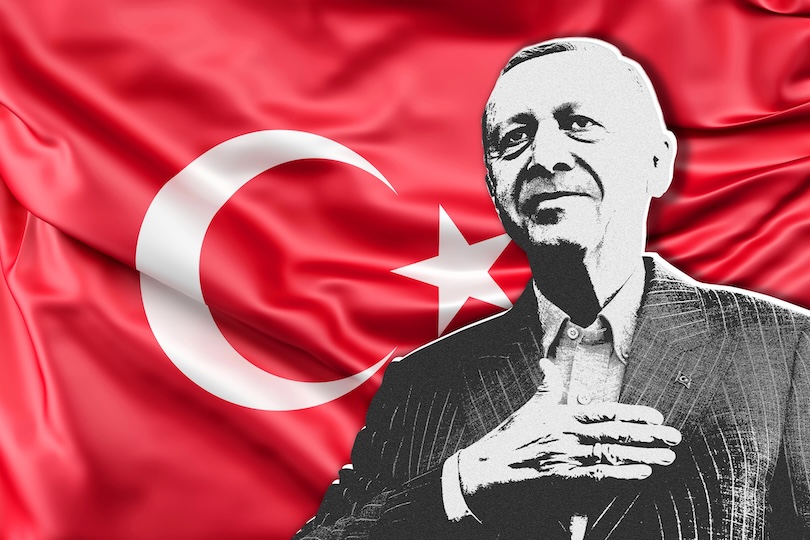
The Resurgence of Imperial Memory: Neo-Ottomanism and Turkey’s Reimagined Role in a Hierarchical World
Turkey under Recep tayyip Erdoğan has witnessed the rise of a potent political phenomenon: Neo-Ottomanism.This isn’t a simple yearning for a resurrected empire, but a sophisticated, strategically deployed reinterpretation of the Ottoman past, fundamentally reshaping Turkish national identity and foreign policy. It represents a bold attempt to renegotiate Turkey’s position within the international order, leveraging a selectively constructed ancient narrative to overcome perceived vulnerabilities and assert a new form of leadership. this analysis will explore the core tenets of Neo-Ottomanism, its domestic function in bolstering Erdoğan’s authority, and its implications for Turkey’s regional ambitions.
For decades, Turkish national identity was largely defined by Kemalism - a project of Westernization and secularization aimed at forging a modern, European-facing nation-state. However, Neo-Ottomanism offers a compelling alternative, one that rejects the perceived failures of mimicking the West and instead draws strength from a reimagined imperial heritage. This isn’t about literal territorial restoration; it’s about reclaiming a sense of historical grandeur and asserting Turkey’s unique civilizational role.
The Domestic Function: Unifying Through Imperial Nostalgia
A key function of Neo-Ottomanism is its ability to address internal divisions and consolidate political power. The narrative skillfully utilizes the shared history of the Ottoman Empire to downplay contemporary ethnic and sectarian tensions.Specifically, it addresses the long-standing “Kurdish question” by framing Kurds not as a distinct national group with legitimate claims to autonomy, but as fellow Muslims within a broader Ottoman-Islamic civilization. This effectively delegitimizes Kurdish aspirations for self-determination,portraying them as “un-Islamic,” ”separatist,” or the result of foreign manipulation. The Kurdish struggle for cultural and political rights is thus recast not as a modern democratic issue, but as a threat to the continuity of a historically unified imperial order.
This reframing is crucial. Neo-Ottomanism doesn’t promote diversity through democratic pluralism, but through a hierarchical logic reminiscent of the Ottoman millet system, where religious communities were unified under a single imperial authority.This approach resonates with conservative segments of Turkish society and provides a powerful ideological tool for suppressing dissent.
Moreover, Neo-Ottomanism has become inextricably linked to Erdoğan’s personal authority. As economic challenges – including mismanagement, inflation, and corruption allegations – erode public trust in the governing party, Erdoğan increasingly presents himself as the indispensable leader tasked with restoring Turkey’s lost dignity and reclaiming its historical prominence. His legitimacy is no longer solely based on present-day governance, but on the promise of historical redemption. He positions himself as the sole protector of the nation against both external threats and internal division,invoking the specter of past humiliations like the Treaty of Sèvres (1920) – a symbol of foreign intervention and territorial loss.
By fusing his political survival with the nation’s destiny, Erdoğan effectively transforms criticism of his rule into an attack on the entire civilizational project. This is less a coherent ideology and more a “politics of emotional compensation,” deriving meaning not from positive principles but from a selective and often historically inaccurate portrayal of the Ottoman past. It’s a powerful strategy that mobilizes emotions – national frustration,status anxiety,and economic insecurity – converting them into symbolic pride and framing domestic failures as necessary sacrifices on the path to civilizational revival.
A Civilizational State: Redefining Turkey’s International Role
Neo-Ottomanism represents a basic shift in Turkey’s foreign policy orientation. Kemalist nationalism sought security and prestige through integration with the West. Neo-Ottomanism, however, proposes an alternative: a “civilizational state nationalism” anchored in a reimagined imperial heritage.
This translates into a multi-regional activism, extending Turkey’s influence across the Balkans, the Middle East, North Africa, and even Central Asia. Turkey is no longer content to be a peripheral ally or a frustrated candidate for EU membership. Rather, it aspires to become an autonomous civilizational actor, actively shaping regional history rather than passively enduring it.
This ambition is fueled by a perception of a Western-centered international order that marginalizes Turkey and fails to recognize its legitimate interests. Neo-Ottomanism offers a framework for challenging this order, asserting Turkey’s leadership within the Muslim world and positioning itself as a mediator and protector of regional stability – on its own terms.
Challenges and Future prospects
The sustainability of the Neo-Ottoman project remains uncertain. Symbolic capital and emotional resonance cannot indefinitely compensate for sustained economic underperformance or a lack of institutional robustness. Moreover, the emphasis on sunni-Turkishness inherent in the narrative risks exacerbating internal fractures and alienating minority groups.
Though, irrespective of its long-term viability, Neo-Ottomanism


![Fritz vs Baez: Live Score, Odds & Head-to-Head | [Tournament Name] 2024
OR
Taylor Fritz vs Sebastian Baez: Prediction, Preview & How to Watch
OR
Fritz & Baez Battle: Tennis Prediction & Live Streaming Info](https://static.ffx.io/images/$width_800%2C$height_450/t_crop_fill/q_86%2Cf_auto/9fe36dc8713e1dfa3909875f502144df8bf4dadc "Fritz vs Baez: Live Score, Odds & Head-to-Head | [Tournament Name] 2024
OR
Taylor Fritz vs Sebastian Baez: Prediction, Preview & How to Watch
OR
Fritz & Baez Battle: Tennis Prediction & Live Streaming Info")

