
Tesla is implementing a new manufacturing strategy centered on a highly efficient “unboxed” production process to reduce vehicle costs and maintain market leadership amidst rising competition from Chinese automakers. This shift in manufacturing methodology aims to streamline the assembly of next-generation electric vehicles (EVs) by allowing different sections of a car to be worked on simultaneously, rather than along a traditional single-line assembly system.
The strategic pivot comes as the company faces significant pressure on profit margins due to global price wars and increased market share from competitors like BYD. According to recent production data and company filings, Tesla’s ability to scale its “Giga” factory network—including facilities in Texas, Berlin, Shanghai, and Nevada—remains critical to its ability to meet its long-term volume targets.
Industry analysts suggest that the transition to more modular manufacturing is a direct response to the economic challenges of high interest rates, which have impacted global consumer demand for high-priced electric vehicles. By lowering the cost of production per unit, Tesla seeks to introduce more affordable models to a broader global demographic.
How is Tesla’s “unboxed” process changing production?
Tesla’s proposed “unboxed” manufacturing process represents a fundamental departure from the standard automotive assembly line used for decades. In traditional manufacturing, a vehicle body moves along a single line, with components added sequentially. In contrast, the unboxed method involves assembling large sub-sections of the vehicle—such as the front, rear, and floor pan—independently before joining them at the final stage.

According to technical details released during Tesla’s recent investor presentations, this modular approach is designed to achieve several key objectives:
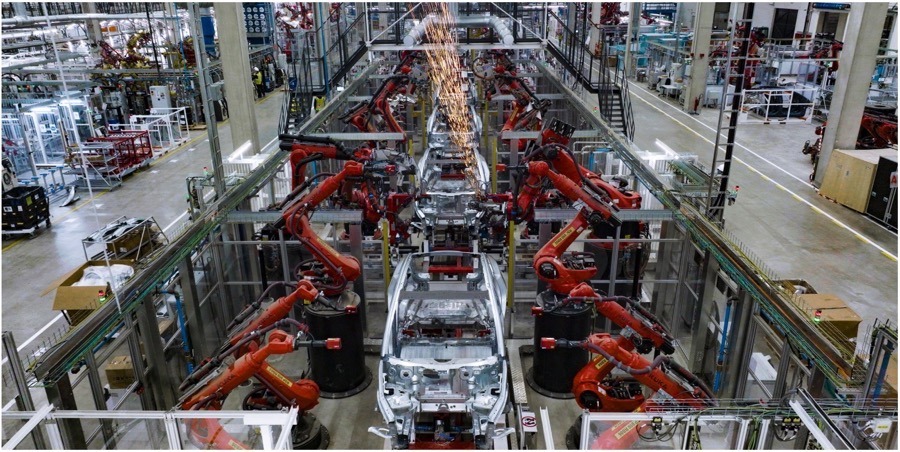
- Reduced Footprint: By working on sub-assemblies in separate areas, the factory floor space required for the assembly process can be significantly reduced.
- Increased Efficiency: Multiple teams can work on different parts of the vehicle simultaneously, minimizing the time a vehicle spends on a single station.
- Lower Capital Expenditure: The modular nature of the process allows for more flexible factory layouts and potentially lower initial investment costs for new production lines.
The implementation of this process is expected to be a cornerstone for Tesla’s upcoming, more affordable vehicle platform. By optimizing the assembly of these next-generation models, the company aims to defend its margins even as it lowers vehicle prices to stimulate demand.
How does Tesla’s factory expansion compare to Chinese competitors?
While Tesla continues to expand its global footprint, it faces a formidable challenge from Chinese manufacturers, most notably BYD. The competition is defined not just by vehicle sales, but by the scale and vertical integration of their respective manufacturing capabilities.
BYD has demonstrated a high degree of vertical integration, manufacturing its own battery cells, semiconductors, and even much of the electronic components used in its vehicles. This control over the supply chain allows BYD to maintain low costs and high production flexibility. In the fourth quarter of 2023, BYD’s battery electric vehicle (BEV) sales briefly surpassed Tesla’s, highlighting the rapid scaling of Chinese manufacturing capacity.
Tesla’s response focuses on advanced automation and the aforementioned “unboxed” process to achieve similar cost advantages. While Tesla’s manufacturing is highly centralized in its “Giga” factories, its global strategy involves localized production to mitigate logistics costs and navigate regional trade policies. For example, Giga Shanghai serves as a critical export hub for the European and Asian markets, while Giga Berlin and Giga Texas are positioned to serve their respective continents.
The following table compares the primary manufacturing and market positioning of the two industry leaders:
| Feature | Tesla | BYD |
|---|---|---|
| Primary Manufacturing Strategy | Advanced automation & “unboxed” modularity | High vertical integration (batteries to chips) |
| Key Manufacturing Hubs | USA (Texas, California), China (Shanghai), Germany (Berlin) | China (Multiple regional hubs) |
| Battery Supply Chain | Partnerships (Panasonic, LG) & 4680 cell production | In-house production (Blade Battery/LFP) |
| Market Focus | Global premium and mass-market segments | Dominant in China; expanding in Europe/SE Asia |
What are the economic drivers behind Tesla’s manufacturing shift?
The drive toward more efficient manufacturing is fueled by a complex set of macroeconomic factors. First, the global shift toward electric mobility has moved from an early-adopter phase to a mass-market phase, where price sensitivity is significantly higher. To capture this segment, automakers must achieve economies of scale that were previously unnecessary in the luxury EV market.
Second, the rising cost of raw materials, particularly lithium, nickel, and cobalt, has made manufacturing efficiency a survival requirement. Tesla’s efforts to simplify vehicle architecture and reduce the number of parts per vehicle are intended to insulate its bottom line from fluctuations in the commodities market.
Third, the geopolitical landscape is forcing a rethink of supply chain logistics. As governments in the United States and Europe implement subsidies and local-content requirements—such as the Inflation Reduction Act (IRA) in the U.S.—Tesla’s investment in domestic manufacturing (like Giga Texas) is essential to qualify for consumer tax credits and maintain competitiveness.
The intersection of these factors means that the next two years will likely be defined by a “manufacturing arms race.” The winner will not necessarily be the company with the best software or design, but the one that can most efficiently convert raw materials and energy into finished vehicles at the lowest possible cost.
The next major checkpoint for investors and industry observers will be Tesla’s upcoming quarterly earnings report, where executives are expected to provide updates on production volumes at Giga Berlin and the progress of the next-generation vehicle platform development.
Do you think Tesla’s modular manufacturing can successfully counter the rise of Chinese EV giants? Share your thoughts in the comments below and share this article with your network.